
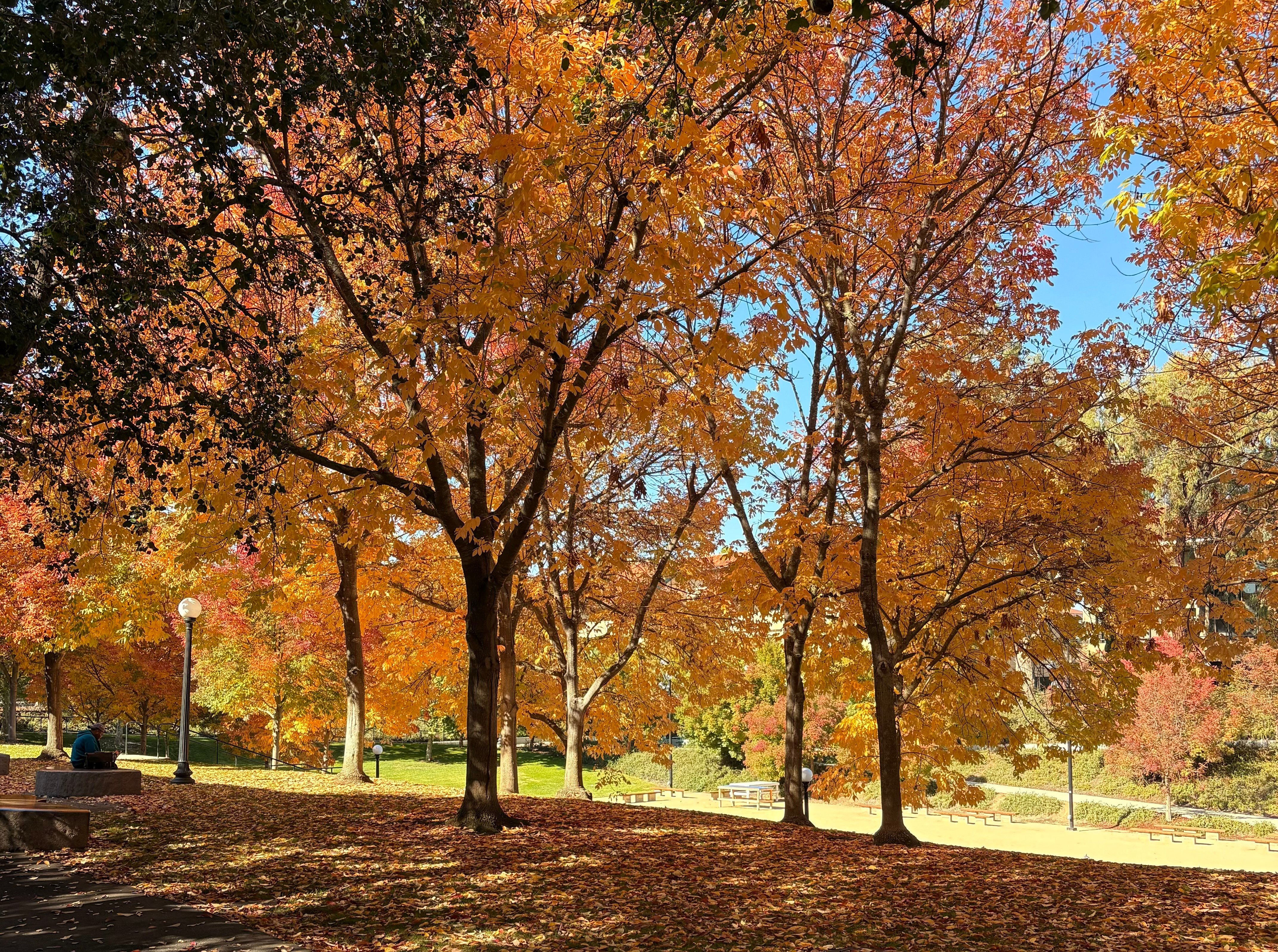
In her column “The In-Between,” Olivia Jean Kao ’29 profiles students and their favorite third places, aiming to explore student life at Stanford beyond classroom and career pursuits.
A week ago during lecture, I realized I could remember the major of a girl I’d been sitting next to for four weeks, but couldn’t recall her name. At that moment, something hit me: I’d lost the proverbial plot.
Since coming to Stanford, I’ve noticed an endemic emphasis on knowing a peer’s academic personality and career goals. The questions we ask one another — What are you studying? Where are you interning? So, like … what do you do? — reflect Silicon Valley hustle culture at large. (At least I hope so; if not, I just admitted to a moderately embarrassing mindset.)
That’s why I started “The In-Between” to highlight the lives of the Stanford community outside of academic and professional success. Of course, there is an argument to be made for valuing our “work selves.” Rigorously developing our intellect, honing in on projects that matter to us and connecting with successful people we hope to emulate can give our lives purpose and motivation. Stanford is arguably the best place for such pursuits. From Supreme Court justices to Big Tech founders, many of the world’s greatest minds sat in the same desks and ate in the same dining halls that we do every day.
However, meaningful motivation can easily transform into empty ambition when we derive our value only from our accomplishments. When we chain our identities solely to our success in classrooms and careers, it can feel degrading when certain outcomes don’t live up to our expectations. Receiving criticism on a paper becomes a personal attack and getting an exam score below the median becomes a measure of our worth. Being situated in the heart of Silicon Valley can easily normalize a culture of idolizing ambition, optimizing efficiency and maximizing output … sound familiar?
But what exactly does life outside of these things look like at Stanford? Maybe it’s celebrating a birthday on the Oval or watching a student music group perform at Mars House. Perhaps it’s going on a spontaneous trip to San Francisco or making a short film with friends by Lake Lagunita. Whatever it may be, the presence of such avocational and non-academic experiences reflect their often understated value. And more often than not, they don’t take place in a stuffy lecture hall.
In his 1989 book “The Great Good Place,” American sociologist Ray Oldenburg writes about the significance of third places. In his work, Oldenburg defines first places as the home in which you live, second places as where you work and third places as gathering spaces distinct from home and work. Many sociologists argue that there has been an overall decline in third places, with the pandemic lockdown and increasing digitization of the world bearing some of the responsibility.
At Stanford, first places might look like our dorms or houses, and second places our classrooms and pre-professional clubs. But what are the so-called third places on campus? I believe they do exist — and in this column, I’ll go searching for them. Over the next installments, I’ll interview students about their non-academic passions and how they stay grounded in their fast-paced lives at Stanford.
I’ll dig into where all this is happening. I’ll examine the atmosphere and personal significance of students’ precious third places, from the colorful collection of lawn chairs in White Plaza to the cozy counters of CoHo. I’ll find out how third places at Stanford uphold personal expression, and how our community is cultivating them.
I am not arguing that we should abandon all academic and professional ambition. Nor am I saying we should always set aside our readings and p-sets for the sake of nourishing our souls. Such action would swing to the other side of the pendulum, and may be just as harmful of a mindset.
I am, however, a proponent of reflecting on what it means to find fulfillment beyond our GPAs and LinkedIn networks — of understanding others as people first; as the end and not the means.
To quote the academic savant Ferris Bueller, “Life [at Stanford] moves pretty fast.” So let’s not waste it.
The next time your professor has you “turn and talk with the person next to you” in lecture, try to internalize their name before their major (even if you have to ask multiple times). Leave Lathrop Library or the CoDa basement and venture to a third place with them, not with the goal to accomplish something, but to experience. It’s in these places we find real meaning.
And if you need inspiration for your next destination, “The In-Between” will be here.