
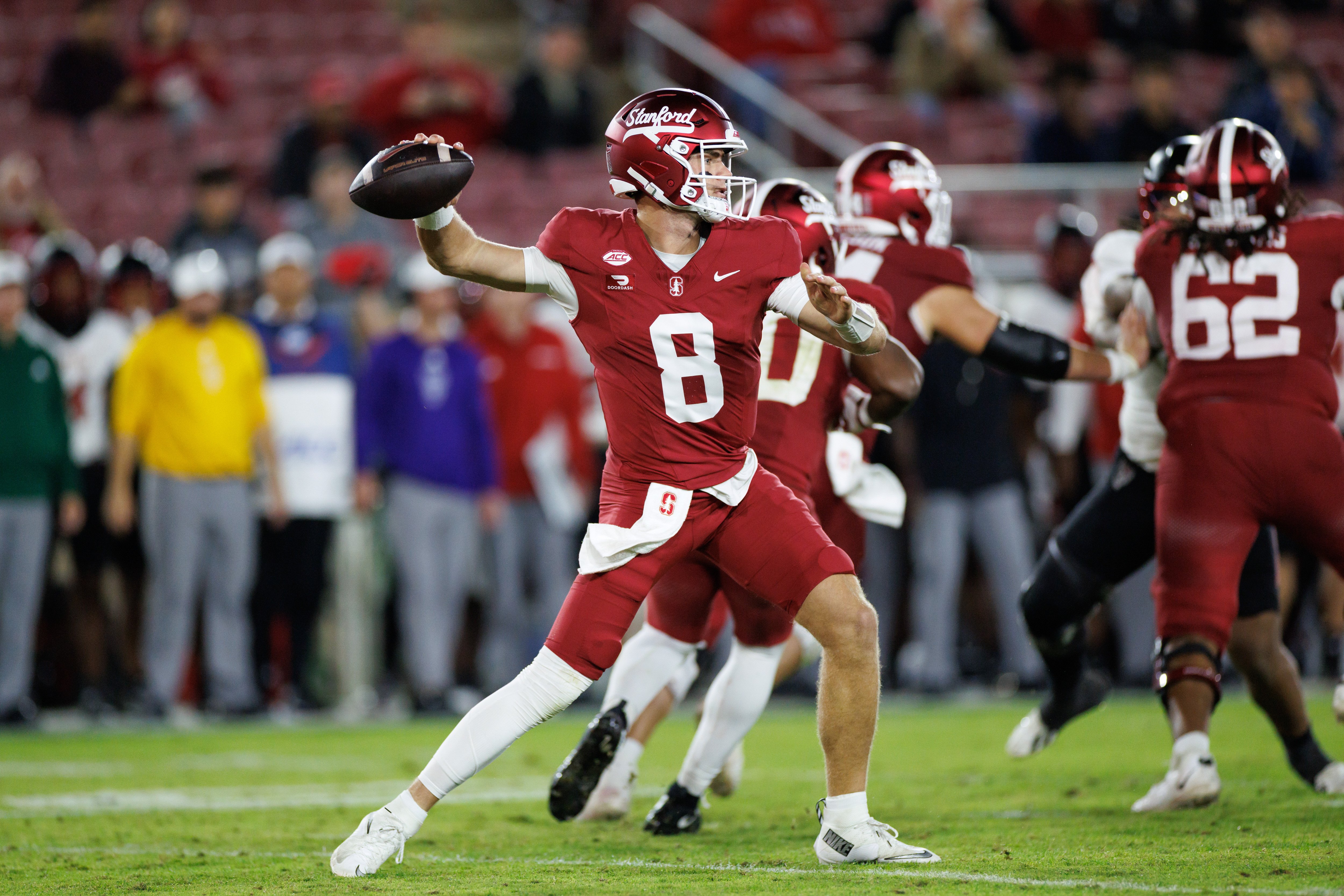
Despite the lopsided final score of 52-24, the Stanford Cardinal (4-5, 2-4 ACC) showed incredible promise and improvement on the road against the Louisville Cardinals (5-3, 4-2 ACC). Stanford played well on both sides of the ball in the first half, tying the game on a junior running back Micah Ford catch-and-run just over two minutes into the second half. Yet, a failed trick play would cause a turn for the worse, as defensive inconsistencies and offensive desperation caused a second-half collapse.
Saturday’s loss was the 15th consecutive road loss for the Cardinal, the worst streak in the FBS. They did, however, hold their first road leads of the season as the teams went back-and-forth in the second quarter.
The opening quarter of play was best characterized as both teams finding their footing. Louisville’s scripted opening drive saw junior dual-threat quarterback Lincoln Kienholz dissect the Stanford defense for a touchdown, set up by a 44-yard completion to their top receiver, senior Tre Richardson. The remainder of the quarter saw aggressive offensive moves by both teams that did not pay off: Stanford junior safety Darrius Davis shut down a fake field goal attempt by Louisville in the red zone, and Stanford’s fourth-and-four gamble around midfield fell short as sixth-year quarterback Davis Warren took a sack.
Down by seven, the Stanford’s spark came after recovering a Louisville fumbled center-quarterback exchange. Several positive plays then set the Stanford Cardinal up in the Louisville Cardinals’ territory by the end of the quarter. Head coach Tavita Pritchard said in a between-quarters on-field interview that they needed to “reengage and persist.”
That they did, as a dogfight erupted between the two offenses. Sixth-year cardinal kicker Emmet Kenney drilled a 48-yard field goal to open the scoring for Stanford. Junior linebacker Sam Mattingly and senior defensive lineman Braden Marceau-Olayinka made key defensive plays to force third-and-long on Louisville’s next drive, resulting in a punt.
Just two plays later, Warren and company found the end zone with a 41-yard shot to junior wide receiver Nico Brown. The extra point by Kenney then gave Stanford a three-point lead, notably their first road lead of the season and the team’s first road lead in almost exactly a year. Louisville’s rushing attack, however, wasted no time responding, as they clawed through Stanford’s run defense on a five-minute touchdown drive to once more gain a three-point lead.
Warren made an opportunistic move on the very next play from scrimmage when junior tight end Aiden Black slipped open for a 75-yard catch-and-run up the middle of the field for his first reception of the season and another Stanford touchdown. According to Warren, Black “wasn’t really the primary target,” but didn’t want to waste the luxury of a wide-open receiver after Louisville failed to account for him in their coverage.
The back-and-forth would continue before the half with a field goal and quick touchdown by Louisville, once again giving them a seven-point lead. Yet, with how Stanford had responded in the first half, such a lead felt tenuous at best. For one of the first times this season, Stanford had actually capitalized on their opponent’s mistakes and kept pace with an opposing offense.
When the Cardinal returned to the field for the second half, it looked like they would keep doing just that. Ford continued to get going in the pass game for the third straight week as he scored on the opening drive to tie up the game.
Those would end up being the final points scored by the Cardinal.
After the Louisville Cardinals regained a seven-point advantage, Stanford attempted a hook-and-ladder on third and 12 that went horribly wrong when Brown’s pitch was bobbled, recovered and returned for a touchdown by Louisville senior defensive back Tayon Holloway.
Now down by 14, the offense continued to spiral out of control. Stanford’s next two possessions ended after seemingly desperate fourth-down attempts led to an interception and incompletion, respectively. Both of those turnovers resulted in Louisville touchdowns, placing Stanford at a 28-point deficit. That turnover on downs was well within field goal range.
The failed hook-and-ladder, the interception and the turnover on downs on Louisville’s side of the field were all backbreaking moments for Stanford and a direct 21-point swing in the opponent’s direction.
Pritchard was disappointed in the day’s mixed results and expressed his frustration in the postgame press conference. “We wanted to come in here and play for four quarters,” he said, and while they “gave [themselves] a chance to go into that second half and compete to win,” it was ultimately “mental lapses” in all phases of the game that led to Stanford stalling out in the third and fourth quarters.
Pritchard was also asked to walk through his aggressive decision-making after the game. He said he felt at the time that they had to go “score points and match them… [those plays] felt like the space where we had to give ourselves a chance.”
Warren said he thought the plays “swung the game in [Louisville’s] favor” and that they “weren’t able to gain momentum back after that.”
While the result is disappointing for the Cardinal, the second-half decisions make more sense in the context of a first-year head coach, first-year starting quarterback and a team that is both desperate to make something happen on the road and seemingly unable to score sustainably.
As the team heads into their bye week before the final three games of the season, they must win at least two more games to be bowl-eligible. Both Pritchard and Warren stressed the need to improve one week at a time: “I have every faith that this team will come back ready to work come tomorrow,” said Pritchard.
Warren took ownership, saying, “I’m the quarterback. I’m the tip of the spear. So, it’s my responsibility to get our guys and our offense moving in the right direction.”
They’ll certainly need to use the first half of Saturday’s game as a blueprint in two weeks as they go back on the road against an inconsistent Virginia Tech (6-2, 3-2 ACC) team that has recorded losses against Cal (2-6, 2-4 ACC) and Pitt (6-3, 3-3 ACC), while only narrowly beating Boston College (4-4, 2-3 ACC).