
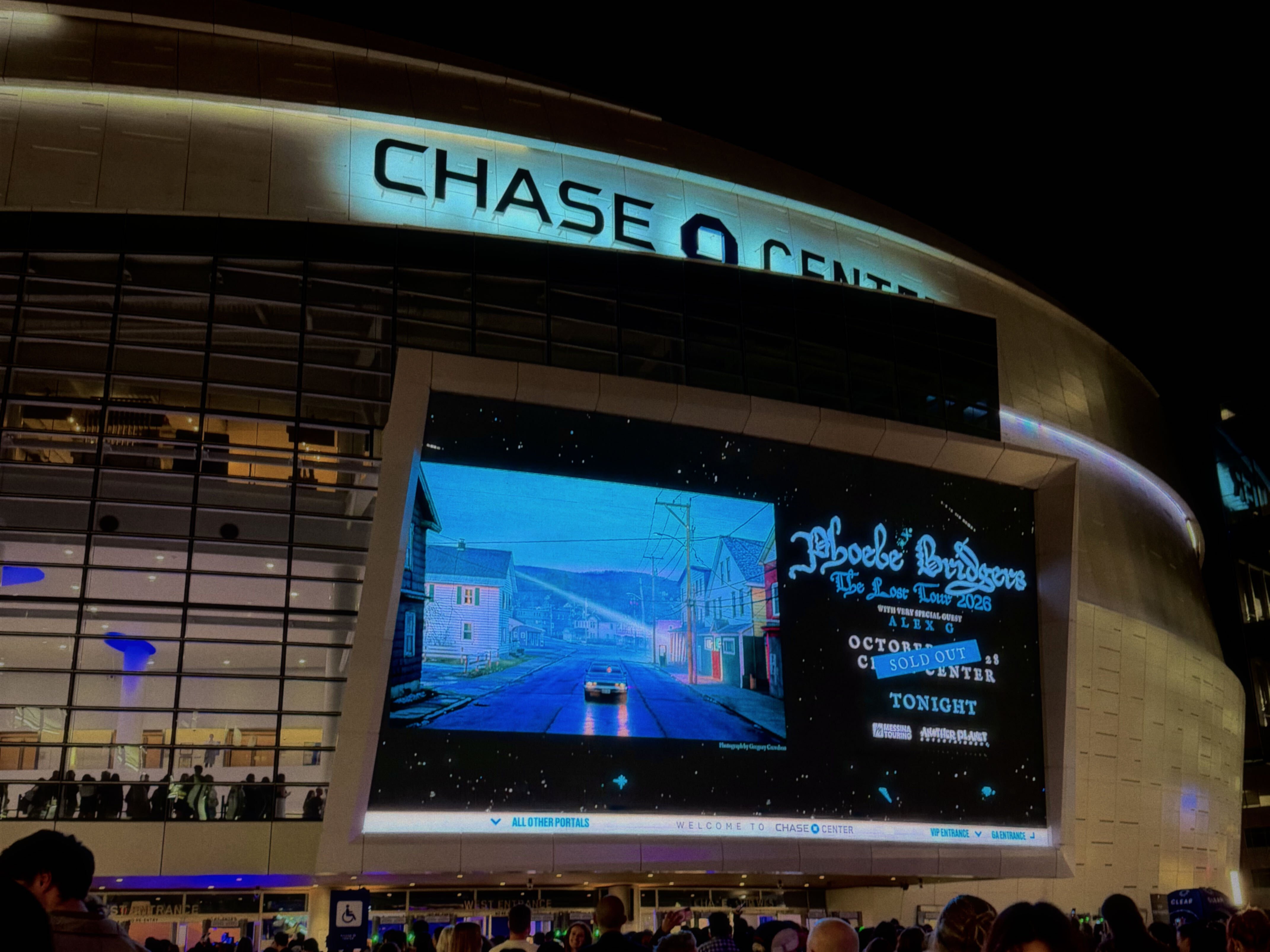
The first thing that struck me about Phoebe Bridgers’ phone-free concert was the light. As Bridgers took the stage at Chase Center on Oct. 27 — opening with her kinetic indie-rock hit “Motion Sickness” — the stadium erupted into rapture. Synthesizers surged, the band launched into a thundering bass line and beams of light exploded across the stadium.
But between the chaos, for an unassuming, wondrous second, the stadium’s floodlights fixed themselves on the crowd. Suddenly visible, audience members were granted a glimpse into what a future of performance could look like without the strain of technology: one when the lights turn on, and we are surrounded only by people.
Bridgers’ concert marked the first of her band’s two stops in San Francisco on “The Lost Tour.” The tour, which accompanies the release of Bridgers’ third album, “Lost Weekend,” has faced a mixed reception from fans for its phone-free policy, which mandates that all attendees lock their electronic devices — from iPhones to Apple Watches — in Yondr pouches before the concert.
But “The Lost Tour” is a reminder that it is life that defines us, not our posts about it. By forcing us to put our phones away, Bridgers’ policy makes the case that anything worth remembering must first be lived.
After “Motion Sickness,” Bridgers and her band performed “Kill Me” — a song that, in true Bridgers fashion, explores questions of existentialism with almost invasive familiarity. Bridgers’ audiovisual effects paralleled the turbulence of her lyrics. By its second refrain, the chorus’ soft instrumentals deteriorated into booming, discordant notes as an electronic voice began chanting “Tamám Shud” — Persian for “It is finished” — over and over again. Lights began to flash in swift, debilitating succession; meanwhile, a colossal, planet-shaped sphere careened above the stadium, hurling neon lasers through darkness.
Bridgers’ momentum was unrelenting. With the afterimage of her spectacle still fading, floodlights swathed the stadium in a flickering gold. Bridgers began the chords to “Funeral,” a raw, gut-wrenching ballad tracing Bridgers’ grief after the death of a close friend.
At times, having to peer at Bridgers from partially-obstructed, laughably remote nosebleeds felt less than ideal. Critically, though, this moment was not one of them. As Bridgers sang her opening lines (“I’m singing at a funeral tomorrow / For a kid a year older than me”), sections in the far-flung 200s were granted a sweeping view of Chase Center, illuminated. With no way to shine their phone flashlights, fans improvised: In waves, audience members began pulling lighters from their pockets, turning the arena into a constellation of tiny orange flames.
At its core, “Funeral” is a song of memoriam. If at a vigil, candlelight represents the endurance of a life, the crowd’s lighters were an immortalization — an appropriate eulogy for anyone ever loved and lost. I thought of a line from Leonard Cohen’s opening introduction at the 1970 Isle of Wight Festival: “Could I ask you, each person, to light a match, so I can see where you all are?” Standing in that stadium — facing each other, alight — this is what Bridgers’ audience was doing. Tasked to light a flame, we revealed ourselves to one another, again and again and again.
Bridgers sustained the emotional intensity throughout the night, rapidly transitioning from mood to mood. Eerie, mournful ballads were interrupted by playful indie-pop songs like “Kyoto” and “Liberty Tree.” One moment, audience members were sobbing convulsively; minutes later, they were belting in full. But rather than conjuring chaos, Bridgers’ movement created an experience that was at once otherworldly and intimate. This, it seems, was the defining attribute of Bridgers’ performance.
During mandolin interludes, girls in Bridgers’ trademark skeleton suits rested their heads on each other’s shoulders. They linked arms as they shouted the bridge of “Haunted”: “I’m gonna put myself together / You can go or you can stay.” It’s difficult to say whether these moments would have been possible without Bridgers’ phone-free policy. But they felt vital in a city ingested by AI — suffocated by a culture that is, as Bridgers put it, attempting to “streamline [the] s—t that’s about us being alive.”
“We’re all experiencing a collective grief about the communities we used to have,” she said.
But as she went on to explain, the tour’s policy is fashioned around the humanity of the performer, too. Bridgers wrote “Lost Weekend” in the wake of her father’s death. It is an album about what it means to love an explosive, unavailable parent; it is about what it means to lose them in the same lifetime. It is an album, Bridgers explained, that was never meant to be performed in front of a sea of screens.
She proved that with her next song, “Still Standing.” Suffused with bereavement, the song reminisces on the violence that surrounded Bridgers’ relationship with her father: “I found her bleeding over the sink / But whеn you said ‘sorry’ / You were looking at me.” At the same time, it captures an unbearable weight: “I can’t imagine you dead / But you are every day / Thank you for everything.”
It is a rawness that is impossible to reach while facing a camera. It is a devastation that Bridgers trusted us, somehow, to hold.
Listening to “Still Standing” as an audience member was a whole-body experience. I empathized with Bridgers in her grief; I wrestled with guilt for intruding on a wound so untreated. Over the course of the concert, Bridgers shed the glory of celebrity and the impenetrability of iconoclasm. She became, simply, a girl who had lost her father.
Bridgers closed the night by paying tribute to the songs that led her to us. Her two surprise songs — “Waiting Room,” which Bridgers released at 16, and “Summer’s End,” a fan-favorite John Prine cover — were received with roars. In the privacy of their delivery, they felt like gifts.
In a way, the concert ended without fanfare. Bridgers said goodbye, walked off the stage and waited 10 minutes before returning for an encore.
Her final number, “Scott Street,” was a song about loneliness. But in its entirety, “The Lost Tour” was a prescription forward. During the encore, light filled the arena for the last time, and every audience member was rendered visible — Bridgers’ final reminder that we are at our most beautiful facing each other.