
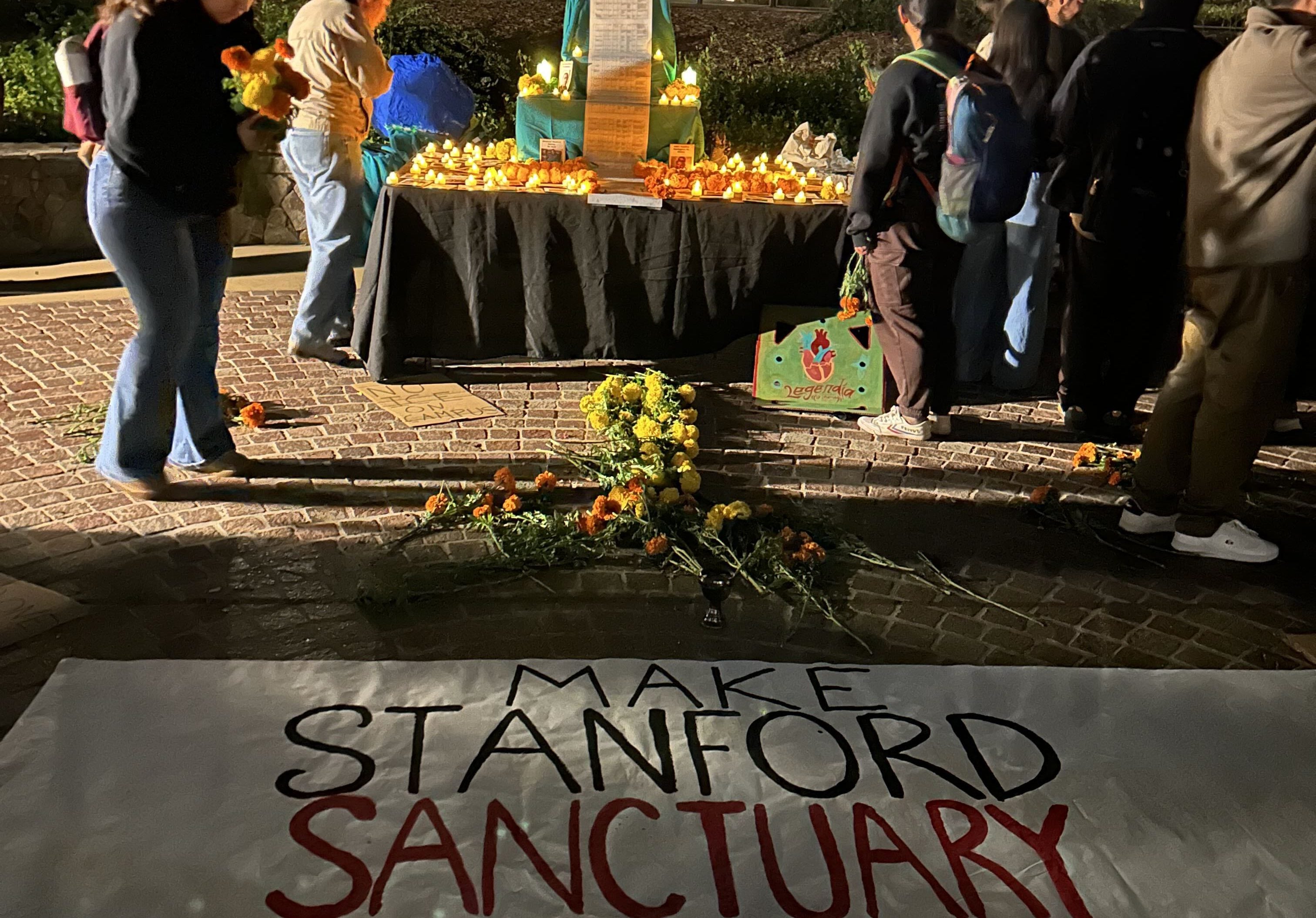
A crowd of around 100 people gathered at Meyer Green on Monday for a Día de los Muertos vigil to honor victims of U.S. Immigration and Customs Enforcement (ICE). Student speakers demanded that Stanford adopt “sanctuary” policies by limiting its cooperation with ICE and working to support and protect undocumented students.
Students read the names of the 82 people confirmed to have been killed by ICE, telling the life stories of several.
“It was beautiful seeing everyone come together around the altar and remember and honor their lives,” said attendee Esperanza Collazo ’27.
David, a fifth-year Ph.D. student who requested to go by his first name due to his undocumented status, read an original poem titled “Prevention through Deterrence.” He also led the crowd in chants stating “What do we want?” “Sanctuary!” “When do we want it?” “Now!”
Stanford Frente Latine Organizando la Resistencia (FLOR), also known as Latine Front Organizing Resistance, organized the vigil, a collaboration between six Latine student organizations.
“Stanford is not a sanctuary. It doesn’t want to really take a stance,” David said. FLOR member and event co-chair Karla Osnaya Roman ’28 also expressed frustration with Stanford’s institutional neutrality.
“The University has been operating under the guise of neutrality, but neutrality can be really harmful, especially when there’s so much violence that is going on at the hands of ICE,” Osnaya Roman said. “More than anything, we want reassurance that the University understands that what is going on right now is wrong.”
President Jonathan Levin has said that he is “very concerned” about the effects of federal immigration policy on community members, but has refrained from explicitly criticizing the Trump administration’s immigration policies.
Hermanas de Stanford, an organization promoting Latina empowerment, and Gammas, a Latine-interest fraternity, helped cater food. Ballet Folklorico performed a Mexican folk dance and other student organizations contributed speakers.
According to David, students founded FLOR to advocate for the University to adopt “sanctuary status” for undocumented students.
FLOR specifically demanded that the University develop a policy to identify and notify students of the presence of ICE on campus. California law SB 98, passed in 2025, requires universities to notify students of any confirmed sightings of ICE on campus. However, David said that currently “there’s no clarity on how they actually determine the presence of ICE.”
FLOR also demanded an “undocumented student program.” According to David, the University’s current resources for undocumented students are insufficient.
Stanford’s undocumented student resources are spread across FLISSC, Bechtel International Center and the Immigrants’ Rights Clinic of Stanford Law School. Stanford’s immigration resources website includes a hyperlinked “Undocumented Student Services” listing.
University of California, Berkeley, along with all other public California universities, houses resources in a dedicated “Undocumented Student Program” which occupies a physical space, employs its own staff, provides in-house legal aid and counseling and centralizes campuswide undocumented student resources.
In February, when asked about his thoughts on the Undergraduate Senate’s (UGS) consideration of a resolution calling on the University to declare Stanford a sanctuary campus, Levin responded that he believes the school already does its part.
“I think most of what the student council would like to see Stanford do, we already do,” he said. “I am not inclined to make sort of blanket slogan statements. I’d much rather we focus on the substance of what we do and how we’re supporting students who need support with immigration issues.”
Diego Porras ’27, a co-chair of the event, reiterated the event’s call-to-action.
“Today we cry, but tomorrow we fight for a better future,” Porras said.