
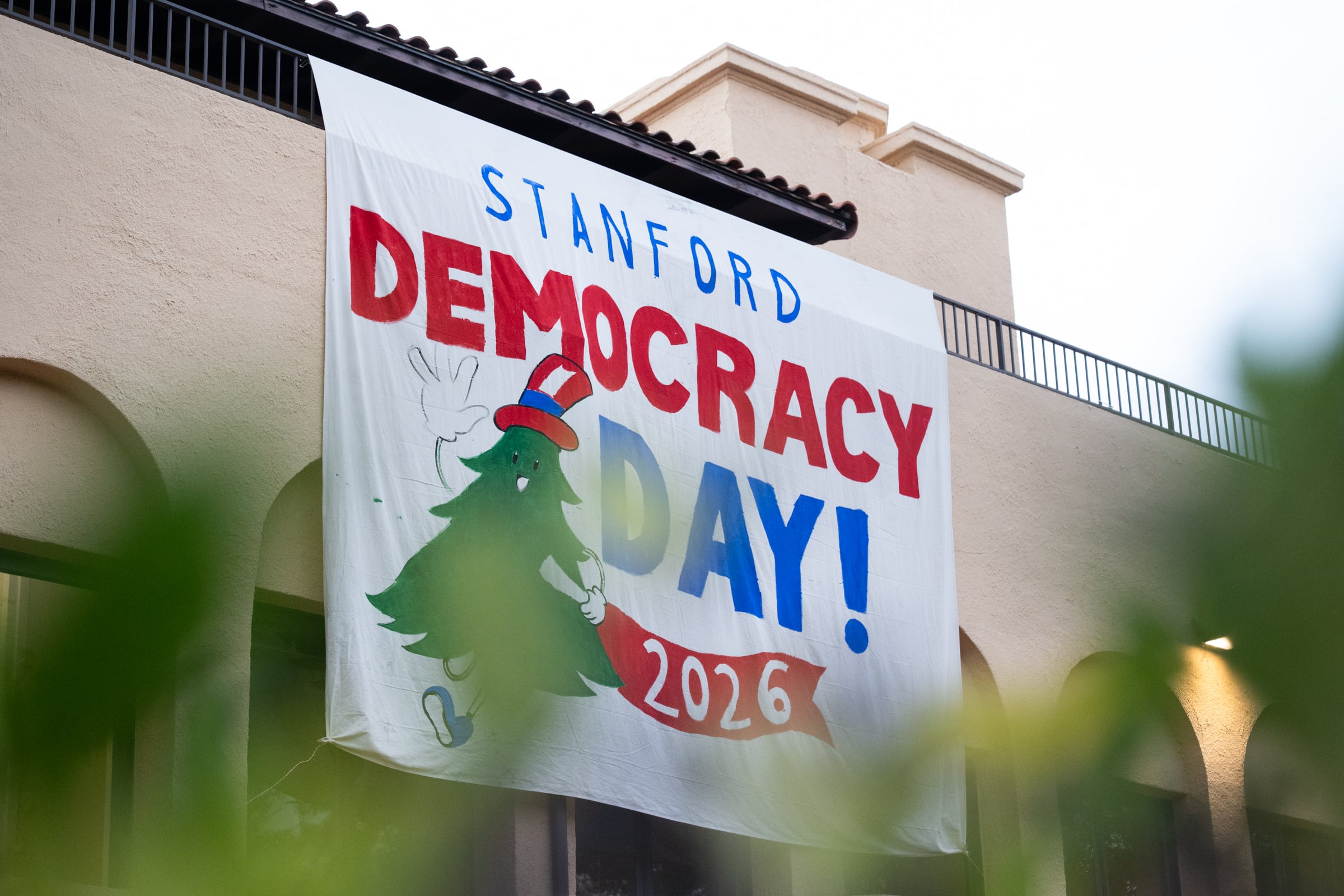
Students congregated at White Plaza to learn about civic engagement, engage in democracy-themed activities and discuss the American experiment during Stanford’s annual Democracy Day Tuesday. The holiday, which coincided with midterm elections, marked its sixth year with opportunities to think both critically and optimistically about American democracy.
The University recognizes Democracy Day as an academic holiday, canceling classes for the day even on non-election years.
“What makes Democracy Day so important is students helping out students to be more engaged citizens,” Democracy Day Chair Jadon Urogdy ’27 told The Daily, “I think that is really what brings so much joy to everyone.”
The celebration, centered in White Plaza, included tables run by various campus groups that provided diverse opportunities for students to engage with democracy.
One such group was StanfordVotes, whose table focused on promoting civic engagement. “We want to make sure that the voting process is as easy as possible for students,” said StanfordVotes Co-Chair Maria Rueda ’28.
The group aimed to spread awareness of various forms of civic engagement, encouraging all students to take part in democracy.
“There [are] people who can’t vote, so it’s helpful for them to see that there’s other ways to be civically engaged that are not necessarily voting,” Rueda said.
Other groups ran creative democracy-themed activities for students. For instance, the Hoover Institution’s Human Security Project (HSP) set up a booth that allowed students to write letters to Russian political prisoners.
“It’s really important to challenge authoritarian regimes through acts of human resistance such as letter writing,” said HSP research assistant Carolyn Kennedy ’26. “Our main hope is to empower people at an individual level.”
Nearby tables included one run by Stanford Class Action and Stanford Moral Ambition — focused on the politics of post-Stanford careers — and one run by the Stanford chapter of the American Civil Liberties Union (ACLU), which invited students to carve rubber stamps to express their political voices through art.
The Stanford ACLU chapter also organized “Protesting 101”, an event held in Old Union. Hosts taught students the skills and practices they said were necessary to plan, organize and participate in protests safely and effectively.
A couple rooms over, StanfordVotes ran a hands-on seminar where participants trained an AI model to emulate their political opinions. The simulation then threw the AIs into an arena, having them autonomously debate each other on various topics while participants watched.
“AI is increasingly making high-stakes decisions,” Arvind Salem ’29 told The Daily. “It is being used a lot in our society and is part of a large-scale technological transformation that will affect how democracy continues moving forward.”
The event aimed to help participants better understand how AI could act when it attempts to represent their political beliefs, Salem said. “Very often it does things that would appall or at the very least surprise you,” he said.
While most Democracy Day attendees were Stanford students, the celebration drew an array of other groups, including one supporting local school board candidate Linda Henigin.
Henigin stressed the importance of voting in local races. “The decisions made at the national and federal level bubble down, but it’s your local electeds that decide the issues that you face on a day-to-day basis,” she said.
Student voices on pertinent issues are invaluable, panelists told the audience at an op-ed training event run by The Daily’s Opinions section. “We all have something very important to say, so don’t ever think ‘they’re not gonna want it from me,’” said journalism lecturer Janine Zacharia.
The event covered the importance of free expression in journalism and opinion-writing. Alongside Zacharia, Vice Provost for Undergraduate Education Jay Hamilton discussed the history of the op-ed, while Daily Opinions Managing Editor Adam Langshaw ’29 guided the audience through writing an op-ed of their own.
“I think that op-eds and structured public debate provide that opportunity to give the community your unique perspective,” Langshaw said.
Later, at the same venue, came a student debate moderated by the Stanford Political Union. “Across the Aisle” saw two conservative and two liberal students argue their perspectives on topics ranging from immigration to supplemental nutrition programs. Waleed Haider ’29 and Ishaan Quazi ’30 represented the liberal side, while Spencer Bluth ’30 and Daniel Jackson ’30 stood for the conservative perspective.
The event ended with each side complimenting the other. “Ultimately, we’re all fighting for a better America, and I thought [the conservative debaters] to embody that pretty perfectly,” said Quazi.
Students were also able to conduct friendly debate among themselves at an event run by legal experts and law students. “Today, I’m going to ask all of you to be the judge,” said law professor Pamela Karlan.
“Mostly what I want people to get out of [the event] is a way of thinking about democracy that they can apply to policy issues in the future,” said Democracy Day Financial Officer Connor Engstrom ’29, who co-hosted it.
Engstrom stressed the importance of dialogue and critical thought. “I think we should be challenging every single underlying assumption we have about the world and how it works,” he said.
While critique of American democracy was a major theme of the day, students across groups seemed to show optimism for the American experiment.
“I am hopeful for democracy, because I look out at Democracy Day and I see so many engaged students, staff and faculty, and especially people my age,” Urogdy said, surveying White Plaza.
“We can still come together and figure out what we can do, individually and together to strengthen democracy,” he said. “Democracy Day proves that.”