
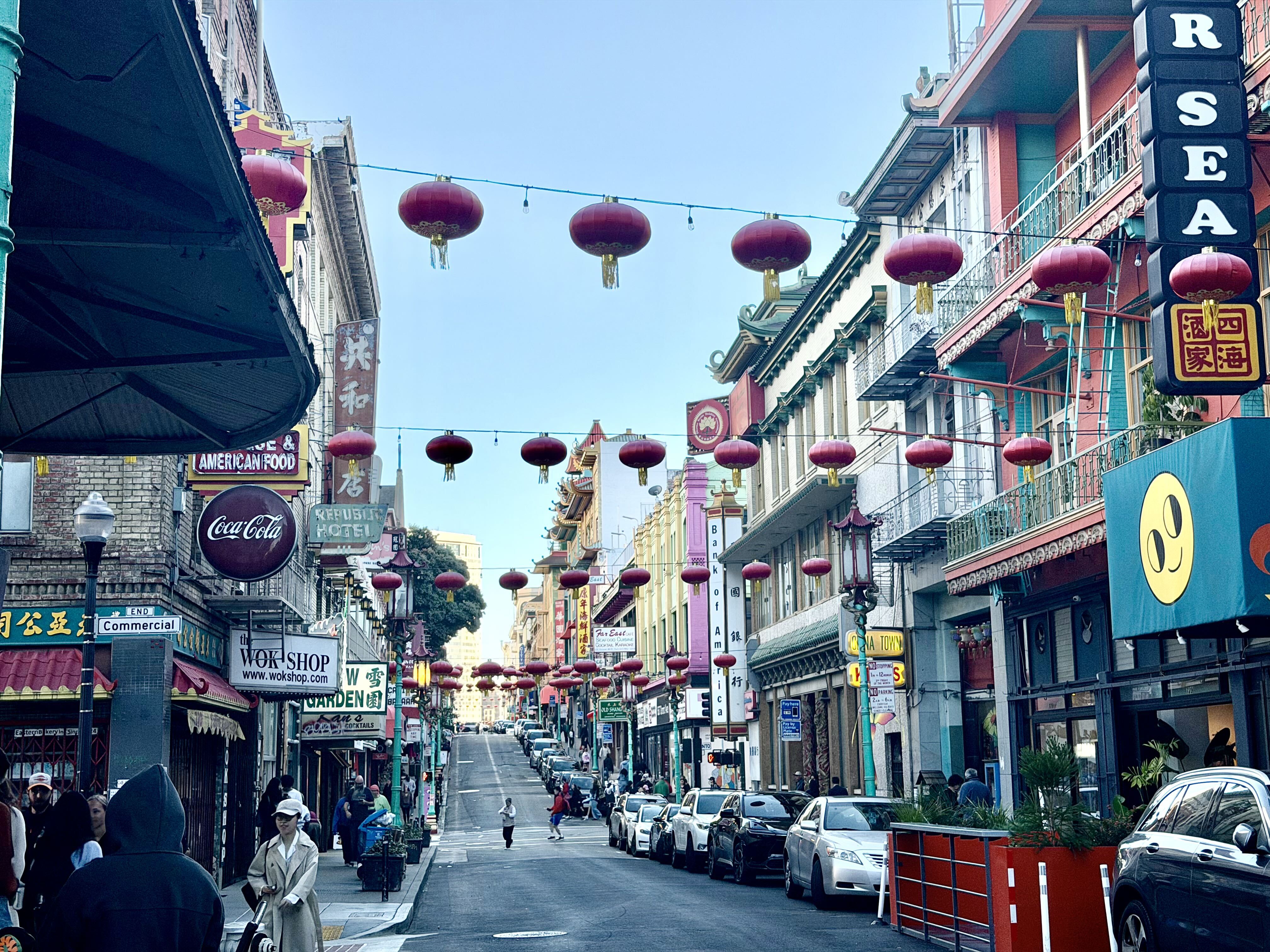
In her column “Small Epiphanies,” Sarah Yao ’30 reflects on the little moments that reveal our humanity and remind us of what we hold close.
Stepping off the Caltrain, I see four Chinese men sweeping leaves off the tracks.
I walk past them, their neon uniforms, their callused, working hands. I notice the metal dust on their faces, as if shaded by graphite pencil with a heavy hand, the beads of sweat concentrated on their foreheads. They stand on the platform below me, occasionally looking up toward the sky as if an invisible clock were there.
I am on my way to eat with friends in Chinatown. I am disturbed by the way I can easily walk past them.
I am suddenly reminded of the essay I wrote in ninth grade about the Chinese immigrants who built the transcontinental railroad, how their labor connected the country even as their lives were treated as expendable. Now, walking by the Caltrain tracks, I feel unsettled. I know nothing about these men beyond what I can see, yet I can’t shake the parallel between the immigrants I wrote about in ninth grade and the men standing before me.
On the Caltrain ride back, I tell my friend how strange it felt to see Chinese men doing the kind of work I had written about in my essay, how I couldn’t help but feel connected to them somehow, how uncomfortable I was with the possibility that nothing had really changed.
He listens before asking, almost casually, “Why does your culture matter anyways?” I struggle to answer. I feel an aching fondness that I can’t explain.
This week, I’ve been exploring culture in my PWR class by researching the Americanization of Chinese food. I’ve learned how Chinese immigrants adapted their food to American tastes, how discrimination shaped their livelihoods and how those adaptations became part of what we recognize as Chinese American cuisine.
In some ways, I’ve been asking the same questions in my research that I found myself grappling with on the Caltrain. What happens to a culture as it moves through history? What do we carry with us, and what do we change along the way? It’s strange to spend a week studying these questions, only to find myself wondering what they really mean to me.
The more I learn, the less satisfying a simple answer becomes. Culture changes as people move, adapt and create. Culture is constantly being reshaped by the people who carry it. In a foreign land, these changes are born out of necessity, yet they become so familiar that we forget to ask how they came to be.
Why does your culture matter anyways?
When I open my mouth in response, I want to say that it’s because history matters, because understanding my roots allows me to better understand myself, because knowing my culture lets me connect more deeply with my parents and extended family.
But even as I think this, I know it’s not quite the answer.
While I want to understand the people who came before me, to remember that history is made up of the sacrifices of those who are gone, I realize, inevitably, that history is also unfolding around me, in the lives of people I pass, in the fleeting interactions of the everyday. Life is not just what has gone by. We are living through history; we are shaping culture.
At the station, I look at those four men. For a moment, they see me. We glance at each other — a simple motion, not friendly enough to be a greeting, just an acknowledgement of each other’s presence.
Standing there, I feel an inexplicable pull towards them. A tinge of empathy, perhaps? A hint of longing to know them, to know their stories? Seeing them brought me back to the history I had learned about years ago, one that had always felt distant until now. We could not be more different, yet something makes me feel as though we are the same.
Though I have yet to form a satisfying answer to my friend’s question, perhaps this is why culture matters. It gives us a history to carry, a point of reference through which we might recognize ourselves in others. It doesn’t mean we understand their lives, but it can make us curious. It can make us pause, empathize and want to understand.
I don’t know whether those men see themselves in the same history that I do. I only know that, for a moment, I felt connected to them. For a moment, those strangers became my family.