
Editor’s Note: This article is a review and includes subjective thoughts, opinions and critiques.
The musical world has been busy remembering Herbert Blomstedt, the former chief conductor of the San Francisco Symphony who passed away on Nov. 4 at the age of 99. His former orchestra paid him tribute before two concerts over the weekend, and the Stanford Philharmonia dedicated their performance of Beethoven’s First Symphony to the Swedish maestro. It is fitting, then, to consider one of his more famous quotes: “The conductor of an orchestra is just one musician among many.”
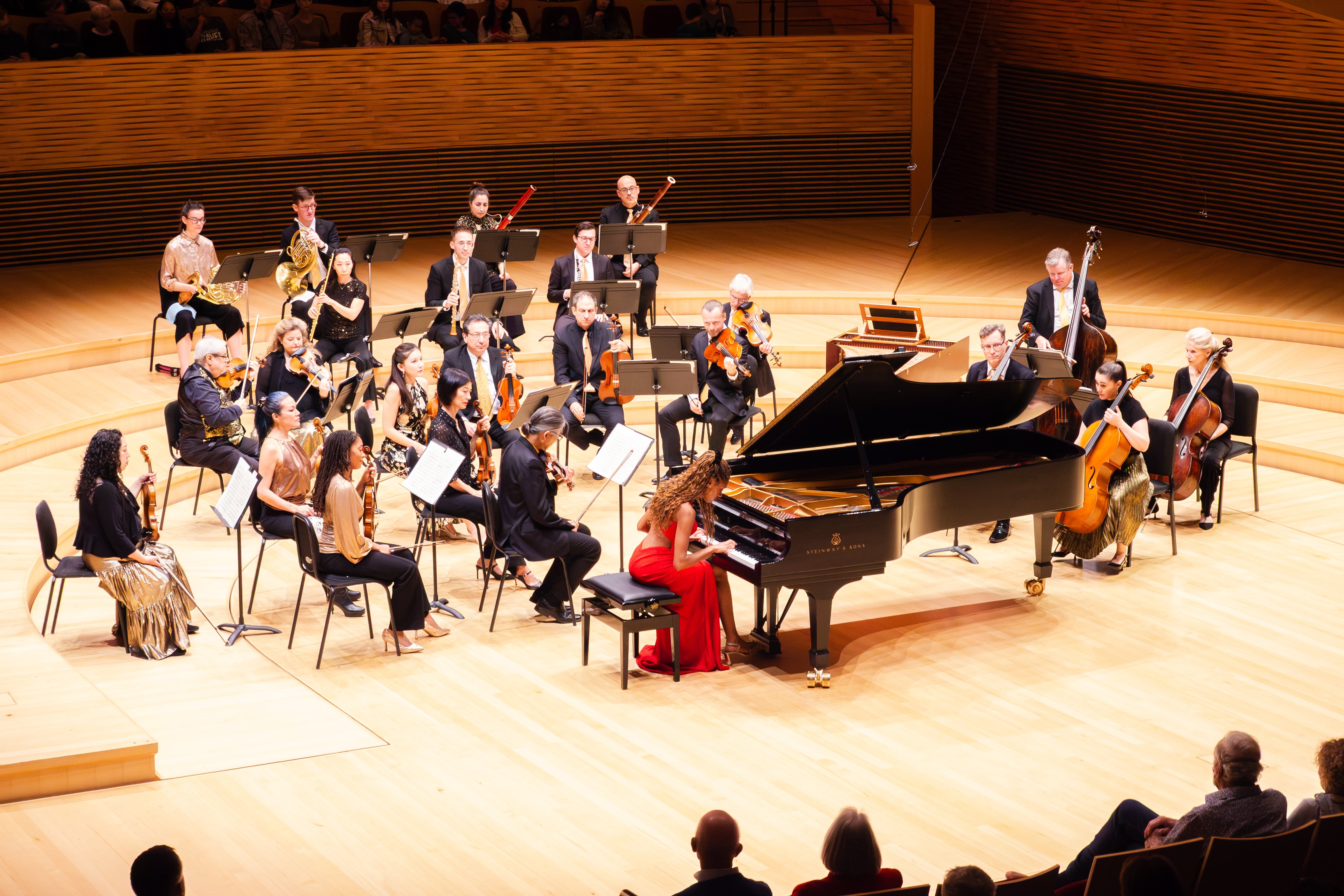
For more than 50 years, the Orpheus Chamber Orchestra has demonstrated that the many can exist without the few, and they did so again on Sunday at Bing Concert Hall. Together with pianist Isata Kanneh-Mason, the famously conductor-less ensemble delivered spectacularly ebullient renditions of classics by Handel, Haydn and Mozart along with a newly commissioned 2026 work by Katie Jenkins.
The program opened with a well-curated selection of seven movements from Handel’s “Water Music” that highlighted a diverse group of musicians. Oboist James Austin Smith sweetened the stately opening of the First Suite’s Overture and engaged in playful counterpoint with the strings. His Andante solo was even more affecting, revealing the composer’s melodic powers.
Not to be outdone, Sooyun Kim brightened the hall with her flute and piccolo solos in the Sarabande and Gigue, respectively. The former was reminiscent of Handel’s best soprano arias, with the instrument sweetly singing through Kim’s exquisitely-crafted phrasing. And the bouncy Gigue, beautifully broken up by the lower strings, was delight itself.
In some of the other movements, the horns romped through their fanfares, and the bassoon charmingly asserted itself in a dance-like duet with the oboes. With such a magnificent performance, the Orpheus players demonstrated why King George I commanded Handel’s musicians to play the suites for more than four hours without pause at the illustrious premiere.
The concert on Sunday, however, had other plans: Mozart’s 27th Piano Concerto, a relatively simple example of the genre that has a modest orchestration and a solo part that lacks virtuosity, was precisely executed with Kanneh-Mason as soloist. She superbly maintained the necessary effortlessness, and she did not insist on any gratuitous flashiness — a task made easier by the fact that Mozart unusually wrote out the cadenzas and left little room for improvisation.
Even so, it was possible to imagine a more sensitive performance, with some brief sections falling victim to monotonous phrasing. The orchestra compensated for these small shortcomings with a performance that emphasized various contrasts and alternated between sprightliness and tenderness.
In a program of works written almost entirely before 1800, Katie Jenkins’ newly-composed “Elixir of Life” may have seemed like an insignificant concession to modern programming sensibilities. It revealed itself to be anything but.
Opening with a basic theme over a repetitive, John Adams-esque rhythm, it soon yielded to a soaring solo violin melody which introduced a touching lyrical section. Throughout its 15 minutes, the main theme would return ever more confidently, restarting a cycle of jauntiness, dissonance, ethereality and virtuosity. The orchestration, the solos, the motivic development, the slow transformation of the opening rhythm into an almost classical-style accompaniment — all of this revealed Jenkins to be a brilliant young composer. She has written a piece that demands not only a second hearing but also widespread programming and studio recordings galore.
Much credit must go to the orchestra for bringing Jenkins’ creation to life. Soloist Maureen Nelson deftly managed the most demanding passages and sweetly introduced a variety of new colors. The solo viola and cello parts, although less prominent, were handled no less skillfully. And the entire string ensemble beautifully underpinned everything, from dark brooding textures to frenetic explosions of light.
In a return to the late 18th century, Haydn’s Symphony No. 91 concluded the program. The symphony is one of many by the Austrian composer that are heard far too infrequently: the chromatic counterpoint in the Allegro alone looks forward and renders the work worthy of attention.
The Orpheus Chamber Orchestra fully understood the music’s potential, offering an energetic showcase of Haydn’s genius. The vivacity of the conversation in the first movement did not overshadow the lower strings’ ferocious articulation, and neither seemed to conflict with the delicacy of the high woodwind solos. The energy continued through to the Andante variations, which avoided a staidness all too common in performances thanks to a sensitivity toward textural change. After a brisk Minuet — the Trio of which was remarkably and sensitively treated — the horns thoroughly enjoyed themselves in the Vivace, bringing the afternoon to a spectacular close.
Sunday’s concert was only the second stop in Orpheus’ nationwide tour with Kanneh-Mason. 13 more audiences will hear this program; they will be fortunate to do so.