
Editor’s Note: This article is a review and contains subjective thoughts, opinions and critiques.
It would be a criminal understatement to say Mozart’s “The Marriage of Figaro” is an important opera. Featuring some of the greatest hits in classical music (such as its iconic overture and “Sall’aria”), it manages to be superbly funny while providing pointed commentary on the sociopolitical situation of 18th-century Europe. My recent viewing of the San Francisco Opera’s rendition painted the classic in a new red, white and blue light.
Here’s the story at the heart of Mozart’s original 1784 opera: Figaro (Peter Kellner) and his fiancée, Susanna (Slávka Zámečníková), are both servants in the house of Count Almaviva (Thomas Mole). Instead of paying attention to his devoted wife Rosina (Olivia Smith), the count heaps his amorous attentions on Susanna and attempts to thwart her and Figaro’s wedding at all costs. A subplot follows Cherubino (Simone McIntosh), a young page, who is utterly obsessed with women and Barbarina (Sofia Gotch), a target of his desire. Over nearly four hours, these characters mingle to create a charming comedy that has all the elements one expects from a wedding: jollity, love and drama.
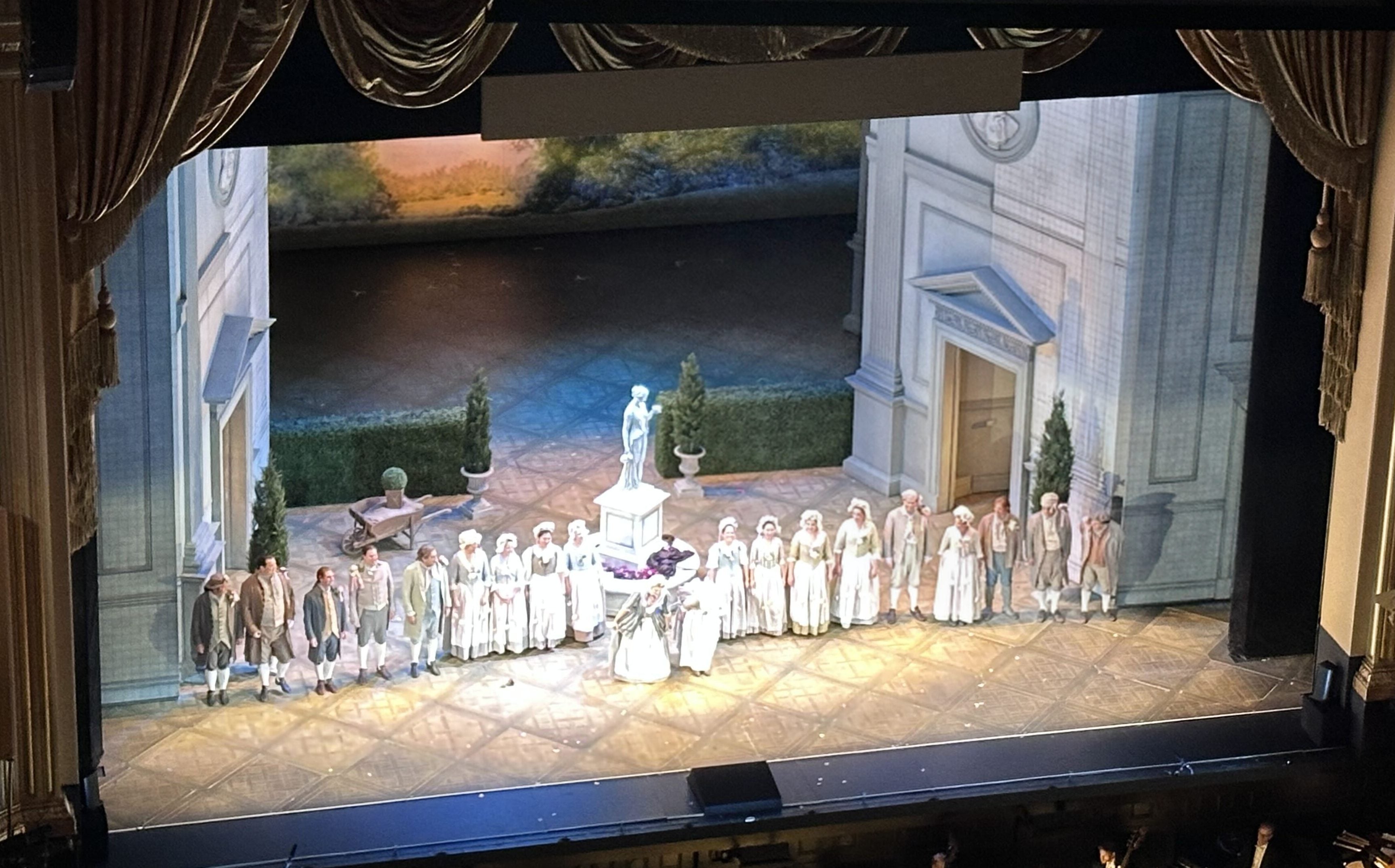
The San Francisco Opera’s new show, conducted by Sebastian Weigle, is a revival of the late producer Michael Cavanagh’s 2019 reimagining. With the help of set designer Erhard Rom and costume designer Constance Hoffman, Cavanagh’s work adds a twist to the iconic story by setting it in revolutionary America.
For an opera that challenges class structures and makes a mockery of the count, the upholder of the aristocratic system, the new setting was fitting — and Rom’s design deftly conjured the spirit of the colonies. The set consisted of neoclassical buildings inspired by Greco-Roman architecture, with much of the mansion still unfinished. In their place were projections of architectural blueprints and drawings. This seemed to be a nod to the United States’ intellectual ancestors of the Athenian democracy and Roman Republic, with the incomplete house representing the work still to be done during revolutionary times.
The colonies’ signature colors were repeated throughout the costume designs in a way that felt suggestive yet unobtrusive. Rather than garbing the count in stereotypically villainous dark capes or hoods, the count’s costume consisted largely of red motifs — a color associated with British colonial power.
Interesting as this reimagining was, it was relegated to the background during the second half of the show. After the set changed and the American flag was put away, it was easy to imagine that the drama was once again taking place in its native Europe. The characters were also not modified in any meaningful way.
The show would have benefited from committing to its American setting, perhaps by making Figaro embody a stronger rebellious spirit. Instead, he remained a clever servant, who, despite his wit, made no change to the system he inhabits. Ultimately, the opera’s creative directors were not willing to be truly revolutionary.
Despite this flaw, the cast remained impeccable. Kellner and Zámečníková portrayed Figaro and Susanna with immaculate chemistry. Zámečníková’s facial expressions were subtle but effective, allowing the viewer to understand her reaction and perspective without words. Her voice soared light and airy as a bird, particularly standing out in “Sall’aria,” the iconic duet between Susanna and Countess Rosina.
Meanwhile, Kellner leaned into the physical comedy of Figaro, often doing little dances and waving around guitars — never was there a dull moment when he stood onstage. Their flirtation and shared mischievous glances looked entirely real … probably because they were. The two actors are actually a married couple, perhaps bringing real love to the adorable relationship between Figaro and Susanna.
McIntosh’s Cherubino danced the line between comedy and vulgarity in a way that would have delighted the notoriously impish Mozart. Through her unrestrained and suggestive body language, she expressed all the silly, exaggerated yearning that young men often develop in adolescence. To complement McIntosh, Gotch’s Barbarina displayed the eagerness and nervousness of a young girl in the first bloom of romance.
As I watched these characters squabble, cry and love, I could not help but be reminded of Shakespeare’s words in “A Midsummer Night’s Dream,” another work filled with miscommunications and mischief. Indeed, “What fools these mortals be!” At the end of the night, I walked out of the theater with an appreciation of how nonsensical, how foolish, but ultimately how lovely our human lives are. What more could one expect from a performance?