
Editor’s Note: This article is a review and includes subjective thoughts, opinions and critiques.
It would be presumptuous to suggest that this review will significantly impact any reader, and I will not do so. But composers have often been far less scrupulous. Music about music’s value has been written since at least the 12th century, when troubadours in southern France penned lengthy songs about their craft. Since then, explicit tributes to the art have been written by the likes of Monteverdi, Schubert and Britten.
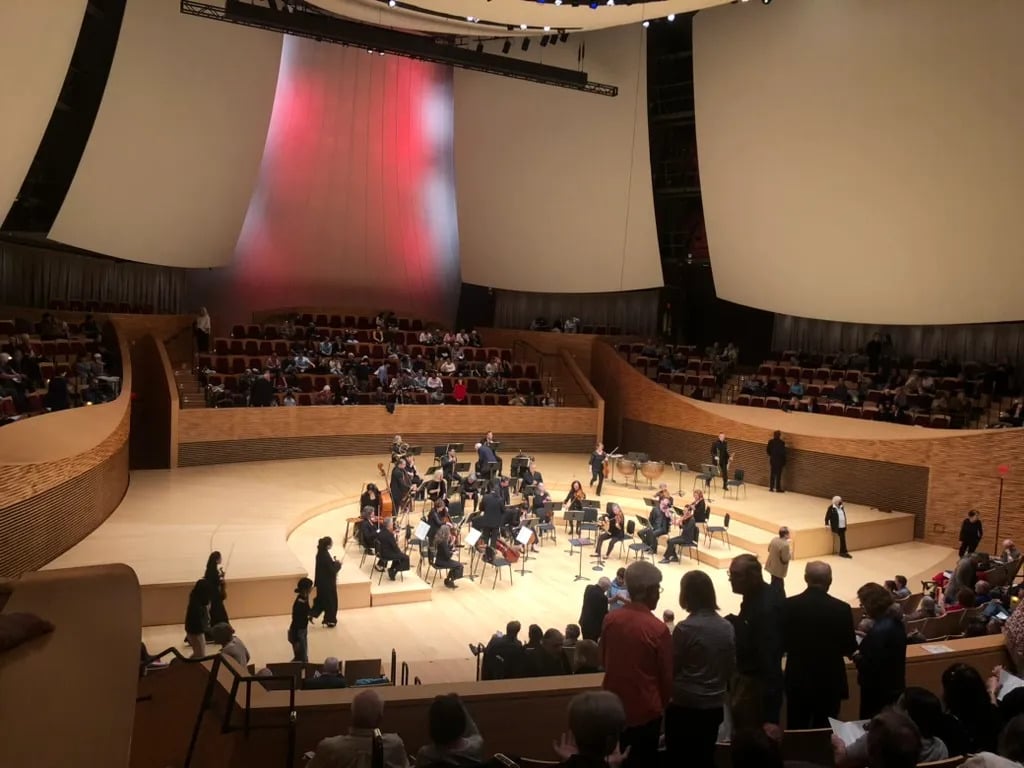
On Wednesday at Bing Concert Hall, the Philharmonia Baroque Orchestra presented Handel’s “The Power of Music,” a firm example of this genre. The oratorio, also known as “Alexander’s Feast,” tells the legend of the Ancient Greek performer Timotheus, who, through song alone, spurred Alexander the Great into battle. Interspersed with praises to melody and harmony, Handel’s creation was an immediate success when it premiered in 1736, but it soon fell into obscurity along with many of his works. Even the composer’s 20th-century revival failed to properly establish its place in the repertoire.
Wednesday’s concert made a compelling case for widespread performance and recognition of the musical feast. Peter Whelan, the ensemble’s new music director, vigorously led the U.S. premiere of his reconstruction of the piece’s 1742 Dublin version, for which Handel extended the conclusion and reassigned vocal parts to add and highlight an alto voice.
So it fell to Rachael Wilson to justify the presence of her lower register, and she did so magnificently. Throughout the night, she fully embodied the Handelian style. In the aria “Softly sweet in Lydian measures,” Wilson exercised impeccable control over the shape of the melody and imbued the deceptively simple quiet descents with a deep pathos.
It is remarkably difficult to reveal the genius behind Handel’s poignant lyricism: The fact that Wilson did so with such naturalness would alone warrant praise. But she also deftly managed her florid coloratura in more lively sections, furnishing the music with delightful whimsy. A singer who can achieve even one of these two polar opposites in a Handel performance is rare; Wilson delivered both with beautiful resonance throughout her range.
Handel’s other major change for Dublin was to transfer two bass arias to the tenor, a somewhat puzzling decision given that the grand declamatory music is decidedly more bass-like. Despite this, tenor James Way offered spectacular renditions of the showpieces. His full voice and darker timbre — which would certainly not be suited to all Handel tenor roles — provided the necessary tone, to say nothing of his powerful expression of both jubilation and anger. Yet this did not limit his agility, as is so unfortunately common for heavier voices. Although Way did not have Wilson’s opportunities to demonstrate his softer nature, several short recitatives proved that he was more than capable in that respect.
Soprano Sherezade Panthaki rounded out the soloists. In the 1742 version, Handel largely confined the highest voice to energetic numbers, a choice that suited Panthaki’s dexterity. She brilliantly ran through all sorts of technical passages, even when Whelan chose positively blistering tempos, as in “With ravish’d ears.” Her delivery also managed to smooth over certain defects in the score: Her expressive shifts elevated the 40 repetitions of “sigh’d and look’d” from annoying to decidedly entertaining. Even so, Panthaki’s Handelian skill set was not quite as broad as the others’, as she was unable to match Wilson’s delicate emotion in the moments that her part required it.
It was Whelan who cast the singers, but he deserves far more credit for Wednesday’s concert. Most apparent, he reconstructed the score (with the help of musicologist Donald Burrows), the most prominent addition to which was a delightful aria-duet pair that extended and revitalized the final chorus.
His direction from the keyboard was also the driving force behind the dynamic energy of the entire evening — the frequent shaking of his harpsichord can attest to that. Whelan often chose brisker tempos, and these were accompanied by large gestures that extracted sharp articulations from the musicians. Most striking, however, was the choral section of “Bacchus, ever fair and young”: Whelan pulled 50 musicians into an accelerando that felt like it simply shouldn’t have worked. And yet it did.
The orchestra was by no means perfect. The natural horns — the Philharmonia Baroque Orchestra is a period-instrument ensemble, so none of the brass instruments have valves — were regrettably sloppy, even once one made allowances for the difficulty of the instrument. And the performance of a movement from Handel’s “Water Music” paled in comparison to the Orpheus Chamber Orchestra’s rendition in the same hall just days before.
But these issues were easily overlooked in an otherwise splendid concert. Why? Because Whelan and company showed us “The Power of Music.”