
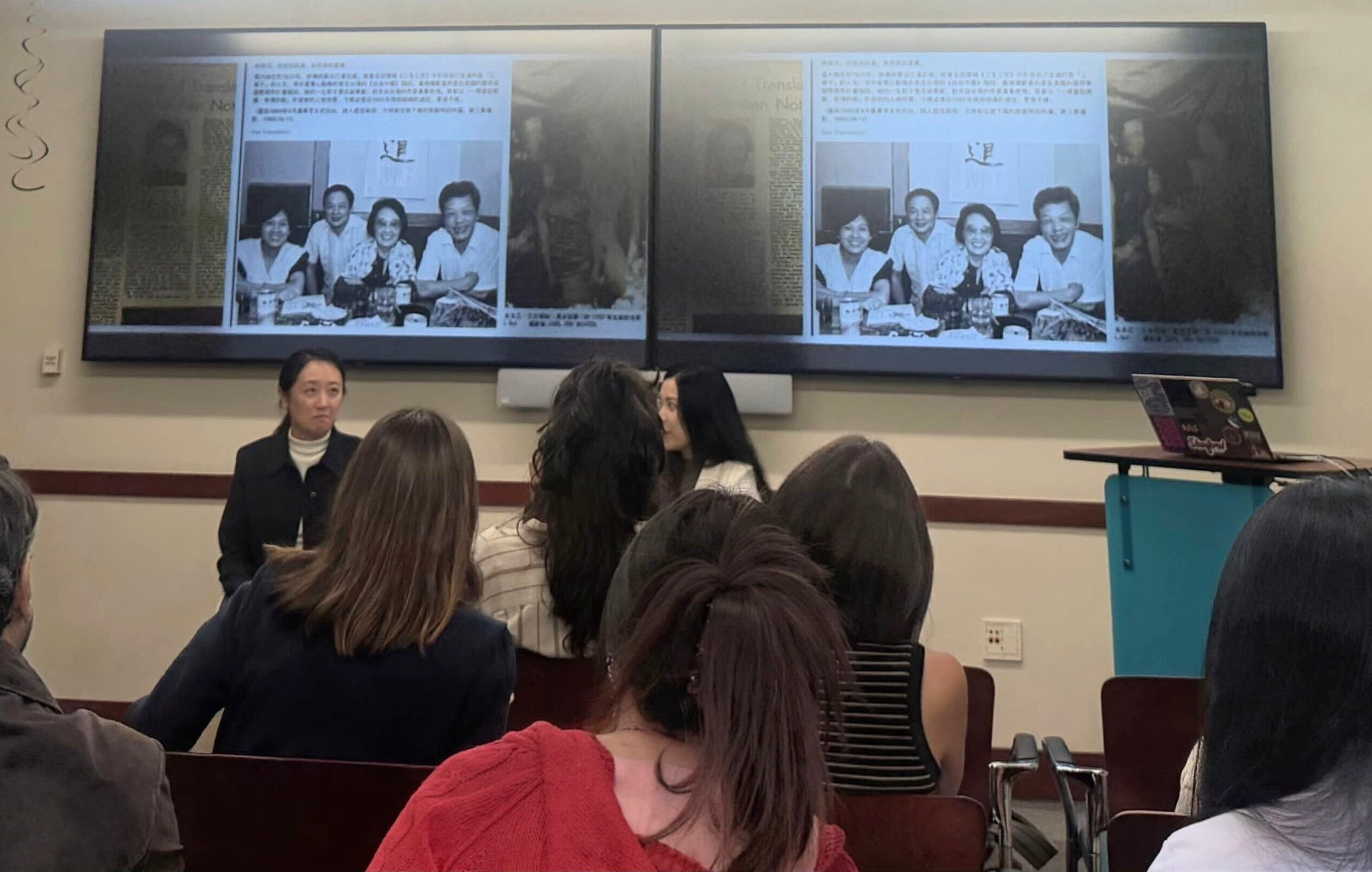
L. Maria Bo, assistant professor of English and a scholar of Asian American literature, highlighted the revolutionary capacities of translation during a talk on Tuesday.
The talk — moderated by fourth-year Ph.D. student Coco Ruan — celebrated the release of Bo’s first book, “Writing on Water: Cold War Literary Translations and the Chinese Diaspora” and was sponsored by the Center for Comparative Studies in Race and Ethnicity (CCSRE). In the CCSRE Conference Room, past and current students of Bo’s, colleagues at the English department and CCSRE faculty members joined Bo in celebrating the launch.
“Writing on Water” explores the weaponization — and in turn, the power — of literature during the ideological battles of the Cold War. In the book, Bo places English and Chinese translations side-by-side and breaks them apart by line, word and phoneme.
At the start of the talk, she contextualized the history underlying “Writing on Water”: as forces in Beijing and Washington poured their resources into translating and publishing their respective bodies of national literature throughout the course of the Cold War, translation became both an archive and an exchange of political ideology.
“Literature was the currency of persuasion in this war of ideas,” she said.
Bo discussed the political and textual trajectories of works now canonized in Asian American studies — works by Chinese American writers like Eileen Chang and Jade Snow Wong, whose popularity at the turn of the Cold War thrust them onto a politicized, vastly polarizing global stage. Bo went on to explain that “Writing on Water” is interested in a methodology beyond historicism.
“My book is not just about propaganda,” she said. “My book is about how literature could never just be about propaganda.”
Bo continued by describing the close reading underlying “Writing on Water.” While dissecting Wong’s “Fifth Chinese Daughter,” for instance, Bo traced the transformation of the Chinese word 认识 (rènshi, “to recognize”), which morphed into 承认 (chéng rèn, “to guiltily acknowledge”) between translations. The endeavor was an intensive one: “Multilingual work takes work,” she said.
To Bo, translation is a craft of “equivocation” — it becomes a vessel for political messaging not by force, but because of the fluidity of the exchange between language and reader. Bo also explained the rationale behind the title: “It’s easy to think of translation as a bridge,” she said. “But we should think of it instead as writing on the waters.”
Bo next analyzed Eileen Chang’s translations of Ernest Hemingway’s “The Old Man and the Sea,” which Chang was hired to complete by the U.S. government. Bo described Hemingway’s style as one characterized by perfection.
“How do we translate the perfect sentence?” Bo asked. She then described how answering this question is a paradoxical undertaking: “In [the process of] translation, we understand how these sentences have become perfect.”
Miranda Johnson ’26 who is currently taking “Introduction to Asian American Literature” under Bo, said the talk enhanced her understanding of course material.
“Something that we’ve discussed in class is how translation has been used as a medium, or an expression, of identity,” Johnson told The Daily. “The talk itself expanded on translation not necessarily as an expression of identity, but a complication of political ideology.”
The talk progressed into an audience Q&A in which Bo was asked about her motivation behind writing the book. She described a lifelong interest in reconciling the materiality of language with the methodology of literary scholarship.
Bo also shared how, as she pursued her masters and Ph.D. at Columbia University, the intersection defined her approach to literary criticism — a field in which she felt “the language [was] treated as transparent.” In contrast, Bo searched for a field that investigated literature alongside the construction of the English language itself.
“I saw this difference,” Bo said. “So why did no one else?”
Annette Lin ’29, who took Bo’s Asian American literature course last spring, reflected on the book’s significance in her own life.
“This kind of literature is not about family in the way that so many Asian American stories are,” Lin said. “But this bilingual work traverses so much distance, both cultural and geographical, between where we are and where we come from.”
During the talk, Bo expressed her hope that “Writing on Water” reaches an audience beyond the academic reader.
“Why do I believe in the ordinary reader?” Bo asked. “Because I believe in my students. Because I was one, and I am one.”