
Since the first Big Game in 1892, Stanford has claimed the mighty Axe 48 times. Meanwhile, UC Berkeley’s taken the trophy on 38 occasions. But we’re rivals off the field, too: For decades, Nobel Prize winners, Olympians and Pulitzer Prize recipients have graduated from or taught at Stanford and Berkeley. So when it comes to counting these illustrious accomplishments, how do we stack up against the bears across the Bay?
The Daily found that while Cal trumps Stanford in its number of Nobel Prizes (Cal 64, Stanford 38), Stanford overshadows Berkeley in its number of Olympic medals (355 vs. 246) and Pulitzer Prize awards (25 vs. 19).
First tallying up Nobel Prizes, Stanford boasts 38, including those won by 2026 awardees Robert E. Hall and Karl Deisseroth Ph.D. ’98 M.D. ’00. Hall is a professor of economics and Deisseroth is a professor of bioengineering and of psychiatry and behavioral sciences.
Meanwhile, Berkeley can claim 64 total Nobel Prizes — a number technically higher than Stanford. However, it’s worth noting that some winners are affiliated with both of the rival schools: For instance, Hall received his bachelor’s degree from Cal, making his recent economics Nobel technically Cal’s as well.
Additional recent Berkeley-affiliated laureates are John Martinis and former postdoctoral researcher Michel Devoret, who jointly won the Nobel in physics last year alongside emeritus professor of physics John Clarke; Omar Yaghi, a professor of chemistry who received the chemistry Nobel; David Baker, who received the biology Nobel; and Gary Ruvkun, who won in physiology or medicine.
When comparing recent numbers, Stanford displays an upward trend. While Cal produced a singular Nobel Prize recipient this year (and the recipient in question is currently a respected professor at Stanford), the Farm turned out two.
Stanford has also produced plenty of medal-winning Olympians. Across sports ranging from soccer to skiing, the University has won nearly 360 Olympic medals since 1912. Current undergraduates that recently earned medals include Zoe Atkin ’26 and Eileen Gu ’26; both are both acclaimed freeskiers.
Berkeley students earned their first Olympic medals at the 1920 Antwerp Games. They’ve since gathered 126 gold, 66 silver and 54 bronze medals, totaling 246. Cal won 23 medals at the recent 2024 Paris Games. Though no current Berkeley student is an Olympic medalist, recent graduates Jack Alexy and Camryn Rogers both won gold in Paris.
Alongside its athletic prowess, Stanford also reigns in the arts: To date, the University has hosted 25 Pulitzer Prize winners..
Among them is Adam Johnson, professor of English, who earned the 2013 Pulitzer for Fiction for his novel “The Orphan Master’s Son.” Seven other faculty members, such as David Kennedy, have also earned the award. Their works span the history and reporting fields.
Berkeley, meanwhile, claims 19 Pulitzer Prizes won by students, alumni and various affiliates, including three in 2026 alone: Susie Neilson, Garance Burke and Kathleen Hennessey. However, the double affiliation question appears again: Burke, a Berkeley alum, currently works as a practitioner fellow at Stanford’s Center for Advanced Studies in the Behavioral Sciences.
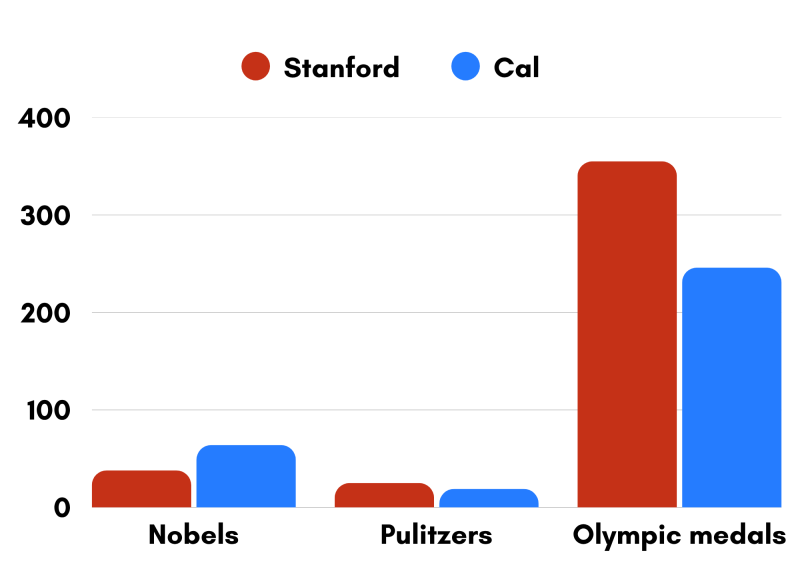
Regardless of any areas of affiliative ambiguity, one fact remains clear: for two out of the three prestigious awards compared, Stanford comes out on top. In the realms of both institutional recognition and the Big Game, Stanford takes home the trophy.
Numbers are only one side of the story, of course. For both Stanford and Cal, every Nobel winner, Olympian and Pulitzer recipient reflects an institution that prides itself not only in past achievements but the ability to drive the future. Still, as far as these awards go, Stanford has undeniably beat Cal — as the popular Farm slogan goes.