
For Alexis Madrigal, Oakland isn’t just a city but an adjective — what he calls “Oaklandish.”
“Oaklandish is funny. It’s a clothing brand,” he said. Madrigal, co-host of KQED’s “Forum” program, a radio show covering local issues in the Bay Area, used the term to highlight Oakland’s unique political and social culture.
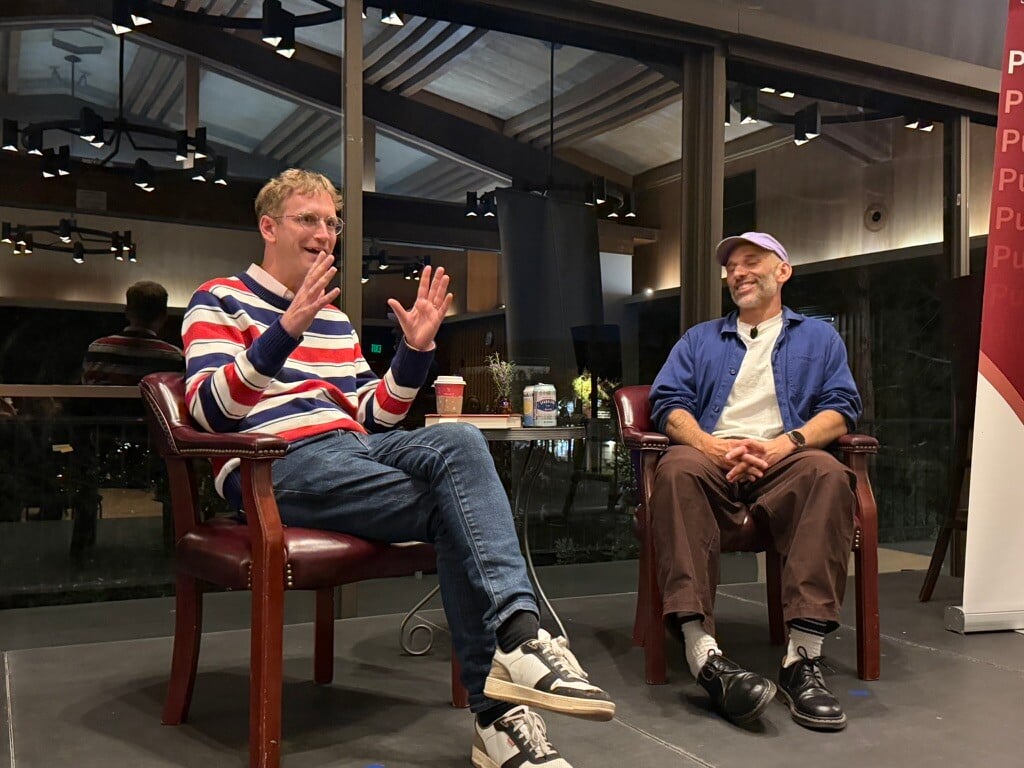
Madrigal joined Stanford comparative literature and German studies professor Adrian Daub on Thursday evening as part of the Stanford Public Humanities’ speaker series, “What is a Public Intellectual Today.” Madrigal spoke at length about the storytelling behind issues and challenges facing Oakland which he explored in his recent book, “The Pacific Circuit.”
To him, Oakland’s “unavoidable” parts, like heavy industry, allow it to become “wildly communal,” where people find their “natural home.”
“[Do] you remember when you were in physics class, and you’d have to draw all the forces that were happening on some particular thing?” he said. “That’s what I wanted to show for West Oakland.”
“The Pacific Circuit” depicts the social history of Oakland — home to one of the largest container ports on the West Coast in the context of Silicon Valley and a changing global economy. Madrigal focused on West Oakland, which he described as the neighborhood with the highest Black population in Oakland, itself having the highest Black population in the Bay Area.
“There’s this kind of lack of specificity to the way people talk about [Oakland],” Daub told The Daily. “People have learned to not pay attention to it in certain ways.”
Madrigal credited “The Technological Sublime” by David Nye as an inspiration for his work. The “sublime,” he says, finds itself where the sheer enormity of a human creation can induce both awe and fear when observing it.
“It’s just the most insane environment to work in and to see. The fact that this system also had a massive transformative impact on the global economy and economic historical tells you [that for] just about every port city [that] was transformed — most especially in San Francisco, London, New York — the big ports ended up being empty above all of their logistics facilities, which then creates the city that we all now know…” Madrigal said.
Madrigal deeply engrossed himself in the culture and community of West Oakland in research for his book. He sought to produce an intersection of data and storytelling.
“One element of [writing] was making sure that this book not only got back into people’s hands, but that the underlying research of documentation also made its way back into West Oakland. It served as an ethical commitment to the people who were sharing their stories,” Madrigal said.
Madrigal said that he wanted to avoid the typical exploitation of research subjects in his work. “People themselves become abstractions,” he said. He noted that the Bay Area was culturally unique, owing to its technological advancements and the rapid, unparalleled growth of Silicon Valley, as well as the culture cultivated by its immigrant community.
“We don’t have just one community [in the Bay Area],” Madrigal told The Daily. “It’s as true at the top [of the class scale] as it is at the bottom that this cultural mixing is happening.”
While writing and promoting “The Pacific Circuit,” Madrigal wanted to keep the people he wrote about at the center of his project. Having spent 10 years immersed in West Oakland, he recalled feeling most passionate about how his book was received by this very same community.
“The people I really cared about what they thought were here,” he said, noting that he didn’t feel the same emotional connection during other stops of his book tour.
Madrigal’s dedication to the Bay extends beyond his book. After working at WIRED and The Atlantic — where he co-founded the COVID Tracking Project — he joined KQED’s “Forum” radio show in June of 2021. As the co-host of “Forum,” Madrigal covers local current affairs each morning at 9 a.m. for radios across the Bay Area.
“The fact that he’s producing radio is a kind of unusual thing,” Daub said. “[It’s] not the medium that we tend to think of primarily when we think of public intellectuals.” Madrigal said his experience in public radio has exposed the interconnectedness of issues in the Bay Area as well, crediting it with helping tie everything together in the “regional space.”
Madrigal also touched on the Stanford cultural separation and the campus “bubble,” and suggested that the community should begin with a fundamental curiosity. He encouraged the community to consider the configuration of the Bay Area itself as a first step.
“Where I would start is with a basic curiosity about where things are — why things are where they are…Why are the downtown buildings where they are? Why is East Palo Alto where it is?” he asked. “What is the bigger crime here?” he said.