
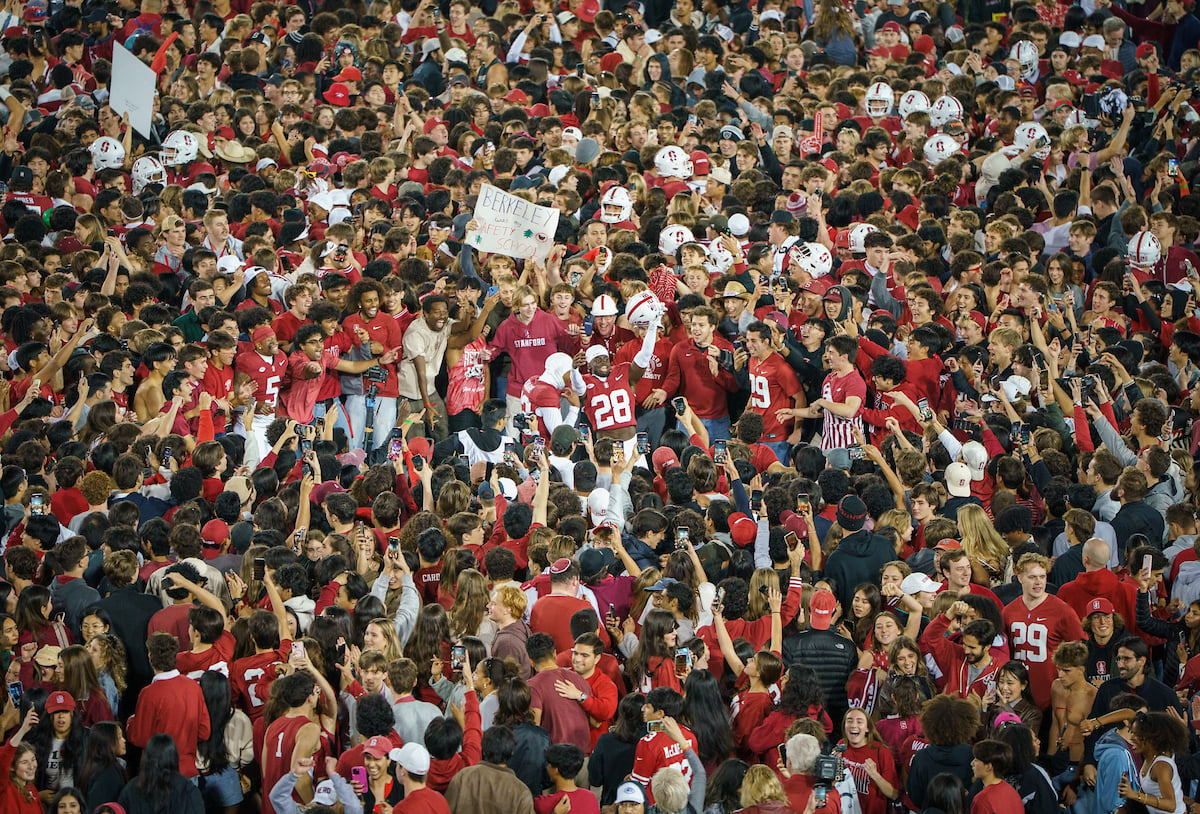
The Stanford Cardinal (5-5, 3-4 ACC) and California Golden Bears (3-7, 2-5 ACC) are slated to take the field in Berkeley, Calif. for the 129th annual Big Game this Saturday. For over a century, their football rivalry has survived as the West Coast’s oldest. The rivalry between Stanford and Cal dates back to the 1910s during the days of the Pacific Coast Conference (PCC), the predecessor to the Pac-8, Pac-10 and later the Pac-12. Given recent shifts in college football, however, does the Stanford-Cal rivalry even matter?
Stanford and Cal are the lone orphans of the Pac-12 in the Atlantic Coast Conference (ACC), with their former Pac-12 siblings scattered throughout the Big Ten and Big 12. Much has changed since the Pac-12’s implosion at the start of the 2020s — Name, Image and Likeness (NIL) policies and college football playoff expansion, for instance.
The fit of two Pacific institutions in an Atlantic conference remains questionable, and decisions on television revenue and NCAA compensation have only served to further dismantle the older regional conference model.
Since joining the ACC, Stanford and Cal have languished as mediocre teams in competition with their newly-minted transcontinental colleagues. However, just three years after adding Stanford, Cal and SMU, the ACC is already showing signs of destabilization.
Miami, North Carolina, Florida State and Clemson, some of the ACC’s powerhouses, have already petitioned the House for major changes to the Protect College Sports Act (PCSA) — namely, increasing the 20-team limit to 22 teams and slashing the three-year independence requirement. To many, it is becoming increasingly apparent that the Power 4 is crystallizing fast, and jumping ship is do-or-die.
Amid all of this, Big Game is likely to remain immune. The Cardinal and Golden Bears are practically joined at the hip and stayed together when they moved across the country during conference realignment. Among the reasons for their refusal to remain in the Pac-12, excluding the desire for long-term stability and power conference status, was academic parity.
Stanford and Cal, along with the other “nerd schools” at the Football Bowl Subdivision (FBS) level, heavily rely on the gravity of their academics for recruiting, and even with sweeping changes in NIL and the transfer portal, these institutions retain a competitive edge. The Cardinal and Bears consistently attract strong talent from high schools and the portal alike, with both schools’ recruiting classes consistently ranking in the nation’s top 50.
Arguably, the 24-team expansion of the College Football Playoff (CFP) could benefit legacy conference schools, namely former Pac-12 members. The 24-team format will erase all conference championship games, further diminishing the weight of regionality in intra-conference scheduling.
The Southeastern Conference (SEC) and Big Ten are strongly anticipated to draft a compact to meet CFP eligibility requirements, which are determined chiefly by the number of scheduled Power 4 teams, by arranging for more cross-conference games.
If the ACC and Big 12 mirror these changes, Stanford and Cal may face some of their old Pac-12 South foes. Within the Big 12, the Colorado Buffaloes might be especially interested in revenge, given their final and most recent collapse against the Cardinal.
Reviving older Pac-12 rivalries is already within sight for the Big Ten and Big 12. UCLA and Cal have agreed to a 4-year series of the Joe Roth Memorial Game through 2029, while the Washington Huskies and Washington State Cougars have revived the Apple Cup for a home-and-home series ending next year. As for the Stanford Cardinal, they will face the Arizona State Sun Devils in home-and-home matchups from 2031 to 2032.
Thus, Pac-12 converts in the Big Ten and Big 12 may continue looking to schedule Stanford or Cal to meet the ten-team CFP requirement while cutting down on cross-country conference opponents. Several dormant Pac-12 rivalries could soon join Big Game on the Bears’ and Cardinal’s schedules. Stanford v. USC (The Weekender), Cal v. USC and Stanford v. Oregon are all in the realm of possibility.
Undoubtedly, college football as in the days of Manziel, Tebow and Newton is all but a memory. Since then, realignment has shattered plenty of long-standing rivalries into sporadic non-conference games: Bedlam (Oklahoma v. Oklahoma State), The Civil War (Oregon State v. Oregon) and Border War (Kansas v. Missouri), to name a few. Still, Stanford and Cal are too similar to be separated. Their academic and athletic pedigrees run deeper than the vast majority of American universities, and their proximity only gives another reason to preserve the heritage behind their rivalry game.
Big Game will forever remain a cherished institution of college football — a relic of the old Pac-12 and the embodiment of “nerdball” — provided neither school is swallowed by an earthquake. Until then, the Cardinal and the Bears will look forward to spoiling each other’s seasons in their annual Bay Area showdown.