
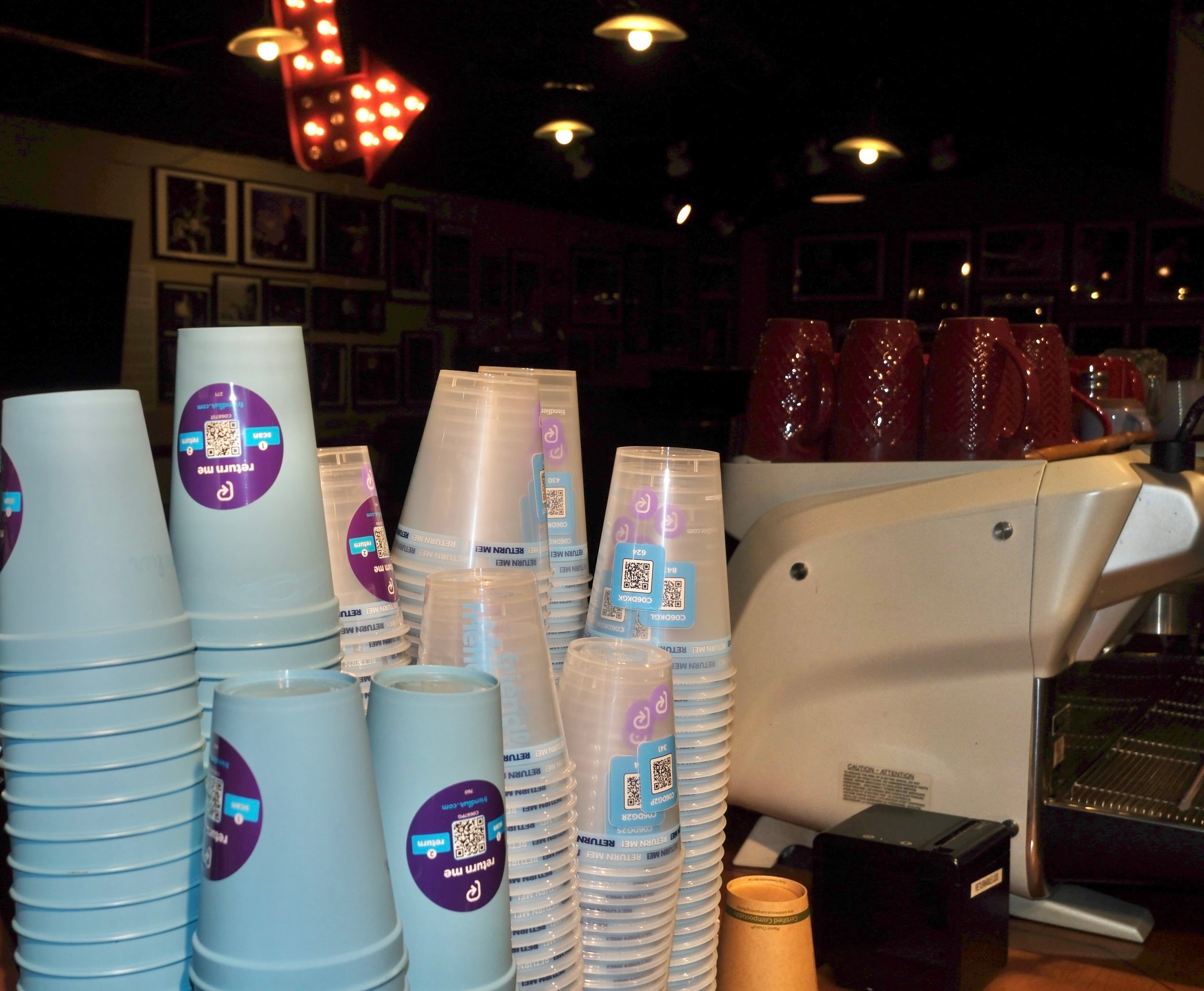
Coffee House (CoHo) has gone blue. After introducing reusable containers from Friendlier, an organization creating sustainable packaging, in August, the team now plans to expand the blue cups and boxes to The Treehouse on Dec. 1, followed by its catering business and Ray’s Grill in the future.
The reusable coffee cups and containers provided by Friendlier cost an extra 50 cents at the register, but customers receive 75 cents after they scan the QR code on the container and return it to one of the Friendlier return bins near CoHo locations.
As of Thursday, the Stanford community has scanned and returned over 10,000 containers, according to Jenny Mountjoy, who co-runs the daily operations of CoHo’s two locations, Treehouse and Ray’s Grill, with her brother, Andy Klein. Friendlier launched their CoHo pilot in August at the Alumni Center location before introducing it to the Tresidder shop in September.
CoHo had previously introduced its own “for-here” red mugs in February, 2026, hosting a “Mug Club” event for students to design their own to be used at the cafe.
Even though the partnership is still in its first phase, with Sustainable Stanford helping fund the operations, CoHo plans to continue its collaboration with Friendlier after the pilot ends in December. Mountjoy said other campus restaurants have inquired about Friendlier’s products and operations.
The partnership came about through a Sustainable Stanford Living Lab Program fellowship undertaken by Astha Bhandari ’26. After months of research, Bhandari presented multiple options for sustainable packaging to CoHo, and after several conversations, the CoHo team felt Friendlier best fit their needs.
“[Friendlier’s operation] was pretty simple, and it wasn’t too much of a burden on our staff,” Mountjoy said. “I can’t speak more highly of [Friendlier].”
Friendlier was founded in 2019 by Kayli Smith and Jacquie Hanton as undergraduate students at the University of Waterloo in Canada. The co-founders told The Daily they came up with the idea after studying abroad in Sweden, where they observed less takeout waste and litter given the country’s widespread use of reusable containers.
“What we really noticed and got interested in is the way our supply chains are set up,” Smith said, “and we identified massive inefficiencies that we saw in how we’re producing and consuming.”
After graduating in 2020, Smith and Hanton said they fully committed to Friendlier and began to sell to local restaurants. At first, they had to be “very scrappy,” Smith said. “We started selling to a lot of local restaurants for takeout packaging. Jackie would literally bike around to pick up all the return packaging. We would wash on our weekends,” Smith said.
Today, Friendlier has upgraded to commercial dishwashing and expanded to over 150 outlets across North America, spread across zoos, event venues and 25 college campuses, including at a University of California, Davis student-run coffee shop. At Stanford, the company simultaneously picks up used containers and delivers clean ones twice a week on Mondays and Thursdays, Hanton said.
Throughout the fellowship and its introduction, the Sustainability Department has had to overcome certain struggles to maintain efficiency, one of the most pressing ones being the return process.
Friendlier first required a downloaded app to receive the deposit, but that has since been removed. As the company collects feedback across both CoHo locations, the main hurdle is still helping customers adopt a new habit.
“Change is hard,” said Julie Muir, director of zero waste systems in the Office of Sustainability. “We’ve been trained over time to take our drink, drink it, and throw it out. This is a new habit that can be really challenging.”
At each stage, Friendlier said it has prioritized customers and staff feedback, including hiring an intern to collect consumer reviews and questions.
From Friendlier’s point of view, the feedback has been positive and, according to Hanton, “the students have been absolutely loving the program.”
“They like that they don’t have waste with their meal. They like the concept. They like being able to scan and track their impact and get money back for returning the products,” she said. According to Smith, some clubs have pooled Friendlier funds for activities.
Other students feel differently, however.
Levi Lebovitz ’27 appreciates the concept of reusable cups, but feels the process “becomes a little bit of a hassle,” given the lack of return bins across campus.
“I’m starting to want my paper cups back because it’s a little bit inconvenient for me to take this blue plastic cup across campus when I want a to-go cup,” Lebovitz said, who has started requesting the compostable cups when he orders. “There’s only one place to put them. It’s CoHo. It’s not a to-go cup.”
While Friendlier’s cups are recyclable, the partners have recognized the return rates are an issue.
“Our return rate isn’t as high as I want it to be yet,” Muir said, noting that CoHo has seen 60-85% return rates across both locations. “So we’re still working on that.”
Lebovitz also said the 50-cent deposit came as a shock, as CoHo began adding it to customers’ bills without prior notice. “I was shocked by that … It feels like they’re cheating me a little bit,” he said, “I don’t think people know that you’re getting charged 50 cents per cup, and that’s a little bit frustrating to me. And it feels like they’re just taking advantage of people buying coffee to make a bunch of money.”
According to Mountjoy, the cost of the Friendlier cups is comparable to single-use packaging. CoHo had considered raising their prices to lower the deposit, but opted out to continue incentivizing the return.
Pending California regulation will make single-use packaging more expensive, opening an opportunity for reusable packaging to grow.
SB 54, California’s Plastic Pollution Prevention and Packaging Producer Responsibility Act, aims to reduce plastic and wood service packaging. The law requires that by 2032, 100% of packaging is recyclable or compostable.
“[Reusables are] the future of takeout,” Muir said, noticing a trend of reusable packaging. “It’s a big space for innovation … to help reduce single-use [and] encourage circularity.”
As plans to expand Friendlier’s presence on campus move forward, the partners will continue to find ways to accommodate the student body and increase efficiency.