
The Undergraduate Senate (UGS) heard a proposal to expand support for formerly incarcerated individuals and debated a separate proposal to establish a $2.5 million student investment fund at its final meeting of the quarter Wednesday night.
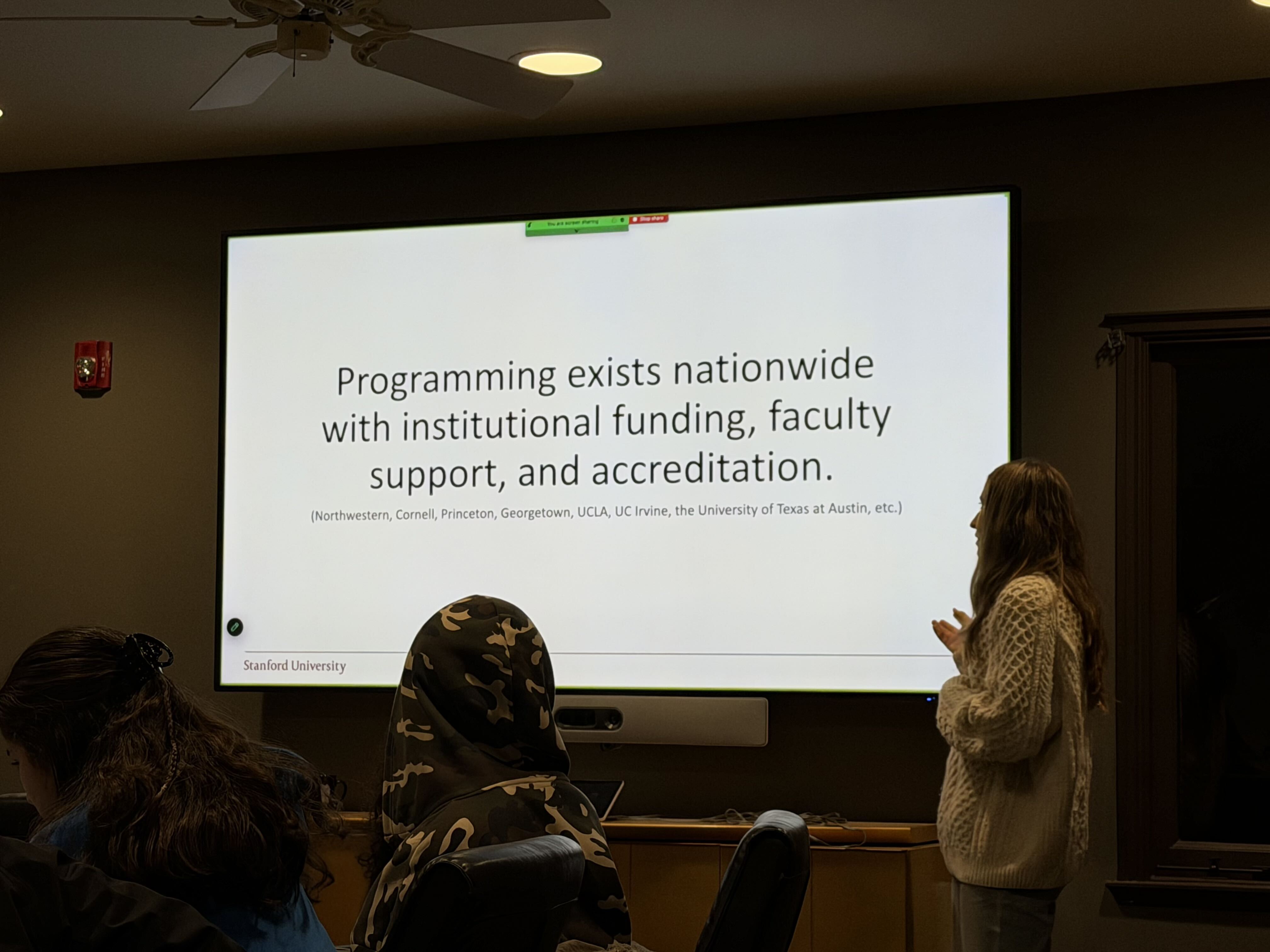
Members of the Senate considered creating an on-campus support network, potentially including mentorship, transportation, academic assistance and integrated community events for previously incarcerated students The initiative would require faculty leadership and funding, presenters said.
The presentation was made by Communications Committee co-chair Ashton Dolce ’29, Financial Officer and Undergraduate Lead for the Stanford Jail and Prison Education Program (SJPEP) Nandita Talluri ’29 and Senator Esther Pottebaum ’27 presented the proposal for formerly incarcerated students.
They argued that building a community for formerly incarcerated and system-impacted students should precede efforts to recruit them to Stanford, though both are important.
“If there’s no support, there’s no community building for students who have experienced similar things in their past,” Dolce said.
Presenters also identified admissions requirements, including application fees and standardized testing for transfer applicants, as potential barriers for entry at Stanford for prospective incarcerated and system-impacted students.
The presenters held approximately 15 conversations with formerly incarcerated students, University staff and program representatives at peer institutions, presenters said.
According to Talluri, the initiative is different from existing prison education efforts. While SJPEP has operated since 2011 and brings graduate students into local jails to teach classes, the proposed Prison to School program would focus on supporting formerly incarcerated students on campus and developing pathways to higher education through partnerships with local community colleges.
Han “Harrison” Lee ’28 also presented a proposal to establish the Astir Fund, a student investment fund that would be backed by $2.5 million from the Associated Students of Stanford University (ASSU) endowment, funded by the University. The proposal would provide students with investment experience while generating returns for the student government, he said.
Lee noted the fund would introduce students to new financial tools and investment strategies.
“We need to have education of new instruments, as a class, and strategies,” Lee said.
He also stressed the importance of teamwork. “We want to select members to achieve an optimal cohort, not just individuals, by looking at them in a vacuum,” he said.
Senators postponed a vote to allow more time to review the proposal.
The UGS also unanimously passed five bills and joint resolutions. One calls for a permanent, university-supported home for sexual violence prevention programming and improved accountability and timeliness in Title IX proceedings. It also urges for restoring sexual violence prevention education during New Student Orientation (NSO), incorporation prevention education into COLLEGE 102 and providing annual training for fraternity and sorority members.
ASSU President Jared Hammerstrom ’27 and ASSU Director of Sexual Violence Prevention Sasha Herthel ’27 introduced the resolution. Herthel said the resolution formalizes longstanding student requests. “We’re not calling for anything new,” she said.
Another resolution calls for restoring mandatory sexual violence prevention education during New Student Orientation (NSO), provides annual training for fraternity and sorority members and potentially incorporating prevention education into COLLEGE 102. It also specifically calls for improved accountability and timeliness in Title IX proceedings and expanded access to university-funded legal assistance. Title IX is the federal civil rights law that prohibits sex-based discrimination and requires universities to investigate and address sexual misconduct.
“[Discussing this] puts the record down that students have been fighting for these things since very early on,” Herthel said.
UGS also passed a joint resolution supporting the College Horizons program, a national nonprofit organization that provides college-access programming for Native American, Alaska Native and Native Hawaiian high school students. The resolution asks the University to publicly explain its decision to withdraw from hosting the event earlier this quarter and continue investing in outreach to Indigenous students.
The decision came just one year after Stanford removed land acknowledgments from all campus ceremonies, Zidek said. She also explained the impact the program had on her college decisions.
“I genuinely, wholeheartedly … would not have even applied to Stanford if I didn’t do the College Horizons program,” Zidek said.
UGS also unanimously passed a bill establishing a Student Organization Leadership Council to create a formal channel for Voluntary Student Organization (VSO) leaders to communicate with the Senate.
Project Manager in the Dean of Students Office Deanne Graesser Ledoux and history professor Karen Wigen presented a bylaw that formalizes campus proctoring guidelines, following changes to the Honor Code and Student Conduct Charter approved in spring 2026, and establishes expectations for instructors when conducting proctored assessments.
The bylaw passed unanimously, and its formal adoption of the bylaw would give the guidelines more authority, Wigen said. “[Without the bylaw] the guidance doesn’t have teeth.”