
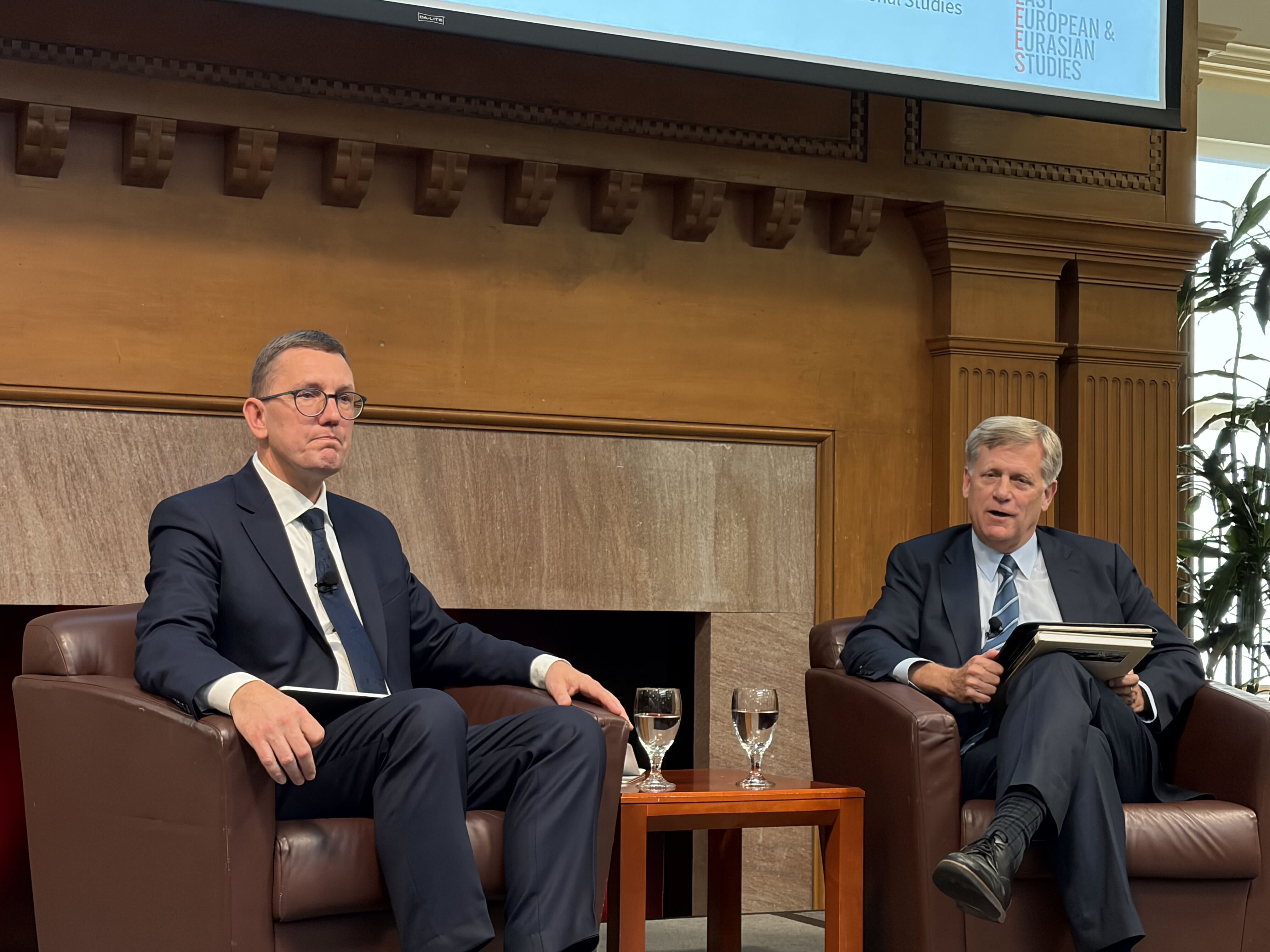
Estonian Prime Minister Kristen Michal elaborated on the country’s security concerns and technological progress at the Bechtel Conference Center on Tuesday.
The event, titled “Estonia at the Front Line: Security, Resilience, and Technology”, was moderated by Michael McFaul, a Stanford professor and former U.S. ambassador to Russia. The hour-long discussion focused on the country’s digitalization, its use of Artificial Intelligence (AI) and the threats Michal believes Russia presents to European security.
Characterizing Estonia at the start of his speech, Michal said that his country is “the eastern flank which is protecting Europe against Russia, and innovating everything.”
Estonia’s advantages and challenges, the prime minister claimed, are those relevant to other smaller countries in the world. “The main question is that if you are a small country, how can you be free, competitive, relevant to the world, which is becoming more dangerous and changing fast?” he said.
As a small country, he noted Estonia has the ability to change quite rapidly. “Resilience is not resistance to change,” he said, speaking of his country. “You can take what is valuable, and change what is needed.”
Michal elaborated on how Russia remains a security threat to Estonia and its fellow European countries. On the evolution of the North Atlantic Treaty Organization’s (NATO) defense technology ecosystem and its preparedness in light of the Russian invasion of Ukraine, he noted that “the problem is that Russia still outproduces Europe”. “[The European military industry] is not on the level I … would like to see,” he said, expressing his belief in the necessity of a “Europe that America also can count on.”
As an example of the threats Russia presents, Michal praised Ukraine’s rapid innovation when it came to their military, while arguing that support for Ukraine’s freedom in the face of Russian aggression concerns a fundamental, global question: “Is there a rule-based world in which every nation, everybody, decides its own future?”
Estonia has also faced its own security concerns, including a recently thwarted sabotage operation in the country that Michal previously attributed to Russia’s military intelligence. The prime minister stressed the importance of keeping pressure on Russia, including through border restrictions.
Michal’s talk also touched on technological advancement for Estonia. He described the country’s success in becoming a very “tech-savvy” nation, claiming that about 100% of all services are online. “In Estonia you can get married and divorced online,” he said, drawing laughter from the audience.
Michal also pointed to AI’s transformative and beneficial impacts at the national scale. He said that about a third of secondary education in Estonia already uses AI for “helping to think and learn, not giving easy answers,” characterizing this as a Socratic approach.
In medicine, meanwhile, the prime minister said that AI already permits doctors to worry less about taking notes and focus more on interacting with patients. Estonia could soon be the first country in the world to have registered AI agents acting officially on behalf of individuals, he said.
Michal believes that this may just be the beginning, and that there will be a “second wave of physical AI,” in this case consisting of robots and driverless cars. In light of this, he pointed to the necessity of what he characterized as “cyber-hygiene”. “This is still a tool for humans to use, not [to] replace humans,” he said of AI, stating that the technology must first and foremost be beneficial to consumers.
During the later Q&A with the audience, Tomas Klima ’30 asked how European countries can “win the race against China in technologies, but still keep our strong institutions and democracy.” The prime minister pointed out that Estonia’s high technological integration did not stop it from being a very democratic state, but highlighted the need to balance innovation and capitalism with public liberties in the future.
“This is not against innovation. This is like using the innovation for [the] common good,” Michal said. “We are trying to do this, and also preserve everything that is liberal.”
In response to another question on the phrasing of Article 5 of the North Atlantic Treaty — which states that an attack on any NATO member is equivalent to an attack on all NATO states — Michal highlighted that the consequences of each attack must be discussed before any action is undertaken.
“Should it be remaining ambiguous? Somewhat it has to be, because all the threats are new,” he said. “Ten years ago we wouldn’t even be discussing [if] a swarm of AI agents [can] do something that is already crossing the threshold of Article 5.”