
The National Labor Relations Board (NLRB) dismissed Stanford’s request to reconsider the Board’s previous Columbia decision, which established graduate student workers at private universities as employees nationwide.
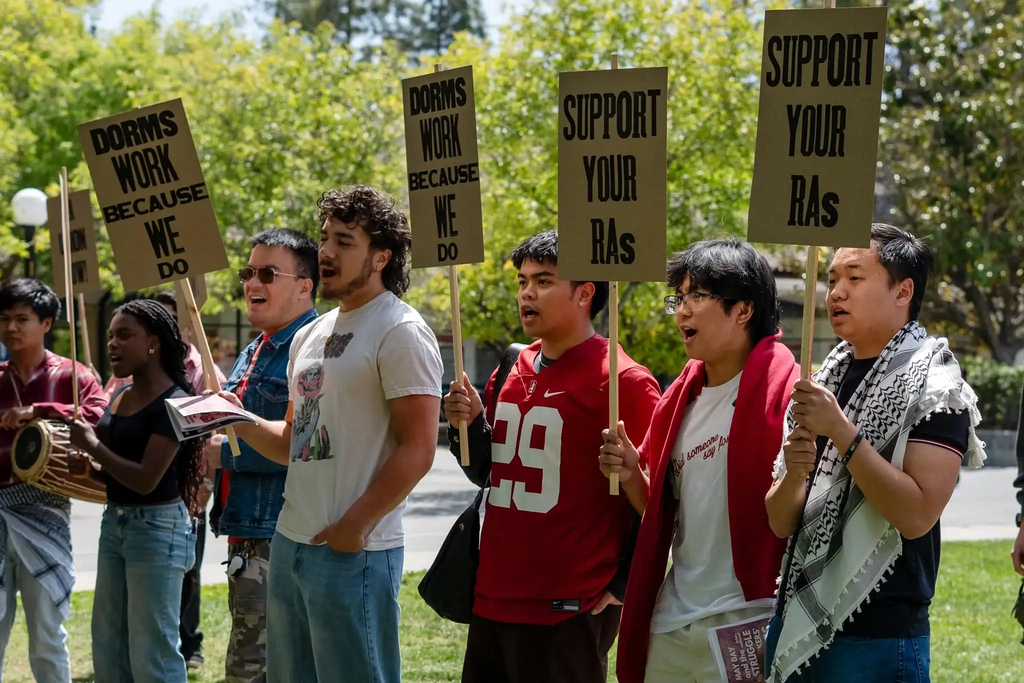
The move marks the conclusion of the latest wave of unionization efforts by the Stanford Resident Assistant Union (RAUR), which had withdrawn its Oct. 8 vote to unionize over concerns Stanford would attempt to overturn Columbia. In Stanford’s request for review of the regional decision which approved RAUR’s union election, the University called for Columbia’s overruling, arguing the case failed to consider “‘the enormous complexity’ of a university setting.”
Beyond RAUR, the Columbia precedent affects other on-campus groups. Stanford Graduate Workers Union (SGWU) relies on the decision in order to organize as a statutory labor organization. SGWU faces upcoming negotiations with the University to determine the details of its next contract, as the current contract is set to expire in 2027. The negotiations are expected to focus on cost of living, cost of healthcare, and job security guarantees, according to an SGWU website.
“[Columbia] is the ruling that legally requires Stanford to bargain with us and recognize us as a union,” said Liam Sherman, SGWU member and a fourth-year Ph.D. student. “[Columbia’s overturning] would be one of the largest losses of collective bargaining rights in recent U.S. history.”
Despite RAUR withdrawing its request for an election to unionize, the University had moved forward with its request to review the now-cancelled election. In a letter to the NLRB, the University reiterated its stance that groups such as RAUR did not represent university employees. “[RAUR’s withdrawal] raises multiple substantial questions of law and policy on which there is no on-point Board precedent,” including “whether undergraduates holding leadership roles in on-campus housing… are ‘employee[s]’,” the University wrote.
“We were definitely disappointed [by Stanford],” said Jacob Bowers ’28, a member of RAUR’s organizing committee, referring to the University’s refusal to withdraw their request for review. “At this point, they really don’t have much to gain from [refusing to withdraw the petition], aside from taking the rights away from unions nationwide.”
Stanford justified its refusal to withdraw their request for review to the NLRB using precedent set in a 1950 NLRB decision on the case of Munsingwear, Inc. Munsingwear determined that whenever a case becomes moot in the process of adjudication by “happenstance,” like RAUR’s petition withdrawal, the national board would vacate the regional board’s decision. Stanford argued that, as such, their case should be redecided at the regional level.
“We understand the Board’s decision and appreciate that the Board confirmed that the previous decision by its regional office [in this case, to approve the election] is not binding on any potential future cases,” University spokesperson Angie Davis wrote to The Daily. “The unionization case before the NLRB has concluded, and we do not expect further proceedings in it.”
According to Jackie Correy ’27, a RAUR member, the Board’s composition of largely Trump-appointed and less labor-aligned members added difficulty to the union’s plans. She cited the recent midterms as a potential reason the NLRB had ruled against Stanford and emphasized solidarity with RAUR and other organized labor against Stanford’s “very collaborative stance” with the Trump administration.
Despite the ruling, RAUR intends to continue organizing even without recognition as a statutory labor organization. Bowers mentioned protesting, picketing and “hold[ing] the trump card” of striking as means the organization still has to pressure the University.
“Union organizing is not something that begins or ends with legal recognition. It’s forever going to be a fight, whether we’re legally recognized or not,” Bowers said.