
Thaddeus “Tad” Taube ’53 M.S. ’57, whose philanthropy transformed the tennis and Jewish studies programs at Stanford, died in his home in San Mateo County, Calif. on Sept. 13, 2025. Taube was 94 years old.
Taube built his career in real estate, co-founding the now $7 billion management firm Woodmont Companies with his Stanford roommate before turning his focus to philanthropy. He began his own foundation, Taube Philanthropies, in 1981 and served as president of the Koret Foundation for three decades.
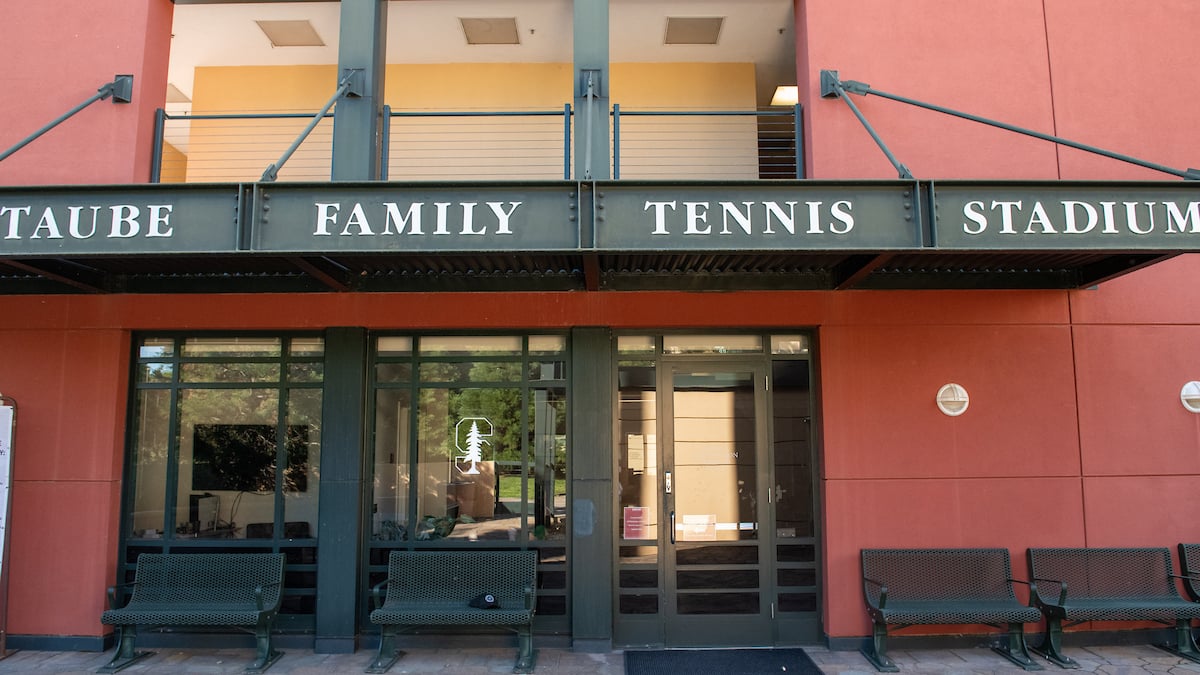
At Stanford, Taube obtained degrees in industrial engineering and competed on the freshman tennis team. Driven by his lifelong love of tennis, Taube contributed $2.5 million to build the Taube Family Tennis Stadium and $3 million to endow the men’s tennis head coaching position.
In its two decades, Taube Stadium helped elevate Stanford tennis into what longtime men’s tennis head coach Dick Gould called a “first-class organization.” The venue hosted four women’s National Collegiate Athletic Association (NCAA) Championships, two combined NCAA Championships, and the 1999 Federation (Fed) Cup final between the U.S. and Russia. Legends like John McEnroe, Bjorn Borg, Venus and Serena Williams, Jimmy Connors, Mats Wilander and Lindsay Davenport all graced the courts before the facility was replaced by the Arrillaga Family Tennis Center in 2024.
“You can’t have a successful program without a couple people who really believe in what you’re trying to do,” Gould said. “We could never have accomplished what we did in terms of successes and wins and losses without his philanthropic help.” Gould is the most successful coach in Stanford men’s tennis history.
Born in Kraków, Poland, Taube immigrated to the United States in the summer of 1939, just weeks before the German invasion of Poland. Having lost 80% of his family to the Holocaust, Taube also dedicated his life to enriching Jewish life in the United States, Israel and Poland.
In 2001, Taube Philanthropies pledged $2.5 million to expand Stanford’s Jewish studies program. The gift, Taube told Stanford Report, was the culmination of “15 years of effort and personal involvement with Jewish Studies at Stanford.”
Now, the Taube Center of Jewish Studies offers students and faculty opportunities to engage deeply with Jewish history and culture through its degree programs, lecture series and library collections.
“The issues of Jewish peoplehood and the fight against antisemitism remained central to him throughout his life,” wrote Vered Shemtov, faculty director of the Taube Center, in an email to The Daily. “At the last fall gathering he attended, he spoke about the resurgence of antisemitism, and I remember how deeply saddened he was by its return.”
His initial donations in 1986 helped Stanford acquire the $1 million Taube-Baron collection — nearly 20,000 scholarly volumes on Jewish history, culture and religion. Later, in 1994, the Koret Foundation granted $50,000 to help the University obtain 20,000 rare Hebrew books from the library of Israel Cohen. Taube also made generous donations to Stanford’s Chabad and Hillel houses.
“What struck me most was his profound respect for the independence of academic work,” Shemtov wrote. “He understood and valued the freedom of research and teaching.”
That respect extended to healthcare, where he invested millions into Stanford Medicine research on youth addiction, concussions and childhood cancer.
In 2018, Taube and his wife, Dianne Taube, contributed $20 million towards the construction of Taube Pavilion in the new main building of Lucile Packard Children’s Hospital. Home to the hospital’s intensive care, bone marrow, cell therapy and hospice care units, the pavilion made a “special impact on children with cancer,” according to Dennis Lund, interim president and CEO of the hospital at the time.
Beyond his generosity, Taube is remembered for his mentorship.
“He taught me how important it is that when you’ve been successful in your work, how important it is to then give back to the community in ways that other people can’t,” said Harvey Cohen, professor emeritus of pediatric oncology. “And he’s both shown through his example and his encouragement how I and others can do the same.”
Shemtov recalled a moment after completing her first term as co-director of the Taube Center where faculty and staff gathered for a celebration lunch.
“Despite his many obligations and countless philanthropic commitments, Tad came in person, gave a heartfelt speech, and offered me a warm hug,” Shemtov wrote. “That gesture — simple yet deeply meaningful — captured the warmth, attentiveness, and humanity that characterized him. While he should be remembered for what he did for the community, this is something that I remember with gratitude personally.”
Taube is survived by his wife, Dianne, and children Mark, Paula, Sean, Juddson, Travis and Zakary.