
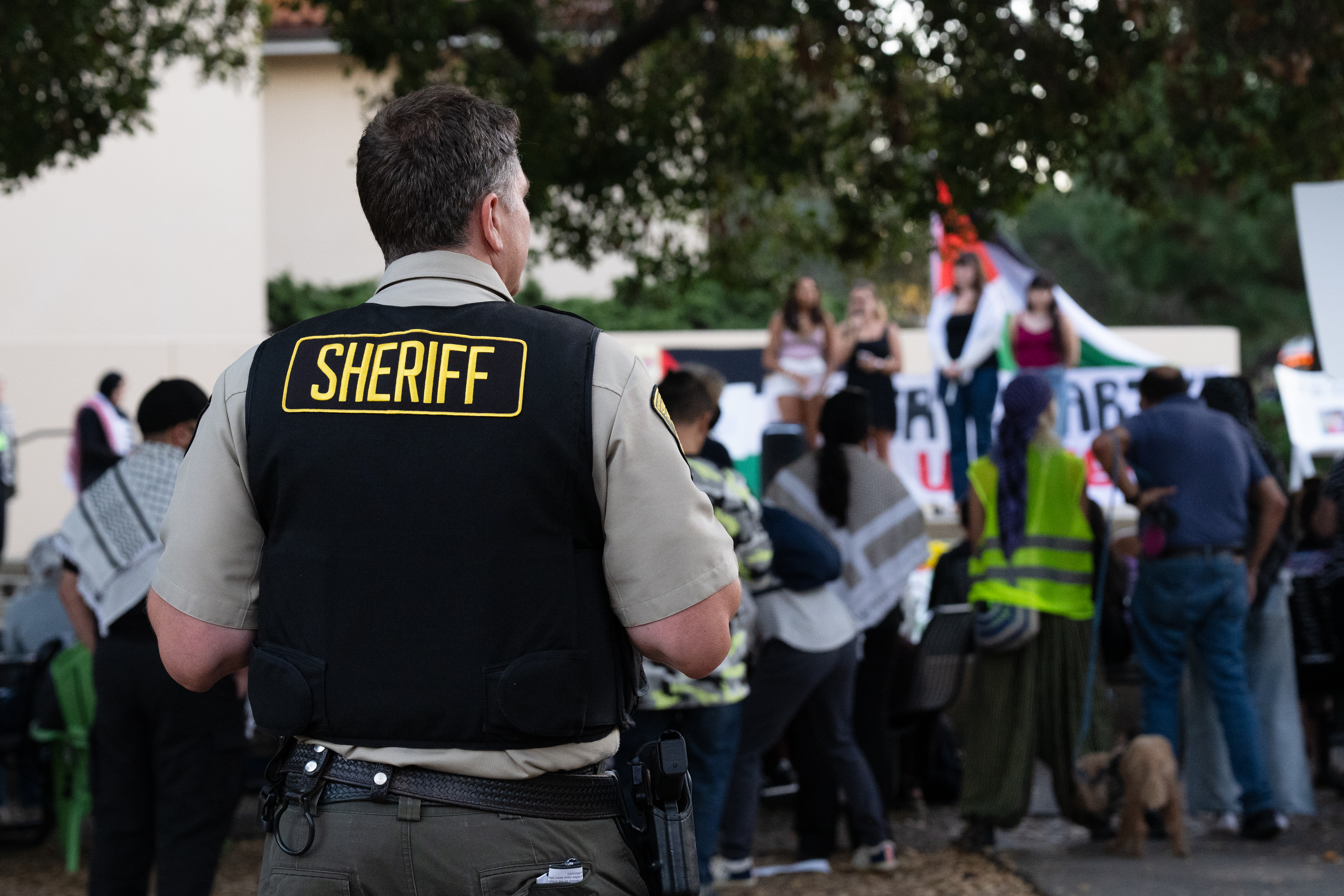
Stanford University has long affirmed its commitment to freedom of expression — the belief that even the most difficult and unpopular ideas must be open to discussion in an academic community. That principle is essential to learning and democracy, and it applies equally to every group and viewpoint. At the same time, the exercise of free speech carries moral weight and community impact. This is why we, as members of the newly established Stanford Community Forum on Antisemitism and Anti-Israeli Bias (a self-organized initiative of Stanford faculty, students, staff and alumni), find it necessary to explain why we condemn the flyers that Students for Justice in Palestine (SJP) has been circulating calling for a White Plaza “Vigil in Honor of Our Martyrs” on Oct. 7.
We recognize that even hateful speech is protected under the First Amendment if it does not constitute a true threat, call for violence or meet a high legal bar for harassment. We accept that the University cannot ban a rally around such speech if it complies with these minimum requirements and comports with the University time, place and manner rules. But we also note that the Fundamental Standard, along with many other recent statements of Stanford University’s values, calls us as a community to a higher standard of civility and mutual respect. When speech is morally odious, celebrating vile and murderous violence — or using language in a way that can be reasonably interpreted as doing so — students and faculty have an obligation to call it out and explain why it is seriously injurious to the kind of culture and community we should seek to build at Stanford.
In the context of Oct. 7, some understand that use of the term “martyrs” is a reference to the terrorists who were killed while waging terrorist violence against Israel on that day. Using this term in a rally or vigil on Oct. 7 is to celebrate the massacre orchestrated by Hamas on Oct. 7, 2023, the largest slaughter of Jews since the Holocaust. Over 1200 men, women and children were brutally murdered in Israel on that day, including both Israelis and foreign nationals, and 251 were kidnapped. The attack involved the the murder of whole families as well as deliberate maiming and mass sexual violence. The atrocity was recorded and livestreamed by the attackers. 48 hostages remain in Hamas captivity.
SJP flyers circulating in advance of the Oct. 7 anniversary call for Stanford students to “Globalize the Intifada” or “Join the Student Intifada.” We recognize that the term “intifada,” like the generic word “martyr,” can have many meanings, but in a long-running and tragic conflict such as this, context is crucial. While the Arabic term “intifada” connotes an “uprising” or “shaking off,” the phrase contextually has come to be widely understood as a call for violent resistance, as in the First and Second Intifadas in the region, which included suicide bombings in Israel and other acts of terror. Even if SJP does not intend to call for or justify terrorist violence against innocent Israelis or Jews outside of Israel, this kind of refrain has been associated with a rising number of attacks on Jews worldwide, including recently in Washington, D.C., Boulder, Colo. and just a few days ago, on Yom Kippur, in Manchester, England. Free speech protects the right to express even abhorrent views, but Stanford’s values of respect for life, reason and shared humanity compel us to name such expressions for what they are: cruel and cynical distortions of moral conscience. We therefore reaffirm both our unwavering defense of free expression and our equally unwavering rejection of language or actions that dehumanize and glorify terror.
We mourn the heavy loss of innocent life in Gaza and pray that this violent conflict will end in the coming days with the release of all the remaining hostages and a viable plan to reconstruct Gaza and relieve the suffering of its inhabitants. But SJP’s rhetoric will do nothing to end the violent conflict or aid the citizens of Gaza — it can only inflame and exacerbate an already precarious situation, and it does not comport with the standards of honest, frank but respectful discourse that this University seeks to promote.
Larry Diamond is a senior fellow at the Hoover Institution and the Freeman Spogli Institute for International Studies. BA ’73, MA ’78, Ph.D. ‘80.
Jeffrey Koseff is the William Alden and Martha Campbell Professor of Engineering Emeritus, MS ’78, Ph.D. ‘83.
Signed by the following members of the Stanford Community Forum on Antisemitism and Anti-Israeli Bias:
Larry Diamond, Co-Chair, Senior Fellow, Hoover and FSI, BA ’73, MA ’78, Ph.D. ‘80
Jeffrey Koseff, Co-Chair, William Alden and Martha Campbell Professor of Engineering Emeritus, MS ’78, Ph.D. ‘83
Paul Brest, professor and Dean of the law school, emeritus
Shirit Einav, professor of medicine
Kalanit Grill-Spector, professor of psychology
Ari Kelman, professor of education and Jewish studies
Amalia Kessler, professor of law, MA ’96, Ph.D. ‘01
Jessica Kirschner, Senior Rabbi and Executive Director of Hillel at Stanford
Jonathan Levav, professor of marketing, Graduate School of Business
Emily Levine, associate professor of education
Samantha Milewicz ‘27
Ethan Orlinsky ’86, president of the Stanford Jewish Alumni Network (S-JAN)
Rachel Rosten, MA ’19, Ph.D. student, school of education
Gabriella Safran, professor of Jewish studies and of Slavic languages and literature
Aaron Schimmel, Ph.D. student in the department of history
Vered Shemtov, faculty director of the Taube Center for Jewish studies
Jeff Stone, BA ’78, trustee emeritus
Benji Welner ‘27
Matthew Wigler ’19, JD ’25