
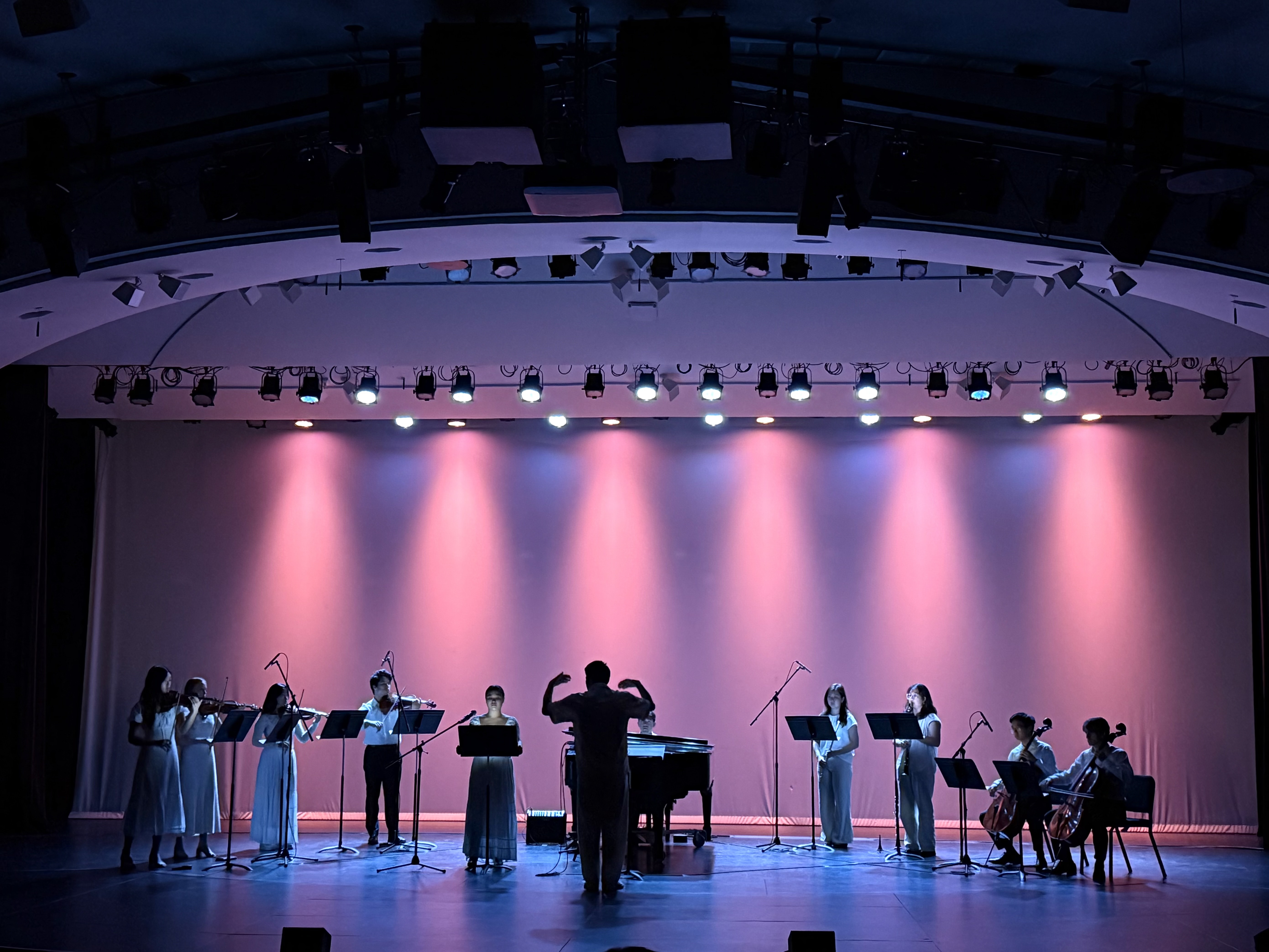
As leaders from science, business and policy united to confront climate change during Stanford’s Climate Week, a group of students reminded the campus of another medium for change — the arts.
On Saturday, 18 student musicians, conductors and dancers gathered for “When the World Breathes Again,” a series of performances that blended movement and music to depict humanity’s relationship with the changing planet. Held in Dinkelspiel Auditorium, the show was one of over 60 events in Stanford’s Climate Week programming, which centered on the theme “Pathways to Impact” this year.
“Numbers are cold, but art is warm,” said co-director and featured composer Howard Qin ’24 M.S. ’26 during opening remarks. “Through art, we feel emotions. The agony from disasters. The hope for recovery. Through art, we unite under this one pathway to impact.”
Conductor Sean Tan ’27 and dancer Eddie Chen ’28 also co-directed the event, spearheading the music and dance acts, respectively.
The evening opened with Qin’s original composition, “La fin de ce monde,” or “The End of the World,” which warned listeners of impending human extinction from unsustainable development.
The composition for strings, flute, clarinet, piano and soprano voice was conducted by Tan and performed by Stanford’s Ensemble OH?, an initiative dedicated to performing and commissioning one student work a quarter. The ensemble aspires to create art and music that makes people go “oh?,” which inspired the name, according to Tan.
Soprano Katrina Franco ’27 laid the scene of a deteriorating environment through lyrics such as “There is no sound except the falling soot / There is no color except the dark dome / There is no feeling except gravity.” The piece used dissonance to represent the unraveling of humanity, eventually resolving into tranquility as Franco sang, “Take me to thy embrace, Gaia [Mother Earth].”
“The Earth has recovered from five mass extinctions,” Qin said. “We could be [victims] of the sixth.”
Music professor Paul Phillips, the Gretchen B. Kimball Director of Orchestral Studies and mentor to several performers, was in attendance.
“I love that our students found a way to make a statement about climate change through music, in a very effective and a very visceral way with that first piece,” Phillips said. “That really represented the tragedy of what’s happened.”
Ensemble OH? followed with a performance of Astor Piazzolla’s “The Four Seasons of Buenos Aires, Winter and Spring” that featured Eric Wang ’26 on solo guitar.
“Music doesn’t have a language, so it connects all cultures and languages,” said local resident and audience member Jash Sayani. “It’s a key for social change.”
While the first half of the evening confronted tragedy, the dance-focused second half offered a more hopeful perspective. Performances of Mereba’s “Rider” and CloZee’s “Black Panther” sought to convey the passion, authenticity and soul that the event’s directors saw as the driving forces behind climate action.
“To engineer any kind of change in the world requires devotion that goes beyond anything you can imagine,” Tan said to the audience. “It requires you to put 100% of your existence, your soul into it. And we musicians, we artists are here to showcase that.”
The evening’s final piece, an original composition by Tan and Lucy Chen ’27, brought musicians and dancers together for the first time. The composition shared its title with the event: “When the World Breathes Again.”
Tan described the opening of the piece as a depiction of “a cosmic rainforest” full of the planet’s oldest sounds — birds, water, wings, air and fire. As Ensemble OH? created the soundscape on stage, five dancers improvised to the music at the back of the auditorium, gradually inching closer to the musicians and bringing the audience into the center of their movement. The piece then transitioned into techno, layering electronic rhythms, vocals and effects in what Tan called the “music of the future.”
“It’s all about coming from your soul,” said director and dancer Eddie Chen, while reflecting on his improvisations. “If you try to fake it, you can’t engage in it. So, when I was improvising, what I was thinking was how would I feel if the world perished? What would that look like? How would it make me feel?”
Phillips said he especially loved the integration of dance and music, adding that he wished he incorporated such collaborations more often when planning programs for Stanford’s orchestras.
As “When the World Breathes Again” concluded and the lights dimmed, the auditorium fell silent. The five dancers faced the audience from the stage, taking slow, collective breaths to close out a piece that encapsulated the objective of the evening — exploring where art meets climate.
Correction: A previous version of this article reported the song lyrics as “There is no color except dark tone” instead of “There is no color except the dark dome.” The Daily regrets this error.