
A few years ago, I started noticing talks about diversity everywhere. My high school had recently launched a new required course for all freshmen called Ethnic Studies, which aimed to diversify students’ knowledge of different cultures by exploring topics such as gender equality, racism and ethnicity. After the death of George Floyd in 2020, I remember constantly hearing news stories about the Black Lives Matter movement and DEI initiatives.
Corporations began making diversity pledges, promising to create a more inclusive workplace and increasing minority representation in their workforce. In higher education, many colleges and universities made statements about their commitment to eliminating racism and discrimination on their campuses and being welcome to everyone. As diversity efforts were increasingly celebrated throughout the U.S., I became interested in discussions about diversity in elite colleges like Stanford. Growing up in the Bay Area, I have always looked up to Stanford as a pinnacle of learning. As one of the most prestigious universities in the world, Stanford is known for shaping future leaders, innovators and policymakers who will contribute to society for decades to come. With the widespread promotion of diversity and inclusion across these campuses, I wondered whether it was actually working. Were universities really moving towards fostering diverse ideas, or just talking about it more?
I decided to find out. I built custom web crawlers in Python to scrape every opinion piece published in The Stanford Daily from 2010 to 2024 — over 5,000 articles spanning 15 years. Stanford has publicly committed to championing diversity through the IDEAL initiative (2018-2025), which aimed to spread diversity and inclusion programs across campus. If the commitment to diverse perspectives was real anywhere, it should be visible at Stanford.
Applying word embeddings, a machine learning technique for transforming documents into vectors in a large-dimensional space, I analyzed each article in my text corpora of opinion pieces. The closer together two articles are in meaning, the closer in proximity they will be as embeddings. To measure the diversity of the ideas being discussed, I implemented a mathematical technique to approximate the volume covered by a span of word vectors for every year. Graphing the results, I compared the trend in the explicit mentions of diversity-related words, like “multicultural,” “equity” and “intersectionality,” with the trend in the actual diversity of ideas.
I found a significant contraction in the idea space of Stanford student discourse, while the number of times diversity-related words were mentioned in opinion articles has steadily increased over the last decade. The topics discussed, the arguments made and the viewpoints expressed have become more similar over time, even as rhetoric about celebrating differences has intensified.
Here’s the paradox: As Stanford students have increasingly emphasized diversity and inclusion, the actual range of ideas expressed has shrunk considerably. Students are talking more about diversity while writing less diverse opinions in The Stanford Daily.
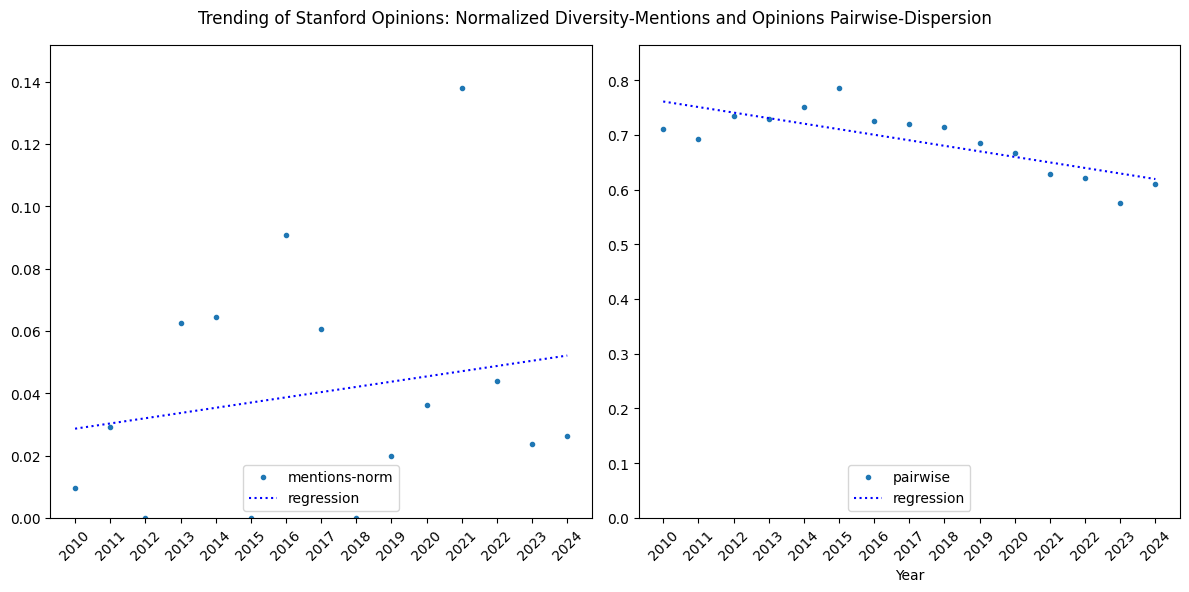
The above left graph plots the (normalized) number of diversity related words per opinion article averaged over all opinion articles in The Stanford Daily per year. The right graph plots the sum of all pairwise distances between the embeddings of every opinion article per year. Dotted blue lines are regression lines. (T. Mui “Semantic Analysis of Diversity Rhetoric and Ideological Contraction in Elite US Colleges,” IEEE International Conference on Artificial Intelligence & Digital Ethics, 2025.)
The gap between explicit mentions of diversity and the reality of narrowing discourse is creating something toxic: cynicism. Expanding upon my diversity analysis, I used Moral Foundations Theory, a social psychological theory proposed by Jonathan Haidt and Jesse Graham, to track the prevalence of language associated with skepticism toward authority, perceptions of betrayal and fairness concerns — key linguistic markers of cynicism. My quantitative analysis of language patterns shows rising distrust in institutions, increasing perceptions of betrayal and growing skepticism about whether universities genuinely value diverse perspectives. When students see their school championing diversity while the space of ideas circulating on campus contracts, they stop trusting not just the school, but the very concept of diversity itself.
Why does this happen?
Several factors could support the relationship between declining diversity and rising cynicism that might feel familiar to students on campus.
First, there’s performative diversity. When colleges advertise their commitment to diversity, it can shift from a genuine value to institutional branding. This could contribute to a belief that institutions are not truly looking out for their students and instead are trying to project a self-image that aligns with the media and certain political agendas.
Second, self-censorship is rising. My analysis of the dataset using Moral Foundations Theory shows that students are increasingly using language around “institutional betrayal” and “subversion of authority.” Students express the feeling that certain viewpoints aren’t welcome. When there is a perceived right way to think and act, people tend to voice only what they think will be accepted rather than what they actually believe.
Third, there is a cynicism feedback loop. When students perceive a gap between diversity rhetoric and reality, they become cynical about institutional intentions. But cynicism itself makes people less open to diverse perspectives. If you believe that conversations you hear are performative, why engage at all? The cynicism that results from narrow discourse further shrinks it.
This isn’t just about opinion pieces. The Stanford Daily opinion section reflects campus culture as a whole. If students continue seeing a widening gap between what Stanford says about diversity and what is actually being done to promote diverse discussions, cynicism will only deepen, making collaboration harder, learning less effective and community building nearly impossible.
This trend isn’t anyone’s fault specifically. It’s a systemic issue that has emerged gradually over recent years. But systems can change, especially when community members recognize the problem and take action.
For The Stanford Daily: Continue actively soliciting opinions that challenge dominant campus narratives, even when editors personally disagree. Consider publishing data on the ideological diversity of submissions to create accountability.
For students: Engage with opinions that make you uncomfortable. Comment, debate respectfully, don’t just dismiss. Real diversity of thought requires courage and stepping out of your comfort zone.
For the University: Make viewpoint diversity an explicit part of diversity initiatives. Create structured forums for disagreement so that students feel that they can openly express their views without being judged.
Real diversity isn’t just about who’s in the room. It’s about what ideas are allowed to breathe in that room.
Theodore Mui is an interdisciplinary researcher and senior at Carlmont High School dedicated to applying advanced artificial intelligence techniques to address complex challenges within the social sciences.