
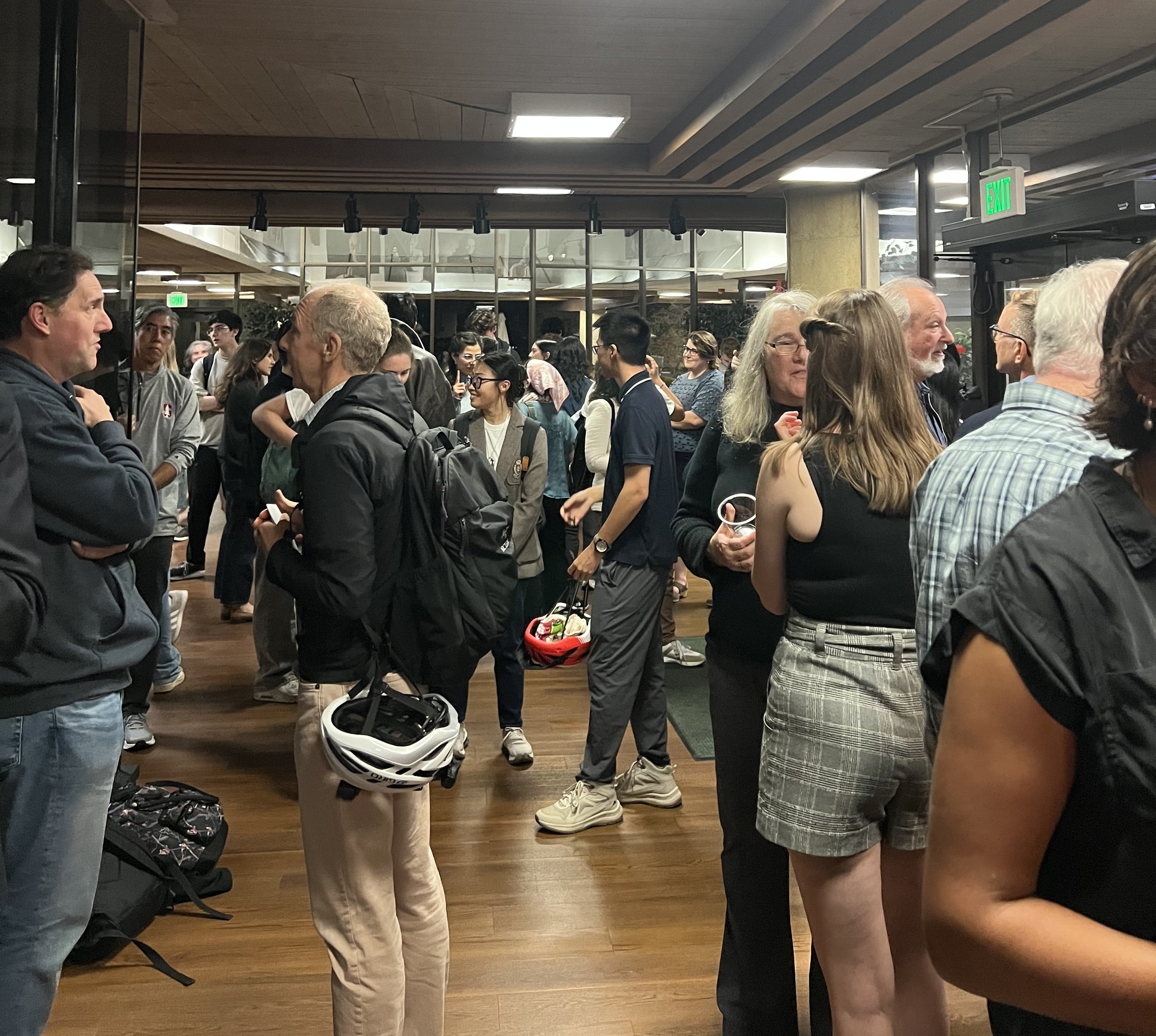
Nearly a hundred Stanford community members gathered on Tuesday evening to discuss civic engagement and the current state of politics in the fifth annual Dine & Dialogue, Democracy Day’s meet-and-greet between faculty and students.
The event featured round-table conversations consisting of several faculty members and students. The discussion, which took place over dinner at the Tresidder Oak Lounge, was centered on the theme of “illumination.”
“We wanted to bring things out of the dark,” said Jesse JudahBram ’27, the lead organizer of Dine & Dialogue. “We’re working on bringing in a wide variety of faculty –– not just people in political science but people in human biology, economics… across the spectrum.”
Haas Center for Public Service director Juliet Brodie hosted a reception for participating faculty members prior to the dinner. To kick off the event, Democracy Day chair Keira Chatwin ’27 and political science professor Larry Diamond delivered opening remarks. Following the speeches, students conversed with lecturers, post-doctoral fellows and professors over Caribbean food.
Hoover Fellow Milan Quentel said that the night served not only as an evening of dialogue but an opportunity to deepen existing relationships through political debate.
“In the U.S., sometimes, there is not much political debate in public spaces,” Quentel said. “You have to create it a little bit. But if the two of us, for example, have a debate at some point, like through Democracy Day, it’s so much easier to have it again.”
Dine & Dialogue hosted faculty members from a range of departments. The event aimed to emphasize the importance of disciplines beyond political science and draw students from other majors who may be less attentive to politics.
“The student I most want to see at an event like Dine & Dialogue is a straight-up, purely STEM kind of person,” said Mandarava Jamyangling-Kawaguchi ’27, a Democracy Day organizer who led humanities-related faculty recruitment for Dine & Dialogue.
Jamyangling-Kawaguchi hoped that the varied backgrounds of faculty attendees at Dine & Dialogue would encourage students of all academic interests to join in political discussions. At Stanford, she said she noticed an appearance of political interest “where there wasn’t much discourse going on, actually.”
Attendee Hanbo Xu ’29 noted that events like Dine & Dialogue, while adequate forums for political discussion, might struggle to garner the attention of certain students.
“The people who show up here more or less care about political engagement,” Xu said. “But, for many people, that Google internship is more important.”
Brodie, who works with law students and undergraduates, said it’s easy for students to lose focus on political involvement.
“If you’re not personally under threat from these democratic threats, there’s a rationale, like, well, nothing’s going to change if I do or don’t go to any particular event,” Brodie said. “Apathy can come from a place of not knowing how you can be effective.”
Jamyangling-Kawaguchi hopes that increasing Democracy Day’s outreach to “faculty members that aren’t primarily political science or public policy” will help improve student participation in political discourse by removing some of these barriers.
To this end, she said, the organizers tried to make events tailored to particular interests, like a poetry submission portal for feature democracy-related written work and speaker events on democracy in healthcare and climate change. Jamyangling-Kawaguchi described these events as “easier-to-bite” for students who may feel nervous about engaging otherwise.
The push towards crossing disciplines was intended to give people “the feeling like they can make a difference,” Chatwin said. The event’s crowd spanned departments, and an overflow of interested undergraduates required a last-minute addition of tables and chairs.
Campbell McClellan ’28 and Diya Bhattacharjee ’28, who sat at a table with political science professors Diamond and Terry Moe, both came to the event interested in learning more about political science and international relations.
“I learned more from that event than I have in a while. I just feel like the depth and openness to discuss any topic was really unique. It’s the kind of opportunity I would love to see more of at Stanford,” said McClellan.