
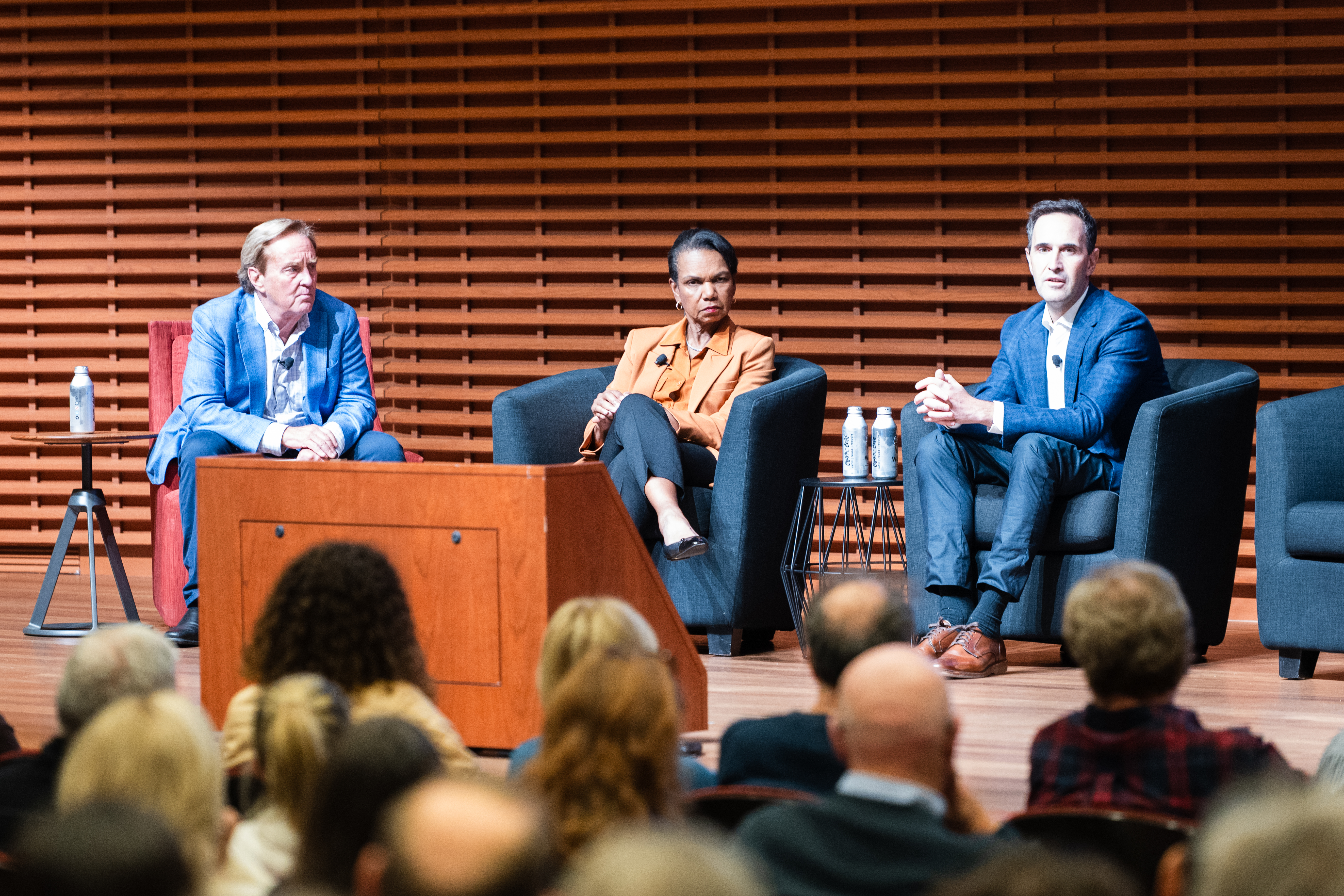
University president Jonathan Levin ’94 and Hoover Institute director and former Secretary of State Condoleezza Rice joined a panel on Monday evening to discuss the current status of American higher education and campus culture.
The panel, titled “The State of American Universities,” came as a part of the POLISCI 31 speaker series moderated by Common Sense Media CEO and professor Jim Steyer. The panel, which later included three current students joining the panel on stage, started with a discussion of Stanford leadership under the current administration, which Steyer characterized as “the era of misinformation.”
University leadership faces “multiple concerns” under this era, including providing resources for students of all backgrounds and advocating for universities collectively, Levin said.
“What makes university research different from company is the freedom here,” he said. “And it is this freedom that will make universities thrive for decades.”
Rice argued that universities should serve as marketplaces for ideas. She championed Stanford and other elite research universities as the innovation engine of the U.S.
Levin aded that while Stanford is out-GPUed by some of the largest tech companies in Silicon Valley, the University will “win by people.”
“The University does not have a private business model… We let people bounce into each other,” he said.
Moving into the broader political climate, Steyer asked about the dual pressures on universities, touching on the “Columbia situation” — referring to threads on funding and free speech — as well as the Trump administration’s pressure on affirmative action, which forced some universities to turn over sensitive student admission data.
“I don’t answer to hypothetical questions,” Rice said. When asked about what Stanford would do if targeted the same way Columbia and others have been, she said she “can’t judge on all these different circumstances”
She added that she was “appalled” by the general lack of understanding of the Middle East on college campuses. She noted she had “worked hard in” the region, flying there 24 times during her time as Secretary of State.
Rice and Levin also emphasized the importance of “other aspects” of diversity. Levin noted that the University has prioritized “diversity of opportunities,” with domestic students in the bottom 80% of the U.S. income distribution paying zero tuition and 90% of students graduating with no student loans.
“Some of what has been defined as diversity… is actually exclusion,” Rice said, pointing to her upbringing in a highly educated Black family compared to the upbringing of an Appalachian child. “Would I feel uncomfortable on a college campus [as an African American]? It is not just about race.”
Student representatives including Daily Opinions managing editor Jennifer Levine ’28, Joe Nail MBA ’26 and Mandla Msipa ’26 joined the panel to discuss the political atmosphere on campus.
Msipa — who is a dual citizen of Zimbabwe and the U.S. as well as a Residential Assistant (RA) at Hammarskjöld House, the international student themed dorm — also asked the president what he is doing to protect international students in a climate where many say they do not feel protected.
Levin said that while the University would engage in other actions to ensure the rights of international students, such as lawsuits, it would remain in full compliance with federal laws regarding immigration.
“There is no way that this country would be the leading country of the world if it does not welcome immigrants,” he said.
Drawing from her experience as an editor, Levine argued for the importance of encouraging the exchange of different opinions on campus.
“Student conversation is important… Their opinions should be [ready to be] challenged,” she said.
Msipa shared that he was grateful to see active political participation from students, pointing to the ability for pro-Palestinian and pro-Israeli tents to sit across from one another for most of the 2023-24 school year “without throwing a punch.”
“I just wanted to ask [the protesters], from which river to which sea?” Rice responded, stressing the importance of students “being informed” on what they are protesting.
Nail said that a campus monoculture stops students from expressing their own opinions. The current ratio between conservative students and liberal students on campus is 5.33 to 1, he said. He shared that a student he met at an event hosted by the Stanford Political Union — a non-partisan student club that hopes to fostering constructive dialogue — told him, “you are the first conservative I met who is not a fascist.”
Levin urged the audience to question, “Why are we here?” He said that students come to Stanford to learn and challenge the orthodox, but it is also important to uphold the spirit of Ted Lasso: “Be curious, not judgmental.”