
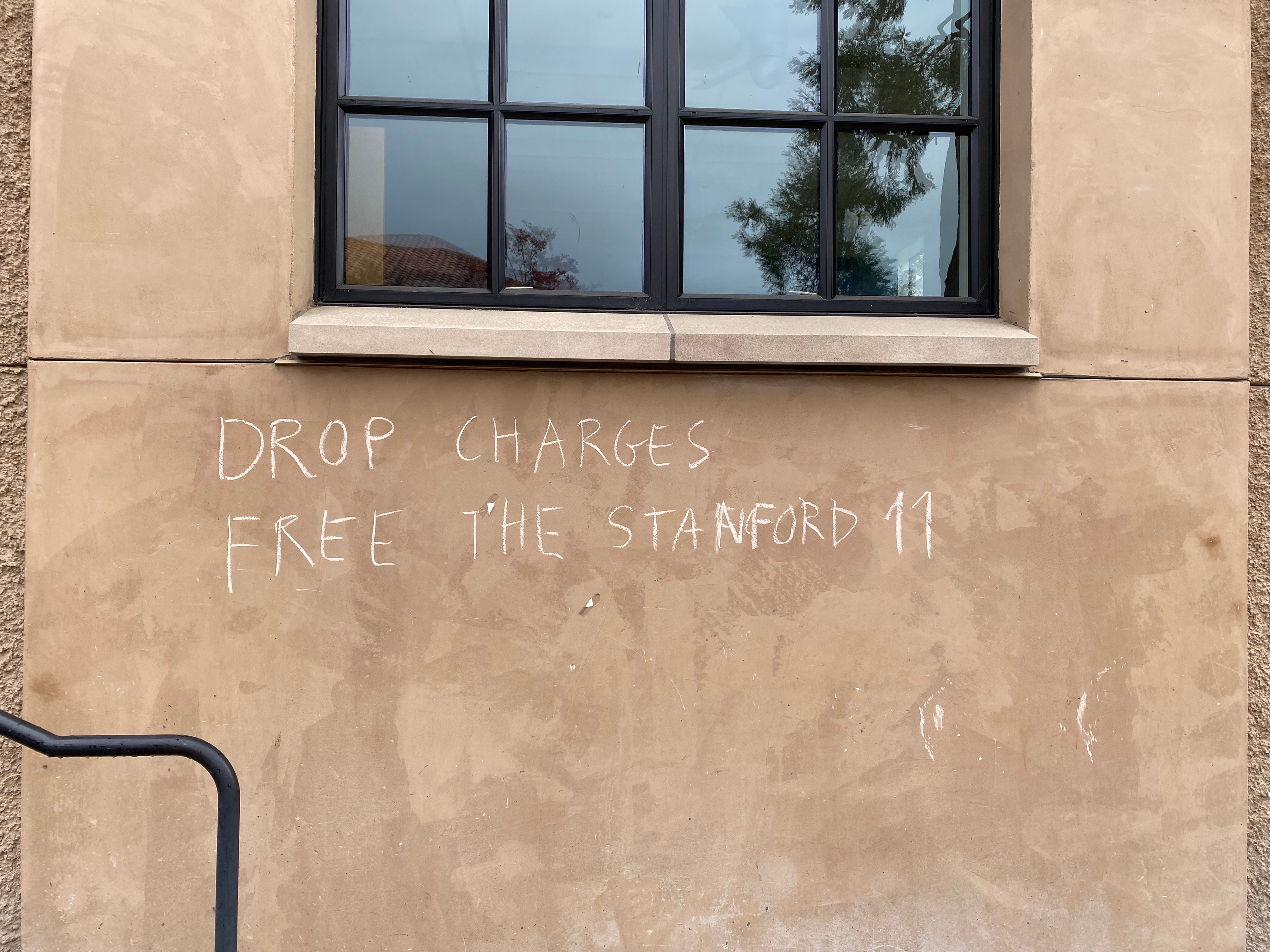
The Stanford 11 students’ case is not merely an internal dispute over campus policy, but an unprecedented legal assault designed to criminalize dissent. Understanding the facts of the criminal case against the Stanford 11 demonstrates how the very university we attend weaponizes its privilege, power and wealth to chill dissent and student activism, and how District Attorney Rosen’s office is leveraging its prosecutorial discretion to disproportionately punish and criminalize student protest.
Since October 2023, student protestors have demonstrated against the genocide of Palestinian people through rallies, walkouts, teach-ins, encampments, hunger strikes and negotiations with university administrators. They argue that Stanford’s ongoing investments in companies with financial ties to Israel directly violate university policy on investment responsibility, pushing for divestment.
The June 5 occupation of Building 10 followed in this long line of broader efforts by students to organize, not from personal interest or malice, but from a realization that escalating tactics were necessary to call attention to Stanford’s moral inconsistencies.
Rosen is now charging 11 students with felony conspiracy to trespass and felony vandalism. They face up to three years and eight months in prison, or alternatively, $329,000 in restitution payments and community service in exchange for pleading guilty. The trial is set for Nov. 17.
Rosen is the only prosecutor in the country who has brought felony charges against pro-Palestinian student protestors. In June 2024, New York prosecutors dismissed misdemeanor criminal trespass charges against the majority of Columbia University student protestors who occupied Hamilton Hall, citing insufficient evidence and probable cause. The 13 defendants who participated in the protest but were not enrolled in Columbia accepted an offer from the Manhattan DA’s office that resulted in full dismissal of charges following a six-month probationary period and completion of an in-person class on “peaceful and legal protesting.”
The Michigan Attorney General dropped charges against seven University of Michigan students arrested for trespass during a May 2024 pro-Palestine protest, and the LA City Attorney’s office declined to file charges against the vast majority of the hundreds arrested at UCLA and USC campuses during the spring protests, citing insufficient evidence.
The decision to bring any level of criminal charge is a question of prosecutorial discretion that most other prosecutors have elected not to pursue. But Rosen elected to bring not just misdemeanor, but felony charges. Both felony vandalism and felony conspiracy to trespass charges are legally considered “wobblers,” meaning they could have been filed as misdemeanors. Rosen chose to seek the most punitive convictions possible.
Additionally, this case involves the weaponization of restitution, intended to provide financial compensation to a crime victim. The amount that Stanford is demanding is far greater than justified by any publicly available documentation.
Stanford’s Facilities Director for Lands, Buildings and Real Estate, Mitch Bousson, testified that he estimates the following damages: repairs to a grandfather clock ($1,000), repairing and replacing the broken window ($2,666), and repairing a doorframe and door ($6,305). His estimate comes nowhere close to the $329,000 that Stanford is demanding in restitution. Other damages were caused by Stanford law enforcement officers who forced entry into the building even after protestors communicated that they would exit peacefully, according to court filings.
The state also issued felony charges through a grand jury proceeding rather than a preliminary hearing. A grand jury proceeding is a private, secretive proceeding: only the prosecution and grand jurors were permitted to be present. The defendants had no right to appear, present evidence or cross-examine the prosecution’s witnesses.
The grand jury hearing transcript remains closed to the public, meaning no other information on repair costs is available. Given that the restitution is set at such a high sum and would pose a significant financial burden to the students involved, Stanford and the DA’s office should provide receipts or payment invoices that irrefutably prove the actual damages amount to the sum requested.
It has been over a year and a half since the occupation of the president’s office. Most other pro-Palestinian student protestors were charged at the time of their protests, over a year ago. Rosen stands alone in bringing these charges in April 2025, almost a year after the occupation happened. Defendants have been in agonizing limbo ever since.
The students have already gone through disciplinary proceedings brought by the University before Rosen filed charges. Students faced suspensions, deferred degrees and loss of health care, housing and scholarship grants. They have also experienced online harassment and death threats according to their testimonies.
Stanford has acted as an active collaborator in this politically-driven prosecution. The university implemented a surveillance campaign against protestors, hiring a private security firm to surveil the pro-Palestine encampment. Cameras were installed in White Plaza in the context of a broader effort to surveil students. The University admitted that they used “camera footage, eyewitness testimonies, and social media posts” to identify students.
In a typical criminal investigation, complainants do not direct the police investigation. But according to court filings, Stanford shared disciplinary records and hearing information with the Department of Public Safety (DPS) and Santa Clara DA after the occupation.
Also according to court filings, multiple cell phones and a camera in the possession of the Stanford 11 were taken into evidence. DPS and Rosen’s office transferred these belongings to the United States Secret Service (USSS), rather than to the Santa Clara County Crime Lab, breaking from typical procedure. USSS broke through encryption to access text messages that form the basis of the felony conspiracy charges.
Rosen’s punitive prosecution and Stanford’s complicity have fused to create a legal strategy that charges protected civil disobedience as felonious behavior. We must rally in defense of the Stanford 11 and demand that DA Rosen drop the charges against them to protect the constitutional right to free speech, the right to assemble and organize and the right to demonstrate and fight for justice.
These students and alumni are young people with bright academic futures and entire lives ahead of them. Felony convictions will follow these students permanently, making it difficult to obtain housing and precluding them from pursuing employment and career opportunities.
To stand up for these protestors, sign this petition and take action through this toolkit. Call DA Rosen’s office to support dropping these unprecedented charges, and call Stanford to demand that they lower their baseless restitution claim.
Sarah Jung is a Stanford Law School (SLS) JD Candidate (2L), and Mohamed Nur is an SLS JD Candidate (2L).