
In 2009, Piya Sorcar M.A. ’06 Ph.D. ’09, freshly graduated from Stanford’s Graduate School of Education, flew to India for a brief five-minute meeting with a Bollywood actor between filming scenes on a movie set.
Sorcar, now an adjunct professor at Stanford School of Medicine and an adjunct lecturer at the Graduate School of Education, wrote her dissertation thesis on “teaching taboo topics without talking about them.” Her research exploring how people learn and how to meaningfully shift attitudes and behaviors became the foundation for TeachAids, her nonprofit dedicated to creating culturally sensitive HIV/AIDS educational software tailored for at-risk youth globally. She was hoping to recruit Nagarjuna, a renowned local actor, to lend his voice and likeness for an animated cartoon character.
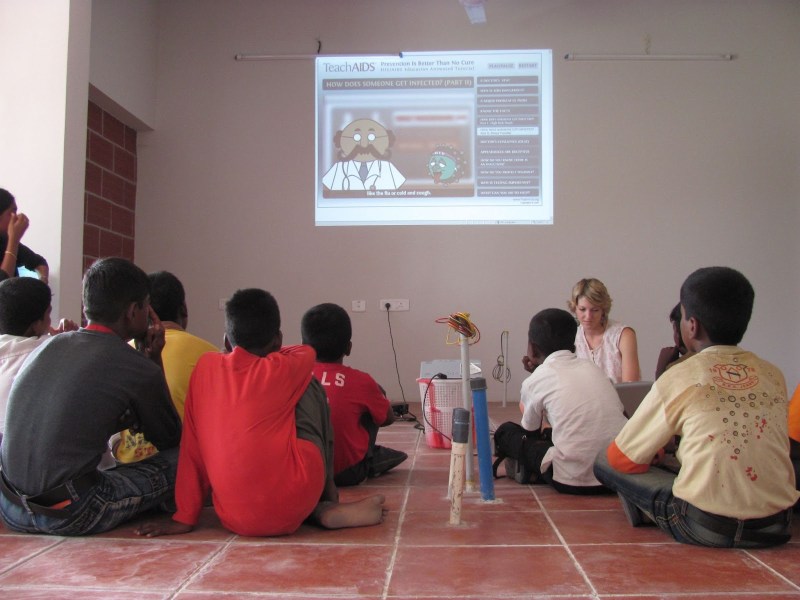
AIDS, or acquired immune deficiency syndrome, is the most advanced stage of infection by the human immunodeficiency virus (HIV), commonly transmitted through unprotected sexual intercourse, breastfeeding and sharing needles during intravenous drug use. Sorcar had read about sex education being banned in parts of India, with materials publicly burned by school teachers. But during this trip, the full gravity of the situation hit her: children were being expelled simply for being HIV-positive in Andhra Pradesh, home to over 53 million people.
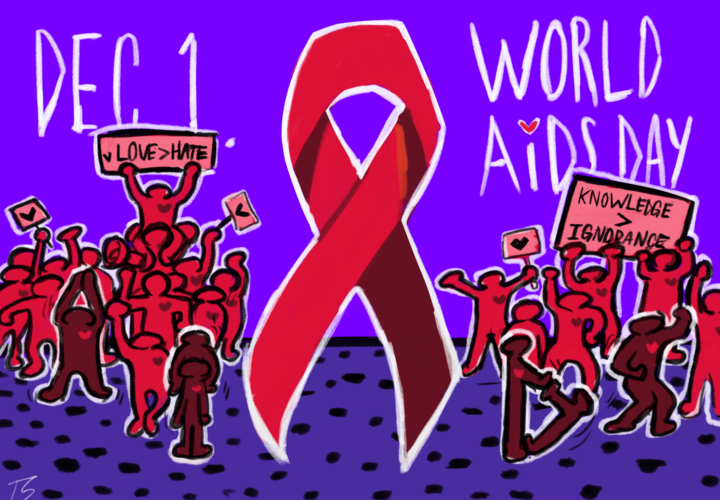
Today, Dec. 1, 2025, marks a pivotal moment in the global fight against AIDS — this is the first year since 1988 that the U.S. will not be joining the rest of the world in formally commemorating decades of struggle and medical progress on World AIDS Day. Just a few days ago, the Trump administration banned State Department employees from publicly promoting observance of the commemorative day, or using any government funds to do so.
The administration’s justification, “an awareness day is not a strategy” to save lives, is a sentiment many believe echoes the early and critical days of the epidemic. During times like these, we must also demand our peers, supported by the institutional heft of Stanford, commit to a renewed wave of advocacy.
I spoke to Paul Wise, professor of child health policy and of pediatrics at Stanford School of Medicine, and asked him: beyond the administration’s resistance to recognizing World AIDS Day, what makes the global fight against AIDS especially relevant at the halfway mark of the decade?
Wise pointed to significant global health program funding cuts. The United Nations (UN) settled on a goal to beat AIDS globally by 2030, but American aid withdrawal is projected to cause 2.9 million more HIV-related deaths by 2030.
“The reduction in funding for global health programs is associated in part with the diversion of societal resources in the West to military buildup,” Wise said. He also notes a shift away from multi-national initiatives like the World Health Organization (WHO) in favor of bilateral relationships.
Wise pointed out that “violent conflict continues to grow globally,” explaining how instability disrupts the infrastructure of community life needed to prevent infectious outbreaks. Individuals with AIDS have severely damaged immune systems and are especially vulnerable to infection. Without treatment, patients with AIDS typically survive three years, and an AIDS-related death occurs about every minute globally.
What makes our generation the most equipped to salvage this movement? As a new Stanford alumna, I’ve often questioned my ability to make a difference without a decades-long career under my belt.
“As more knowledge about HIV/AIDS was generated, it became clear that there were biases affecting our response,” Wise said. Early in the epidemic, there was a widely-held misconception that developing countries like rural Haiti lacked financial means and infrastructure of more industrialized nations to successfully support the implementation of antiretrovirals (medications that reduce the HIV virus in the body and risk of transmission). Scientists proved otherwise in 2001. Yet in 2025, we harbor a parallel bias towards these countries’ intellectual capacities — not only in their responsiveness to medical education, but also in their ability to successfully integrate it within local communities.
By spearheading partnerships with local NGOs, national governments and global institutions, Sorcar dedicated her career to addressing this bias, leading a coalition of thousands disseminating comprehensive and culturally-sensitive HIV education in 27 languages across 82 countries.
Learning from the success stories of these physicians and educators, if we each take our unique specialties and apply them to our areas of interest, we can make miracles happen. This begs the question: What now? What are the next steps we can take?
Tina Seelig, Ph.D. ’85, lost her best friend to AIDS. Now, she sits as an advisor for TeachAids and directs Stanford’s Knight-Hennesy Scholars Program, the largest fully-endowed, university-wide graduate fellowship in the world.
“There is no shortage of problems to address in the world,” Seelig said. “Passion follows engagement — early efforts might appear small, but can compound over time.” In alignment with the lessons of her upcoming book, “What I Wish I Knew About Luck”, Seelig recommends that, as Sorcar did with Nagarjuna, students make small, easy requests targeted to advisors they hope to recruit for projects.
Regardless of your discipline, you can make a difference in global health. As a Stanford student, you have access to a plethora of courses and programs with renowned faculty who may later become your mentors. Upon graduation, you might consider applying to be a Knight-Hennesy Scholar or Global Health Fellow with TeachAids.
At its core, the question “Why World AIDS Day?” is the same as “Why global health?” HIV knows no borders. If allowed to run rampant in the developing world, there is no guarantee that the virus won’t mutate into newly drug-resistant strains that can enter U.S. soil. In our increasingly interconnected world, AIDS has increasingly dire consequences for global security and economic development.
“This is an issue that could have spun out of control. But since HIV/AIDS isn’t airborne like COVID-19 for example, the world has had the opportunity to respond,” Sorcar said. Our peers, as educators, activists and scientists, have an opportunity to put an end to one of the most dangerous, controversial, usually fatal and heavily stigmatized health issues.
Places like Stanford allow for any kind of discourse — but as an alumna living beyond the bubble, I recognize that this is not necessarily the case in the “real world.” World AIDS Day is an opportunity for us to not only raise awareness and educate at-risk individuals, but also cross-pollinate strategies to end the epidemic with collaborators globally.
Aya Aziz ’25 graduated from Stanford with a degree in human biology. She was The Daily’s Vol. 264-265 beat reporter on Stanford Medicine-related news.