
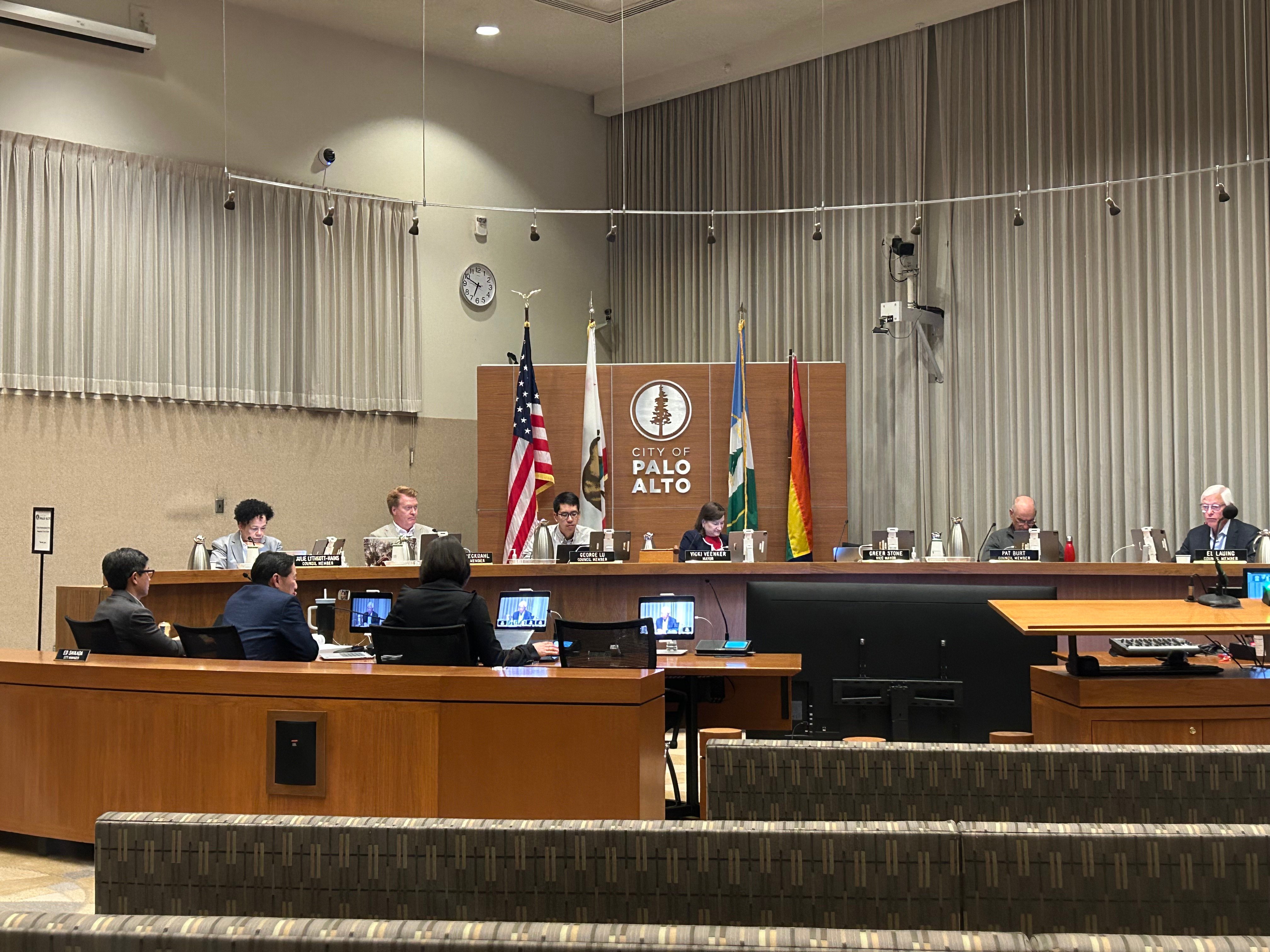
Students and community members advocated for more educational outreach on the health risks of gas stoves during Palo Alto’s City Council Special Meeting on Tuesday. Public comments referenced results from the City’s 2025 Annual Community Survey, which found that a majority of respondents showed interest in converting to electric appliances.
The survey reported that 37% of respondents considered health and safety a top motivation for switching major gas appliances for electric models. Moreover, it showed that seven in 10 Palo Alto residents are interested in upgrading to electric appliances.
Public comment speakers pushed for a conversion to electric and induction stoves, asking the City to warn residents about lung damage from gas stove emissions and inform them about safety measures like ventilation.
“We’re feeding chemicals into people’s homes that injure kids’ lungs. We need to educate the public who don’t know this to let them have a choice,” chemical engineer and resident Sven Thesen said during public comment.
Few survey respondents reported awareness about the City’s sustainability programs. Only one in 20 residents reported being “extremely or very familiar” with Palo Alto’s “80 x 30” goal to reduce greenhouse gas emissions by 80% by 2030.
“Residents aren’t going ‘gung ho’ over the environmental messaging, so we need to transition our focus to be centered more around health and affordability,” Palo Alto High School junior Avroh Shah said over Zoom.
Residents also expressed concern about gas stove emissions causing childhood asthma and requested that the Council add health risks and safety information to the City’s annual gas safety brochures.
These concerns stem from a Stanford air pollution study from 2024, which found that gas and propane stoves expose people to unsafe levels of nitrogen dioxide. Rob Jackson, the senior author of the study and professor in the Doerr School of Sustainability, compared using a gas stove to standing over a car tailpipe and breathing in pollutants like nitrogen dioxide. In the study, authors estimated that nitrogen dioxide exposure from gas stoves caused 19,000 deaths per year and 50,000 current cases of pediatric asthma.
The best way to reduce exposure, Jackson said, is to switch to an induction stove, which emits no nitrogen dioxide or benzene, another hazardous chemical. “If you can’t afford to get rid of your gas stove, buy a countertop induction hob for $50 and burn as little gas as possible,” he said, adding that people should run fans and open windows while using a gas stove.
Anya Rasmussen, another junior from Palo Alto High School, said over Zoom that shared access programs “can go a long way.” She proposed circulating motor induction kits throughout the community.
Mayor Vicki Veenker and Council member Julie Lythcott-Haims expressed concern about the survey’s reach to non-English speaking residents. The survey was mailed out to selected households, and an online version was available in English, Spanish and Simplified Chinese. However, the paper survey was only administered in English, including instructions in Spanish and Chinese on how to access the online version.
Two surveys were completed in Spanish and two in Chinese, which Veenker said was a “suspiciously low” proportion of the 574 responses.
“I want to be sure that we’re getting a representative sample and not conveying to people through the ways in which we’re surveying them that we only care about English speakers,” Lythcott-Haims said.
Veenker proposed exploring the cost of adding Spanish and Chinese to the mailed surveys before gathering data for 2026.