
Xavier Basurto is a professor in the Department of Environmental Social Sciences, a leader in the International Association of the Study of the Commons (IASC), and a former student of Elinor Ostrom.
Sibyl Diver is a lecturer in the Earth Systems Program, co-lead for the EJ Working Group, North America co-coordinator for the IASC, and a former Stanford Co-op resident and kitchen manager.
Nicole Franz (Center for Ocean Solutions, IASC member), Eva Jones (Civil and Environmental Engineering), and Kate Rodriguez (Human Biology) are contributing authors.
“Studying the commons is both understanding how people move intuitively and naturally—as well as understanding the great amount of effort it takes to organize groups of people so equitable access can be achieved.” – Valeria Pulido Paez
Commons can be defined as a social practice of governing a resource, not simply by a state or market, but also by a community of users that self-governs the resource through institutions that they create. Commons are based on principles of social cooperation realized through reciprocity and responsibility for the reproduction of shared wealth, natural or produced.
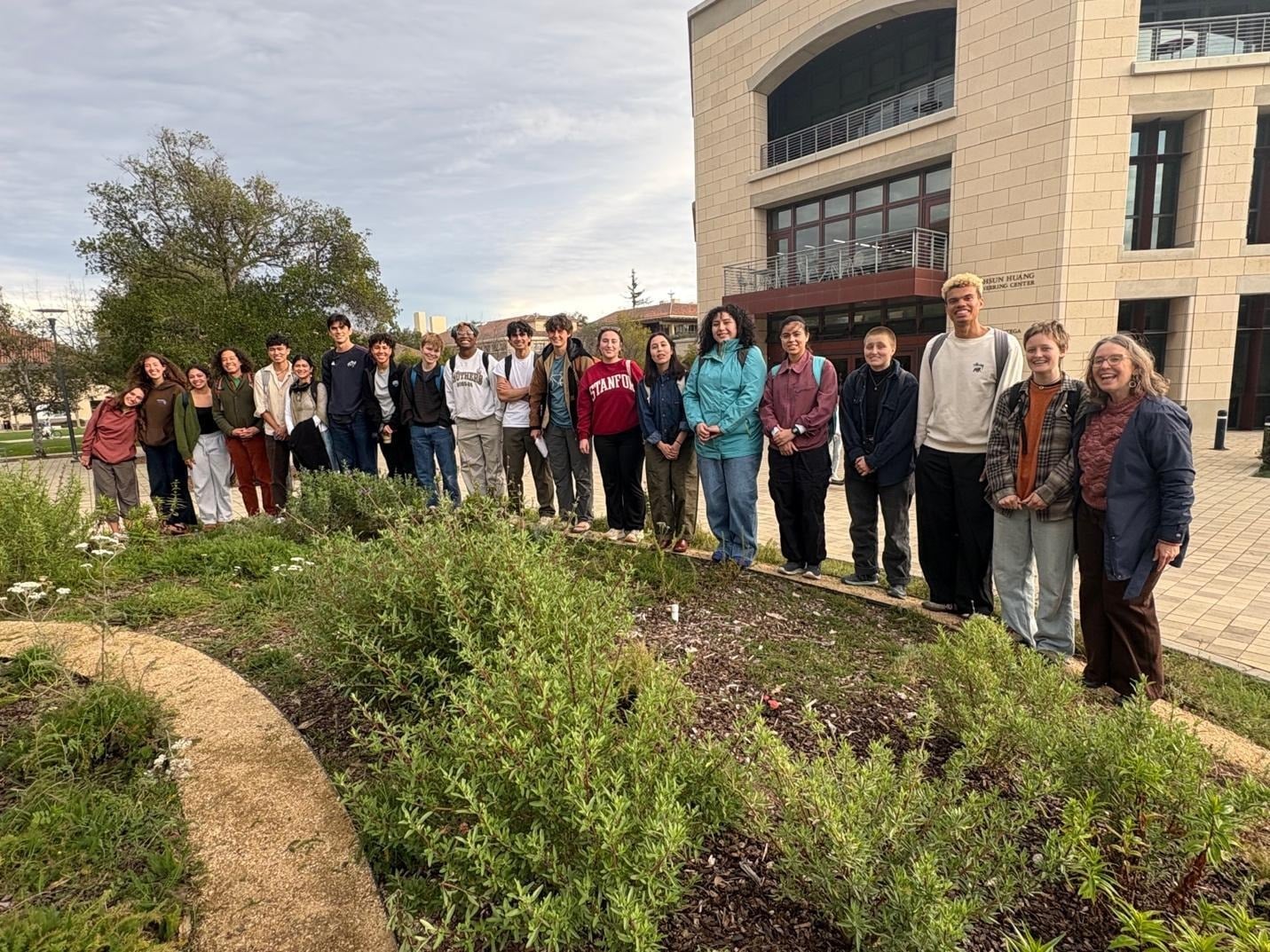
Inspired by the Nobel Prize-winning scholarship of political scientist Elinor Ostrom, a winter course entitled the “Study of the Commons, Commoning, and Cooperative Approaches to Self-Governance and Sustainability” sheds light on the applications of commons governance theory to sustainability problems and collective action solutions – including the essential role that cooperative houses (Co-ops) play in teaching and enacting commons governance at Stanford.
Now, more than ever, there is an urgent need for Stanford to engage more deeply in Ostrom’s transformative research on the commons. Commons governance provides an invaluable framework supporting sustainability education and residential life at Stanford. Specifically, Stanford Co-ops function as a “living lab” where students practice the art and science of maintaining collaborative governance systems in their daily life. At a time when society lacks the basic skills to have difficult conversations and resolve conflicts, we are encouraged by the contributions of our Co-ops in practicing intergenerational, pluralistic dialogue.
Studying the Commons in a new community-engaged course
Course co-instructors Sibyl Diver (Earth Systems Program), Xavier Basurto (Environmental Social Sciences) and Nicole Franz (Center for Oceans Solutions) are all commons scholars affiliated with the International Association for the Study of the Commons (IASC), an organization launched by Ostrom devoted to “improving governance and management, advancing understanding, and creating sustainable solutions for commons, common-pool resources, or any other form of shared resource.” Stanford Co-op housing leaders Eva Jones (Civil and Environmental Engineering) and Kate Rodriguez (Human Biology) co-created the course and joined as student co-instructors.
To understand how cooperative governance contributes to sustainability across domains and at multiple scales, the class introduced students to fundamental principles of commons governance. We explored a range of commons cases that speak to the question: how and why do communities self-organize to create enduring and adaptive governance systems that support community and planetary well-being over time? Part of the class also took on community-engaged commons projects that were supported by the Haas Center. One project focused on aquatic resources and challenges for collective action for small scale fishers in Chile. Another project focused on cooperative housing as spaces of commons governance and commoning.
Understanding Stanford Co-op contributions through a commons lens
The cooperative housing student team created and implemented an outreach strategy to educate our campus community about cooperative housing (Co-op) contributions at Stanford and beyond. Responding to recent administrative decisions that have threatened to close the majority of Stanford Co-ops, this project aimed to support students and alums working to ensure a future for cooperative housing, given their role as invaluable sites for residential education and commons governance at our university.
Summing up Co-op connections to commons, Gigi Knaebel stated, “Co-ops are living spaces where people cook and clean for each other. This form of care is structurally built into a cooperative living situation. It is an example of commoning because it brings in the necessary involvement of residents to keep up the house environment.” She further described health research findings about Co-op housing: “It has all these concrete health benefits where your social and physical needs are kept up by the community. This brings health benefits with eliminating loneliness, improved mental health, and physical health. It is set apart from other housing situations that can be anonymizing.”
Addy Mallott provided additional context on unique contributions from Co-ops to residential education: “Co-ops are where non-institutional learning can happen. This includes teach-ins where students can teach about things that are important to them. The dynamics are different from a normal classroom. . . “ As Gigi Knaebel added, “At a time when Stanford is facing pressure to turn itself away from diversity and equity. . . Co-ops are a place for people to maintain [these] values, and do not bend to the institutional whims of the moment.”
Jules Gittin explained Co-op contributions to sustainable food systems, “Instead of going to large companies like Sysco to source your food, we go directly to farmers. 80% of revenue for one of the farmer groups that we work with is coming directly from our Co-ops. . . we are talking about impacts beyond campus to our broader community.” As Addy Mallott further explained, “Co-ops have control and say over [our] food systems. This has led to specific relationships with farmers. This doesn’t happen with dining halls where you don’t know where your food is coming from.”
Reflections and next steps: Engaging with commons governance and Stanford Co-ops
Now, more than ever, there is an urgent need for Stanford to engage in Ostrom’s transformative research on the commons. As the resources we rely on are continually exploited by multinational corporations and state collaborators, governing the commons fundamentally shifts our relationships to each other and the Earth towards responsibility and mutuality. Importantly, commons governance frameworks encourage the centering of communities and their capacity to collaborate towards advancing meaningful solutions for sustainability over time.
We view commons scholarship and our class as exciting platforms advancing collaborative learning practices for sustainability. We also encourage students to learn about commons governance on our very own campus through Stanford’s cooperative houses. Simply put, cooperative housing provides invaluable sites of residential education about commons governance that are not offered by any other form of campus housing. Stanford Co-ops have operated for over five decades to enrich campus life and provide a vibrant space for community-building. Through cooperative living, Co-op residents build life skills for self-sufficiency and learn how to create and maintain collaborative governance systems.
But to continue this tradition, Stanford Co-ops need your support. Students interested in cooperative housing as a residence should join Stanford Co-op Week and Co-op Crawl.