
Arun Balakrishna is a PhD candidate in Mechanical Engineering at Stanford.
How do we get people from point A to B? The solutions we prioritize for this question illustrate the built environment, land use and our whole political system. In fact, Stanford is a microcosm of the evolution of transit systems in the United States.
Stanford’s first transit solution in the 1880s was to bring people from the Palo Alto train station to campus with a horse and buggy. At the turn of the 20th century, the boom of electric streetcars across the country reached Stanford in the form of its Toonerville Trolley, taking passengers to and around the Quad.
But then came the automobile. As Ford Model Ts began blazing down Palm Drive, the urban landscape of the United States was dramatically changing from walkable cities, interconnected via streetcar and rail, to car-centric infrastructure.
Car dependency is still entrenched in America today. The prioritization of cars is not a historical inevitability or purely driven by market forces, but rather a result of societal choices.
As demand grew for transit services, privately managed transit companies failed to modernize their lines, reducing frequency and increasing fares for short-term profit. The lack of municipal regulations also allowed these services to deteriorate.
In tandem, city officials across the nation doubled down on speeding up automobile traffic, ripping up transit infrastructure in the process. Many balked at the idea of using public funds to support these systems, yet the money was always available for extensive roadway systems, even before President Eisenhower was involved. Redlining added fuel to this fire, leading to further disinvestment of transit while displacing communities of color and shuttering business districts that buoyed those transit systems.
While reversing the scars of automobile infrastructure cannot happen overnight, we can choose to start the process now.
Today, Stanford dedicates a significant portion of its land to cars, as evidenced by its 10 parking garages and many surface parking lots. However, Stanford has also made the choice to modernize campus infrastructure for its student and staff populations rather than cars alone. See, for example, the relatively recent transformations of Jane Stanford Way and the School of Medicine campus.
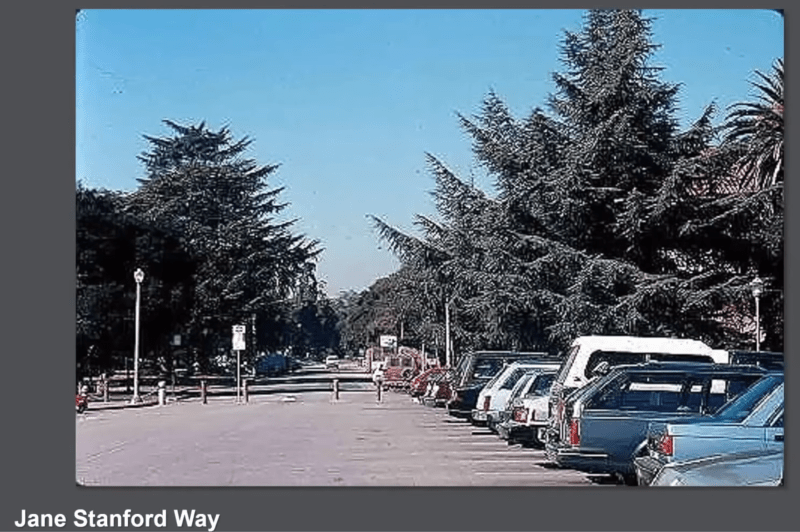
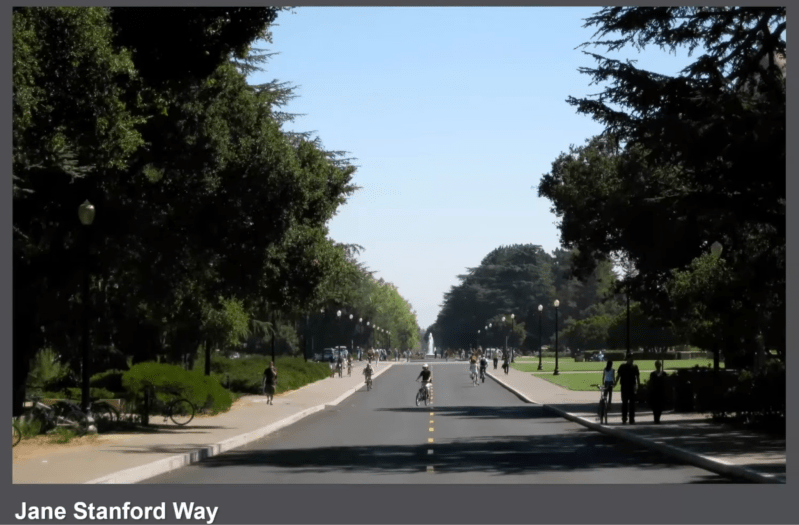
Jane Stanford Way before (left) and after (right) the removal of street parking. Photos from Olmsted to the Future: Stewarding the Planning and Architecture of the Stanford Campus courtesy of David Lenox, Director of Campus Planning.
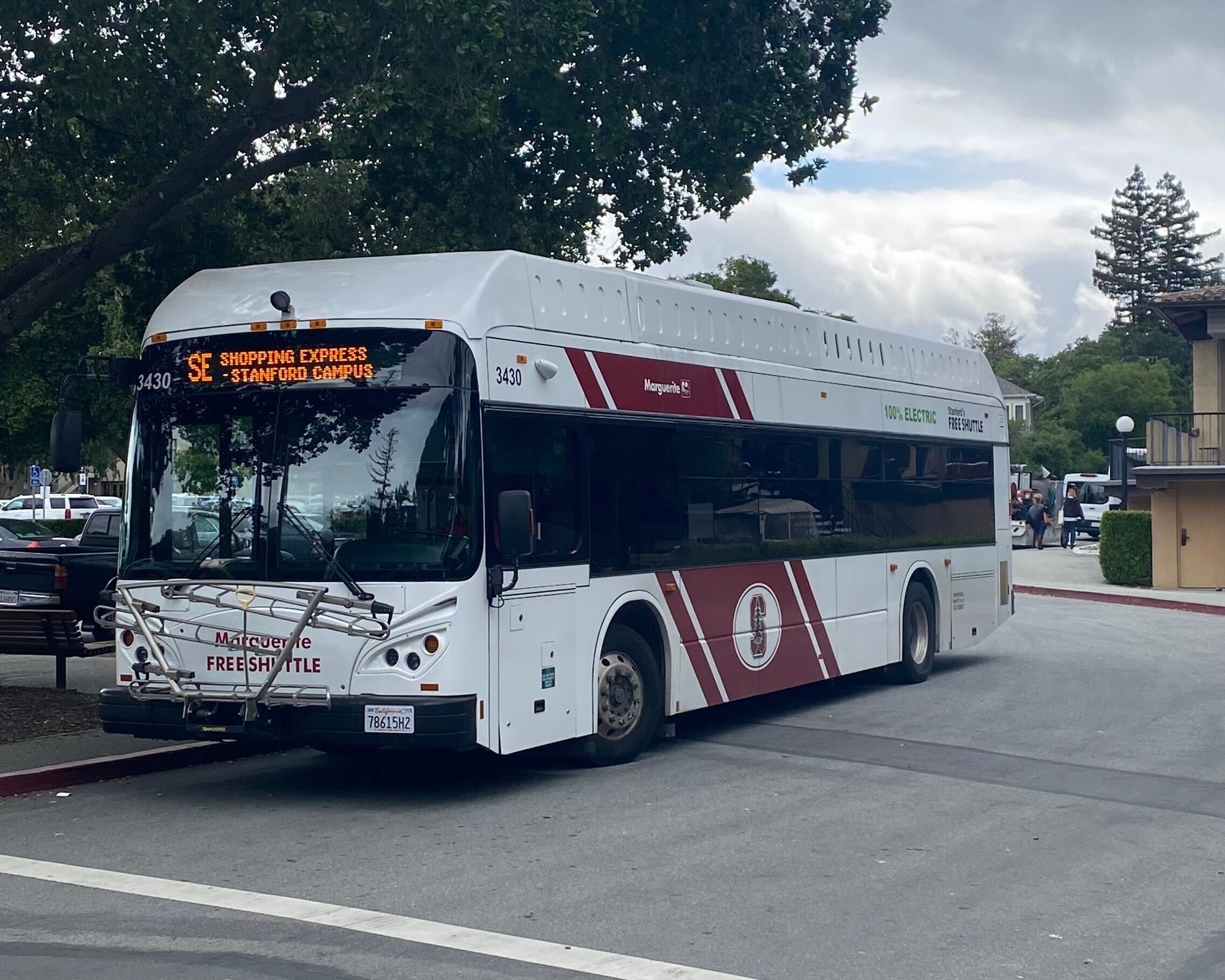
Another major choice by Stanford to serve the campus community was the introduction of the Marguerite shuttle service, a now (mostly) electrified fleet of buses with over 20 lines providing free transport. Over the past two years, the Marguerite boasted a 28% increase in ridership with an average of 8,000 riders per day and nearly 2 million annual rides. The numbers show that the Stanford community deeply values the Marguerite.
As a graduate student without a car, I regularly rely on the Marguerite (lines X and Y) to provide the last-mile connection from the Palo Alto train station to “trading with Joe” at Town and Country for my groceries. For me and many others, public transportation improves my quality of life. Consistent and long-term investment is crucial to the continued success of transit systems. And while Stanford has made progress in this area, including by reinstating the Shopping Express (SE) line after three years of dormancy, more improvements are needed.
The 15-20-minute headways between subsequent buses on X, Y and C, and 60 minutes for SE, make using the shuttle difficult. The X and Y lines are often delayed during peak hours and arrive late, causing off-campus residents to miss their Caltrain connections. One-hour headways on the SE mean that routine chores take longer than needed.
More frequent service, including on weekends, would shift trips from cars to the Marguerite, reducing traffic and creating a virtuous cycle of faster, more reliable buses. The overflowing morning C line, for example, shows that demand exists for increased service. Adding trips improves comfort, safety and on-time arrivals, so students reach classes and exams without stress.
It is abundantly clear that the Stanford community relies on the Marguerite, and there are additional benefits to increased public transportation, from cleaner air to fewer accidents. More than that, the Marguerite democratizes access to the university and the greater Bay Area for students who cannot afford to or are unable to drive. There is no better or more practical method than prioritizing the Marguerite to help pop the Stanford bubble.
Prioritizing the Marguerite should not exist in a vacuum. Bay Area transit agencies are facing extinction-level cuts, despite high ridership levels. The Connect Bay Area Transit measure, which would prevent the closure of BART lines and preserve Caltrain frequency, may fail to gather enough signatures to appear on the November ballot. Supporting these regional systems with local last-mile connections, like the Marguerite, ensures the robustness of the interconnected transit system.
Local advocacy makes a difference, as we have seen at Stanford, with potential ripple effects to larger-scale transportation systems. You can voice your support for the Marguerite before April 24 by filling out the Stanford Transportation commuter survey in your inbox. To save Bay Area transit, consider supporting a petition.
Public transit is a vital service that strengthens the economy, benefits the climate and fosters community. Let’s learn from history and stop the cycle of underfunding it.