
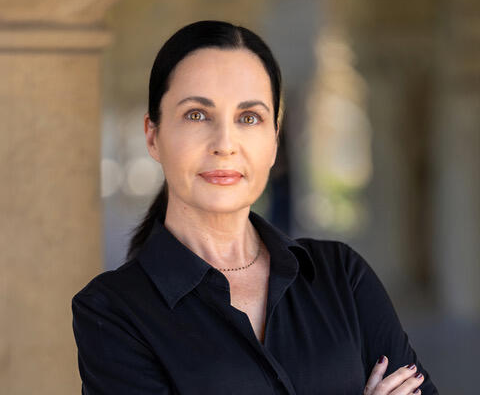
Anthropology professor Angela Garcia is one of five Stanford recipients of the 2026 Guggenheim Fellowship, alongside economics professor Ran Abramitzky, history professor Joel Cabrita, sociology professor Robb Willer and anesthesiology professor Sheng Xu.
Garcia is the Roger and Cynthia Lang Professor and Chair of the Department of Anthropology. Her books have shaped how anthropology engages with addiction, kinship and care under conditions of violence. “The Pastoral Clinic” examines heroin addiction in New Mexico’s Española Valley, while “The Way That Leads Among the Lost” focuses on Mexico City’s anexos, informal and often violent addiction treatment centers,
Garcia received her Ph.D. at Harvard University and was a President’s Postdoctoral Fellow at the University of California, Los Angeles. Before moving to Stanford in 2011, she taught at the University of California, Irvine.
Chosen from a pool of nearly 5,000 applicants, the Class of 2026 Guggenheim Fellows were tapped based on both prior career achievement and exceptional promise.
Garcia spoke with The Daily about the fellowship, the ethics of ethnographic writing and advice for students.
The Stanford Daily (TSD): What does the Guggenheim make possible for you, and which project will it primarily support?
Angela Garcia (AG): The fellowship supports research on the growth and destruction of Santa Rita del Cobre, a once-vibrant, but segregated, New Mexican mining community that is now a gaping hole two miles wide and 1,500 feet deep. Through detailed observations of the mine, interviews with people displaced by it, archival research and photography, the project recovers intimate histories with ongoing social relevance. In what ways is the environment interwoven with human experience? How to live when one’s economic lifeline ensures one’s own erasure? How to respond to loss and cultivate hope in the face of environmental and existential catastrophe? The research is fundamentally philosophical — an ethical inquiry into how to live when one’s way of life has been destroyed. It moves from present to past, from surface to subsurface, unearthing new ways of thinking about environmental and social history. It also reveals the difficult necessity of maintaining our capacities to be resilient when faced with environmental and existential catastrophe.
TSD: Your writing is often described as literary as much as ethnographic. How do you think about form and voice when writing about suffering and intimacy?
AG: I treat form and voice not as a mere stylistic preference but as an epistemological and ethical stance. And I’m attentive to what resists language altogether — the silences, gestures and refusals that shape my interlocutors’ lives. My prose tends to honor those silences rather than fill them with interpretation, a practice shaped partly by my engagement with psychoanalytic thought and its recognition that the most significant things are often what cannot be directly said. And my writing frequently shifts registers: analytic, testimonial, elegiac. This mixing of forms and voices is not indulgence but a way of refusing the clean epistemological authority that social-scientific writing typically claims.
TSD: What do you think ethnography can reveal about the overdose and addiction crises that other methodologies tend to miss?
AG: My first book, “The Pastoral Clinic: Addiction and Dispossession Along the Rio Grande,” concerns heroin addiction and overdose in New Mexico’s Española Valley. Most epidemiological and clinical approaches to addiction treat it as an event with a beginning and measure it along a timeline of individual biography. My long-term presence in the Española Valley, across generations of the same families, reveals instead that heroin addiction there is better understood as a condition into which people are born, something transmitted alongside grief, land loss and structural precarity. In this perspective, overdose is not an aberration in an otherwise recoverable life; it is one moment in a multigenerational pattern that no cross-sectional study or clinical intake form can see. Only duration — the patient, recursive return of ethnographic fieldwork — makes this temporal depth visible.
TSD: Any advice for students drawn to anthropology or to writing as a form of research?
AG: I would advise students to develop a tolerance for the unresolved ending, the open question, the scene that refuses to yield a thesis. This is not intellectual weakness; it is fidelity to the actual texture of lives that do not organize themselves around the researcher’s need for closure.