
Dhananjay Balakrishnan is a second year master’s student in computational & mathematical engineering. He is passionate about understanding STEM from a society-centric lens and studying how people are affected by technology.
Stanford India Policy and Economics Club (SIPEC) is a student-led group whose stated mission is to “empower the next generation of changemakers with the knowledge, networks and insights needed to drive meaningful impact in India and beyond.” They propose to do this by engaging students in meaningful discussions on India’s economic and policy landscape and focusing on India-U.S. relations.
For the past few years, they have hosted an annual Stanford India Conference, with the 2026 edition happening on May 10th, 2026. In this version and in previous editions, SIPEC has shown a strong tendency towards hosting Indian and Indian-origin individuals who speak openly (and proudly) in support of the nation’s ruling Bharatiya Janata Party’s (BJP), and their technocratic and Hindutva agendas. In the BJP’s rule under Prime Minister Narendra Modi, multiple scholars, journalists and international organizations have raised concerns about democratic backsliding in India, alongside ongoing discrimination and violence targeting minorities, including Muslims and Dalit, Bahujan and Adivasi (DBA) communities.
Five out of nine speakers in the 2026 conference alone have strong ties to the BJP and Rashtriya Swayamsevak Sangh (RSS) networks. The RSS is a paramilitary organization considered to be a right-wing extremist group calling for a Hindu ethnostate, with origins tied to Nazism. Most of the remaining speakers are technocrats and economic actors who are sympathetic to and at most, mildly critical of the majoritarian BJP. Are these truly the leaders who SIPEC seeks to influence upcoming generations of changemakers? Is this what it means to “drive meaningful impact” in India?
In their mapping of RSS-associated entities internationally, the Caravan magazine has shown how far-reaching the Hindutva’s networks are. This manifests itself at Stanford as well, with the current general secretary of the RSS, Datatreya Hosabale, recently being invited to speak about “ethical tech” at the THRIVE conference at Stanford.
The various speakers SIPEC has brought to Stanford over the years have routinely spewed hateful rhetoric and Islamophobic sentiments, and constitute a severe narrowness in their set of perspectives. This is an ideology that is not representative of a sizable part of the Indian population. Such open hate is not welcome and is, in fact, actively harmful to many students on campus.
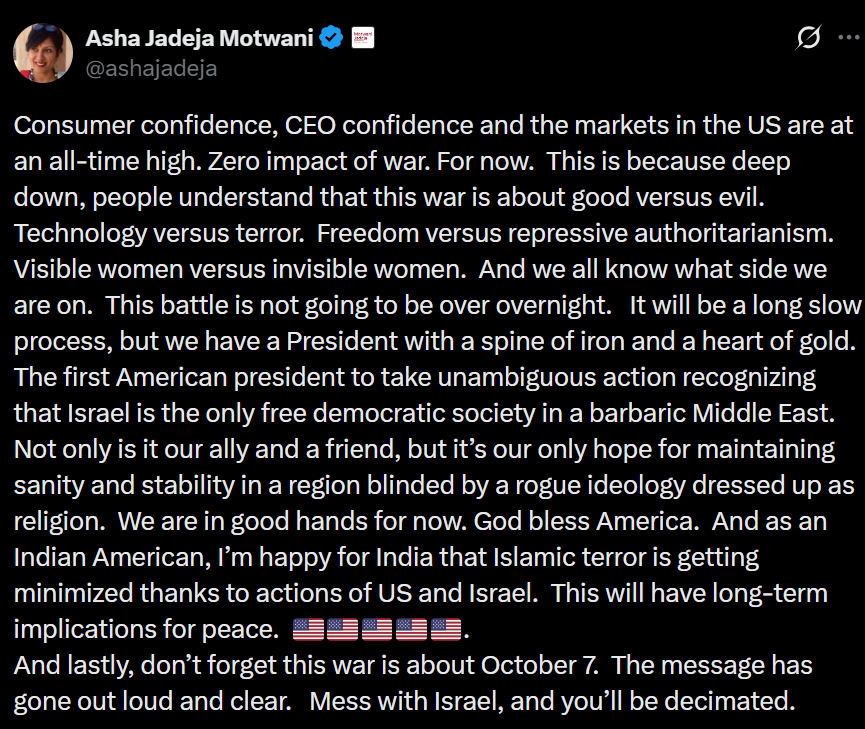
Most of SIPEC’s events have been funded by the Motwani Jadeja Foundation (MJF), who according to their website, empowers young Indian entrepreneurs. The MJF is founded and run by the VC Asha Jadeja, who has been a guest speaker at SIPEC events, talking about defense, security and the importance of India-US-Israel relations. The MJF has multiple initiatives in collaboration with the genocidal state of Israel. Jadeja uses X frequently to make controversial MAGA, Zionist and Islamophobic comments, and there are also multiple tweets she has made where she explicitly calls for the “decimation” of Iran, Palestine and Pakistan.
Also on this year’s roster, we have Tejasvi Surya, the millennial Lok Sabha MP (Member of Parliament) representing Bangalore South, and K Annamalai, the ex-BJP Tamil Nadu chief. Surya and Annamalai mark the new generation of BJP leaders who are guilty of echoing hateful and divisive messaging among the youth. On more than one occasion, Surya has made provocative comments, while Annamalai has been criticized for having a performative commitment to caste equity, even as he weaponized dominant-caste interests in the Coimbatore elections. His rhetoric is often inflammatory, accusatory and grounded in nationalist and unproductive jingoism.
Further, Annamalai is not a voted representative, and his divisive ideology has been rejected by the people in the 2024 Lok Sabha elections, where the BJP under him won 0 seats in the Tamil Nadu State. This is the second consecutive year that Annamalai is being brought as a guest. Even if an argument can be made about bringing him as a guest once, what is the argument to have him as a consecutive speaker? Are we at a dearth of diverse political voices from India? Whose voices do the likes of Annamalai represent?
At this juncture, one might be tempted to point out that SIPEC is bringing Dr. Shashi Tharoor this year, the current MP of Thiruvananthapuram, Kerala from the Indian National Congress (INC), the historic opposition party of the BJP. As an opposition MP, Tharoor opposes the BJP just enough to be viewed as liberal on international soil, and is sufficiently non-confrontational to find himself on SIPEC’s guest list. While Tharoor often engages in public debates and has curated sharp, incisive arguments against Hinduttva, his political actions do not align with his words. When Modi wanted to lease the Thiruvananthapuram International Airport to the Oligarch Adani, Tharoor was quick to break off with both the Kerala Congress leadership and the CPI(M)-led government by publicly supporting the privatization move. He also praised Modi’s Operation Sindoor at moments when his own party was demanding accountability. How, then, can we expect him to hold other members of the panel accountable?
This year’s lineup for speakers also includes Smita Prakash, the editor-in-chief and owner of Asia News International (ANI). The ANI along with other media outlets are colloquially referred to by critics as Godi Media (which quite literally likens the outlet to an infant cradled in Modi’s lap) due to their unwillingness to question the ruling BJP and their disinclination towards showing the unresolved, systemic problems faced by the Indian people. In the 12 years he has been in power, Modi has barely held open press conferences to address his critiques, a complete failure in democratic leadership and indicative of authoritarian rule.
Prakash herself has admitted that the media class that has been completely captured by the BJP is far from free and unbiased. ANI finds itself deeply embedded in the BJP ecosystem, as seen when they rigged the public tendering process to livestream state programs for the government of Rajasthan. Further, she also hosts a podcast where she platforms various right-wing ideologues, including an episode where a guest on her show advocates for an “Israel-like” solution in Kashmir.
Other guests this year include economists Param Iyer and Dr. Aravind Kumar Panagariya, both associated with the World Bank and IMF, organizations which have served as imperial debt-collectors in the global south. In response to a report by the World Inequality Lab that suggested that inequality in India was at an all-time high, Panagariya, who was the newly appointed chair of the Finance Commission at the time, said that we ought “not to lose sleep over inequality.”
SIPEC is also hosting Srikar Reddy from the Indian Embassy. The embassy has served as the BJP’s foreign arm by revoking the OCI status of overseas citizens critical of the government. The Indian embassy in Seattle also rejected an Indian-American stateswoman Kshama Sawant’s emergency VISA application to visit her ailing mother in India multiple times, supposedly because she has been vocally critical of the Modi government. Lastly, the technocrat SD Shibulal, the former CEO of Infosys, is often in news due to how it treats its employees.
The guests that SIPEC has brought in the past, and continues to bring today, represent a narrow class of political, corporate and technocratic elites whose perspectives do not reflect the full diversity of experiences and political opinions within India. Many of these speakers have publicly supported policies and ideologies that marginalized communities, activists, journalists and scholars have criticized as exclusionary and harmful.
I believe that there is no place for the normalization of such politics on a university campus, and I hope that SIPEC will make a more meaningful effort to include speakers representing a broader range of social, political and ideological perspectives in future events.