
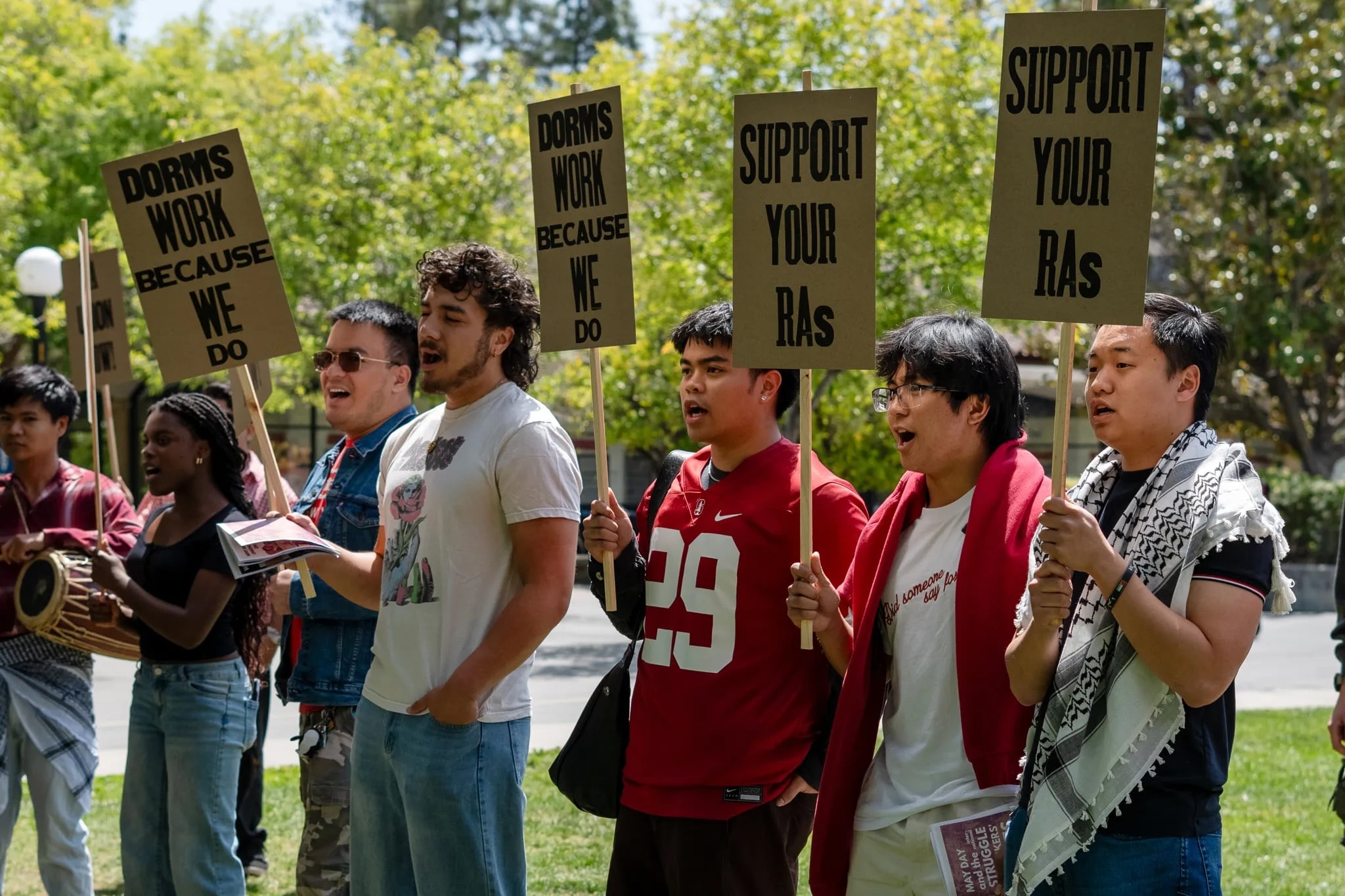
Residential Assistants United Rising (RAUR — a student group advocating for the unionization of Resident Assistants (RAs) at Stanford — received a union election date of Oct. 6 and 7 following a hearing before the National Labor Relations Board (NLRB) this summer.
Stanford responded with an emergency motion on Sept. 14 to postpone the election, asking the board to reevaluate its decision over the classification of RAs as employees.
RAs for the 2026-27 school year will get a chance to vote on whether to unionize. If a majority votes yes, the group will be formally recognized as a union.
“It’s exciting that we’re going to have this organization that can actually make a change at Stanford for the better for our working conditions,” said RAUR member Jackie Correy ’27.
The University believes the deadline for the vote to be too soon. In an email to RAs, Michele Rasmussen, Vice Provost for Student Affairs and Cheryl Brown, Assistant Vice Provost for Residential Education, wrote that the NLRB’s decision to move forward with the election “does not afford Stanford adequate time to comply with the federal Family Educational Rights and Privacy Act (“FERPA”).” According to Rasmussen and Brown, Stanford will need additional time to provide a voter list.
Unionization efforts by RAs began following complaints of being understaffed, underpaid and strained in the fall of last year. RAUR held a march-on-the-boss rally and a card signing event in the spring to organize support for the group from other RAs and residents on campus. RAUR member Jesse Judah-Bram ’27 said that support from students was crucial because “essentially everyone on campus in one way or another has engaged with an RA.”
“We work hard to provide for our residents and care for our living spaces, and our compensation must track the costly basic needs we’re forced to cover,” RAUR member Turner Van Slyke ’28 wrote to The Daily.
Stanford pushed back on the classification of RAs, or Resident Student Leaders (RSLs) as Residential Education (ResEd) refers to them, as employees both during the hearing in June and in their recent motion to review the board’s decision.
“The role of RSLs is uniquely tied to their role as Stanford students and is a part of the educational experience itself,” Rasmussen and Brown wrote to RAs, explaining their reason for the appeal.
Since the hearing in June, RAUR has hosted events and weekly meetings to discuss their future plans while they awaited NLRB’s decision on their election.
“It’s pretty easy, as you might imagine, for something like [RAUR] to dissipate during the summer, but we still had consistent showing from RAs at our meetings, as well as continued interest from RAs who are even just newly coming into the roles this year,” Judah-Bram said. “I think [that] just proves how much of a need there is for a union at Stanford, right?”
In their email, Stanford informed RAs that their participation in the unionization efforts will not impact how the University views them as students and workers. They also directed RAs to a page from ResEd, the body which employs RAs, that outlines potential questions RAs might have about the union as well as changes the formation of a union could bring. This includes sections covering potential union dues and taxation of RA stipends.
On the website, ResEd writes “Some of these historical practices [of RSL duties] could be discussed and potentially changed through good faith bargaining. For example, if stipends earned by RSLs are legally considered to be wages earned from employment, then they could be taxable.” Previously, the stipend was structured as non-taxable aid.
Members of RAUR expressed frustration over how the hearing between them and Stanford played out, including it being scheduled during finals week last spring. They stated that the process wasn’t intended to be adversarial. According to Jenny Ballutay ’28, RAUR wanted to move forward with the speedier card-check option, which establishes a union if over 50 percent of employees sign authorization cards instead of an NLRB ballot election. Stanford did not agree to the request for a card-check. Ballutay is the humor editor for The Daily.
“When there were opportunities to take advantage of [RA’s] position as students, when we may have conflicting obligations as a labor organization with less resources than them, [Stanford] did make moves that allowed them to have an advantage,” Ballutay said.
“Stanford values the role of RSLs in supporting undergraduate life on campus. RAUR began this process by filing a petition for an election with the NLRB, and Stanford is now following the established procedures of that process,” Angie Davis, Assistant Vice President of Strategic Communications and Media Relations, wrote in a statement to The Daily. “This includes presenting the NLRB with the information required at each stage of the process. The hearing date was set by the NLRB, not the university.”
According to Judah-Bram, RAUR’s work will not stop now that an election date has been set.
“We will be staying engaged, working with people on campus, reaching out to [organizations] and talking with residents,” Judah-Bram said.