
David Palumbo-Liu is the Louise Hewlett Nixon Professor and Professor of Comparative Literature at Stanford.
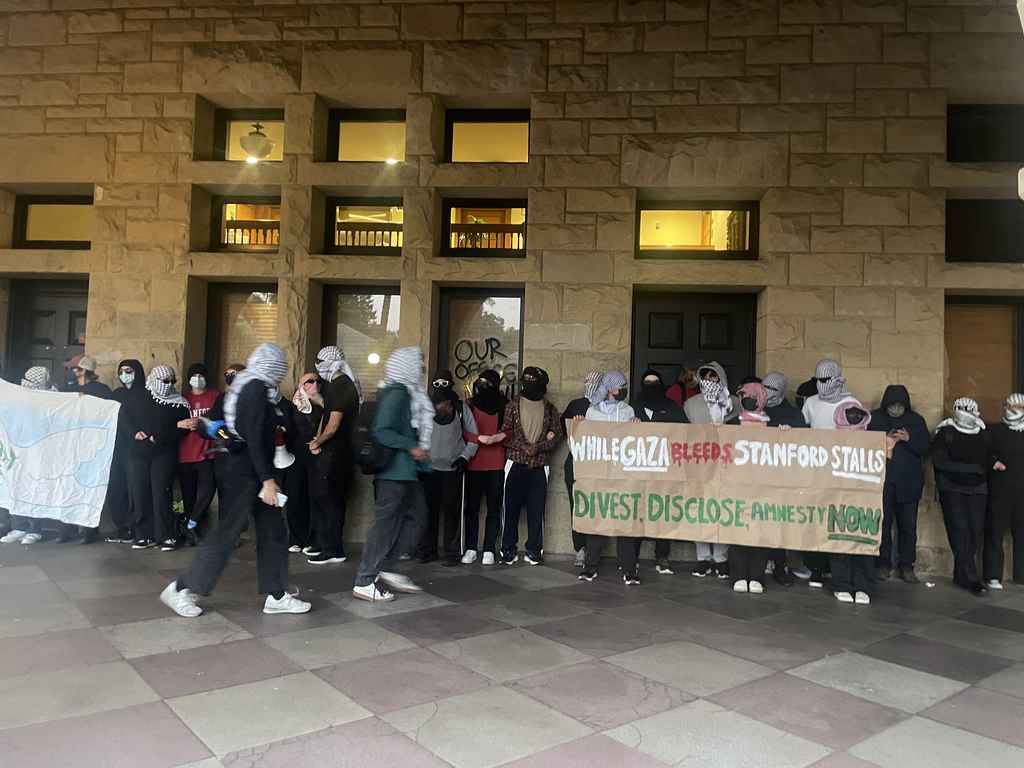
As the Stanford Daily reported, on September 21, charges were dropped against the students who occupied the President’s Office in June 2024. The Daily gave important background information on the case, but in order for people to understand why the pro-Palestine activists did what they did, one needs to understand how consistently Stanford has acted to stifle legitimate appeals to divest from Israel. Without that knowledge, the break-in seems entirely impetuous.
Indeed, the prosecuting attorney often chastised the defendants in court for, in his words, “F-ing it up for the peaceful demonstrators.” I was there — I heard this more than a few times.
In fact, both well before, during and after the Sit-In to Stop Genocide, Stanford students had followed the required steps and passed divestment resolutions asking that Stanford follow its own policy on investments, which states:
“The Trustees recognize that many issues of broad social and political concern raised by members of the University community are worthy of debate and study. Consistent with the University’s educational mission and its commitment to academic freedom, facilitating campus programs and processes by which these issues can be discussed and thoughtfully debated within the campus community is the most appropriate channel for most broad social and political issues to be addressed in the University context.
The Trustees recognize that very rare occasions may arise when companies’ actions or inactions are so abhorrent and ethically unjustifiable as to warrant the University’s dissociation from those investments. Such activities include apartheid, genocide, human trafficking, slavery, and violations of child labor laws. These instances may be reviewed on a case-by-case basis and must meet the very high bar articulated above.”
Despite this explicit language regarding apartheid and genocide, the response to the students’ petition to divest was met with corporate-speak that completely skirted the issue. The Board precisely refused to: “discuss and thoughtfully debate” anything whatsoever. It refused even to acknowledge that the consensus of the international human rights community, including organizations such as Amnesty International, Human Rights Watch and the United Nations, was that Israel is an apartheid state, and that the International Court of Justice evoked the Genocide Convention call on all signatory states to prevent any further genocidal acts in Gaza.
Specifically relevant to the issue of divestment, Francesca Albanese, Special Rapporteur on the situation of human rights in the Palestinian territories occupied since 1967, issued a damning critique showing in detail how businesses reaped huge profits off the genocide. This confirmed the students’ charges that universities were placing greed above ethics. In her July 2025 report, Albanese writes, “In the past 21 months, while Israel’s genocide has devastated Palestinian lives and landscapes, the Tel Aviv stock exchange soared by 213 percent (USD), amassing $225.7 billion in market gains — including $67.8 billion in the past month alone. For some, genocide is profitable.”
The Office of the UN High Commissioner on Human Rights noted: “Albanese found that these entities have failed their most basic legal responsibilities to exercise their leverage to bring an end to the violation at stake or terminate relations and disengage. Instead, they have treated Israel’s illegal enterprise in the occupied Palestinian territory as ordinary economic activity — wilfully ignoring documented, systemic abuses, even as atrocities mounted after 7 October 2023.”
And even if Stanford’s Trustees want to turn a blind eye to apartheid and genocide, a simple financial calculation would remind them that investing in Israel is a dangerous business proposition.
As the Trustees ignored their own “ethics,” Stanford’s prosecution of the Stanford 11 was the most severe of any imposed on Pro-Palestine activists in the United States. Stanford went so far as to bring criminal charges against the Stanford Daily reporter who was in the building to report on the event. As the Columbia Journalism Review noted — “Even as the case languished for months, Stanford wanted prosecutors to pursue it.”
If punishment is warranted, I submit that it is the Board of Trustees and Stanford that deserve scrutiny.
I mentioned the importance of knowing the deeper history of Stanford’s stifling legitimate, by-the-books attempts to call attention to our investments in apartheid and genocide. I end with this, from over a decade ago. In 2015, students had petitioned to present a case for divestment before the Advisory Panel on Investment Responsibility and Licensing. I was one of the two faculty mentors for that group. The students presented what I felt was a comprehensive, well-documented case, in a clear and firm and respectful manner. After they finished, I asked the board what the next step was. They looked puzzled, as if of course, there was no next step. I kept asking, politely. They literally said they would “have to check.” As soon as we left the building I told the students — the fix was in.
Being excellent students, they began to do some research. They discovered that the chair of the committee also sat on the board of Hillel. Predictably, when Stanford agreed to look into possible conflict of interest, it came back with the judgment that everything was fine. Here is the opinion piece written by Stanford’s Students for Justice in Palestine, describing the affair — it is well worth reading.
I go to these lengths so that the wider public can understand how awful the prosecution of the Stanford 11 was, and how it was not an aberration but rather consistent with Stanford’s treatment of those who protest a genocide, whether they follow the rules, or not.
The Stanford 11 has paid an enormous cost — nothing can restore the time, energy, physical and mental health they lost, the destruction of their education and perhaps employment, nor all the sacrifices of their loved ones.
But the fight for Palestine is not over — we start the new academic year ready to protest, rally, petition. Those acting for Palestine will be remembered being on the right side of history. Conversely, history will not look kindly on those who side with silencing, raw power and evasion of moral and ethical principles.