
Editor’s Note: This article is a review and includes subjective thoughts, opinions and critiques.
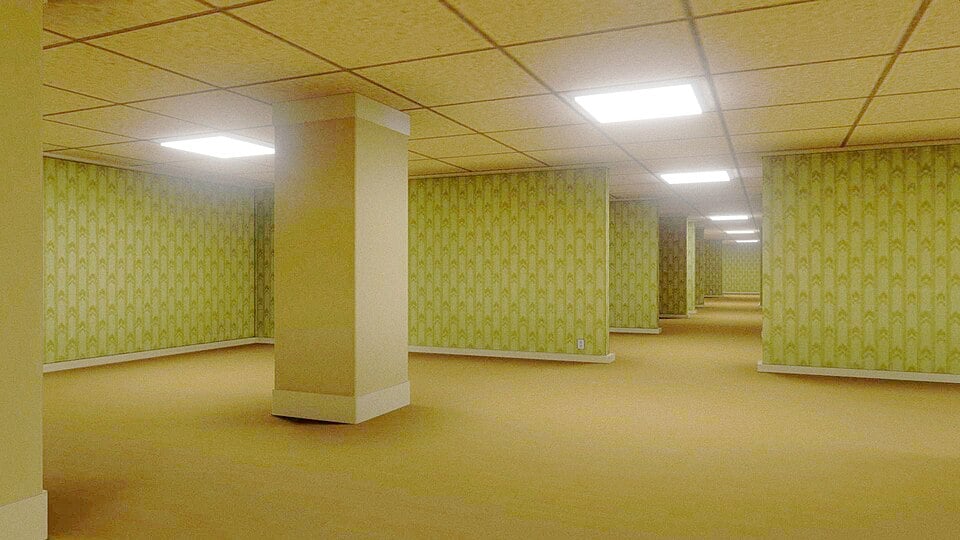
Picture this: You’ve sunk into the walls of your nextdoor Bob’s Discount Furniture, and respawned in a musty yellow alternate reality. The nightmare of it all isn’t the shadows, or the creaking floors — it’s the fact that everything in this yellow corporate labyrinth called “the backrooms” is completely normal … and also completely off.
From “Obsession” to “Leviticus,” 2026 has proven to be a golden year for horror, and one of the most successful recent releases is none other than “Backrooms” (2026), directed by Kane Parsons. At only 21 (20 at the time of the film’s release), Parsons pulled off what many only dream of: a highly successful debut film produced on a meager budget of ten million dollars, which has already generated hundreds of millions of dollars at the box office.
Originally based on an unsettling photo posted on 4chan of an empty room plastered with yellow wallpaper, the story of the backrooms has developed into a web of internet lore, spawning original stories and YouTube films online. Parsons began his own YouTube film series about the backrooms in 2022, generating a widespread fanbase and eventually leading to his feature debut.
The film follows unsuccessful architect-turned-furniture salesman Clark (Chiwetel Ejiofor) as he discovers a portal in the subfloor of his store. Walking through the wall, Clark uncovers a labyrinth of identical connected rooms with inoffensive yellow wallpaper and musty carpeting. His therapist, Mary Kline (Renate Reinsve), must also navigate the unsettling territory beyond the furniture store’s portal when, after Clark goes missing, she goes looking for him. Both quickly realize something is wrong upon first seeing the backrooms — from the sterile rooms teeming with furniture that appears almost improperly rendered, as though the ordinary itself had glitched, to the shifting entities in the dark they know could kill them.
Audiences can expect a horror film more nuanced than your typical haunted house fantasy replete with cliche jumpscares and character tropes. The fear that the backrooms inspire is, more than anything, psychological. It adapts to whoever is in it, mirroring and warping around the minds of whoever enters, bringing in details from their memories into the labyrinth. Both the characters and the viewers of the film know something is wrong — the furniture is sometimes built into the walls, stacked on top of each other, or utterly broken, with no indication of how. The rooms repeat, making escape feel futile. Things are in places they shouldn’t be, made of things they shouldn’t be. The fear lies in the way a normal world has folded into itself.
The brilliance of “Backrooms” lies in the movie’s patience. Rather than rushing the development of the plot in order to hit major narrative beats, especially ones canonical to the horror genre, the film takes its time with the two main characters. It allows you to grasp the edges of their personalities, fears, egos and regrets, and Parsons integrates these features throughout the film rather than dumping it all at once.
You feel for the struggles of Clark, from his career failures to his ruptured marriage, and you understand who he is while watching him move through a nightmarish plot. You grasp at the tragedy and pity of Mary’s past while clutching your seat for the things she endures in the present. Parsons doesn’t treat a character’s background as information to be presented and then discarded — it is not merely context. It is the very heart of the story.
The horror of the setting, too, is not a vacuum into which Clark or Mary are placed (despite what it seems), but a labyrinth of their own minds. It forces them to ask fundamental questions about who they are as people, and whether or not they can change — whether or not memory and the past are just a mirror of one’s future, or a sidewalk to its destination.
Whether you are searching for a movie that grapples with deeper meanings or simply a fun (and thoroughly frightening) ride riddled with memorable characters, “Backrooms” is bound to impress.