
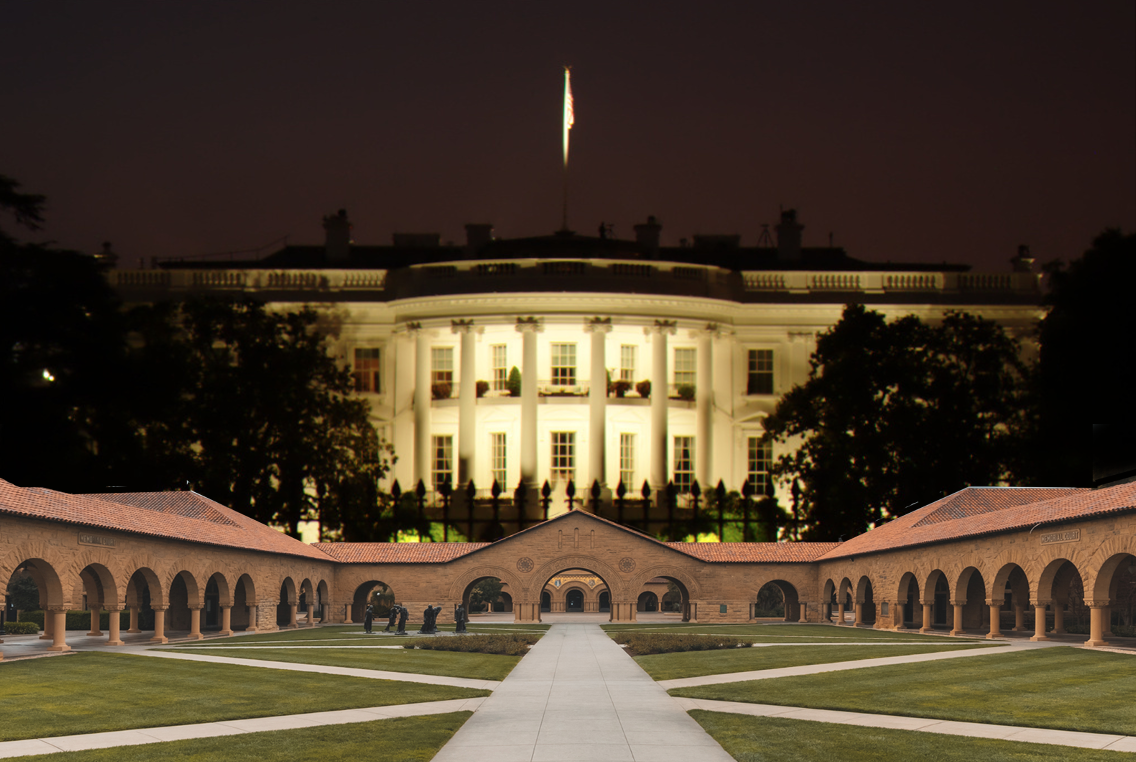
Stanford University addressed its partnership with the Trump administration on a new manufacturing program called Foundry School on Wednesday. The University joined the project to “prepare the skilled technical talent that American industry needs,” Angie Davis, assistant vice president of strategic communications and media relations, wrote in an email to The Daily.
“Stanford works with every federal administration, including the current one, to advance the public interest,” Davis continued. “The longstanding partnership between the federal government and research universities like Stanford drives American innovation, fuels economic growth and strengthens national security.”
Foundry School is a training program for entrepreneurs, engineers and technicians. It is also an initiative of Pax Silica, the U.S. Department of State’s flagship effort on artificial intelligence (AI) and supply chain security. Stanford will develop a “first-of-its-kind advanced manufacturing curriculum for American students” and host a 10-session core program beginning in January, according to a Department press release.
Joseph DeSimone, a chemical engineering professor and the faculty lead for the project, wrote that University president Jonathan Levin attended the Foundry School launch virtually. The event, which took place on Sept. 3 at the recently renamed Donald J. Trump Institute of Peace, also featured Vice President J.D. Vance and Secretary of State Marco Rubio.
While the University did not independently confirm Levin’s attendance, he appears on a projector screen in a photo posted to DeSimone’s LinkedIn. DeSimone and a colleague represented Stanford in person at the launch.
The Department of State selected Stanford for its academic, technological and convening strength as a leading research university in Silicon Valley, with the industry and university relationships needed to build Foundry School, a Department spokesperson wrote.
Levin became aware of an opportunity to help develop an advanced-manufacturing curriculum in the spring, according to DeSimone, and shared that opportunity with School of Engineering dean Jennifer Widom to gauge interest at Stanford.
At Widom’s suggestion, Levin spoke with DeSimone and engineering professor Allison Okamura, DeSimone wrote. Julie Greicius, associate dean of communications and alumni affairs for Stanford Engineering, confirmed this account.
DeSimone said he was enthusiastic about the initiative.
“Given my experience inventing new manufacturing processes and translating them into products and companies, I was eager to become involved,” he wrote, referencing his co-founding of the biotechnology company Liquidia Technologies and the 3D-printing company Carbon.
He and Okamura assembled a Stanford faculty team including Joe Felter, director of the Gordian Knot Center for National Security Innovation, and Glenn Tiffert, a distinguished research fellow at the Hoover Institution. Together, they began shaping the curriculum with the Department of State and the other participating universities.
Neither Okamura, Felter nor Tiffert responded to a request for comment.
The Department of State officially entered into a public-private partnership with Stanford on June 24, 2026, according to the Department spokesperson.
Like Davis, Greicius emphasized the University’s longstanding work with federal administrations.
“Since the 1930s, Stanford Engineering has worked with every federal administration in some way to support education, accelerate discovery and provide training,” she wrote. “Stanford Engineering has welcomed such opportunities to take a leadership role to advance technology, reach a broader set of students and make job training more widely available.”
DeSimone directly disputed the idea that the University’s work on Foundry School bears political implications.
“The Foundry School was launched by the current administration, so that context is plainly part of its origin. But Stanford’s participation is academic, not partisan,” he wrote. “The underlying challenge — rebuilding advanced-manufacturing capability, preparing students for an AI-enabled industrial economy and strengthening supply chains — is much larger than any one administration or political party.”
The chemical engineering professor added that universities often work with the government on national priorities while maintaining intellectual independence; that is the case here, he wrote.
While Stanford is leading the curriculum development, DeSimone continued, Foundry School is intentionally designed as a multi-university effort. He wrote that he expects more institutions to join, and that each participating university brings “distinctive capabilities and proximity to an important regional manufacturing ecosystem.”
“The Foundry School will succeed only if it draws upon the expertise, infrastructure and industrial relationships of universities and communities across the country,” he wrote.
DeSimone also provided details on the January core program, writing that it will be divided into two complementary courses: a seminar featuring headliner speakers and a Foundry Lab in which student teams will analyze manufacturing challenges, engage with experts and translate what they learn into practical recommendations.
He described the Sept. 3 event as both a formal launch and a working session around a larger objective: “building a durable educational platform for developing the engineers, entrepreneurs, operators and industrial leaders needed for advanced manufacturing.”
DeSimone called Secretary of State Marco Rubio’s and Vice President J.D. Vance’s public remarks about the importance of manufacturing inspiring, writing that Rubio’s characterization of Foundry School as a generational initiative extending beyond the current presidential administration especially resonated with him.