

Researchers from Stanford’s Hopkins Marine Station presented the latest tracking technology and findings on white shark behavior at a “Sharktober” event on Saturday. The event is part of the Monterey Bay White Sharks Project, a research collaboration between universities.
Sharktober refers to the season in which adult great white sharks return from what researchers call the White Shark Cafe, a “fast food” area in the open sea where they spend six to eight months.
Hopkins’ studies of white shark movement found that they are in Monterey’s coastal waters from October to January, peaking around Halloween.
“I’m excited to have this event about white sharks because there’s a lot of misinformation, and they all often have a bad reputation,” Isabella Brown, California State Parks interpretative specialist, said in an interview with The Daily. “This will be good to help people really understand from a scientific perspective about these animals and to make them seem less bad and scary.”
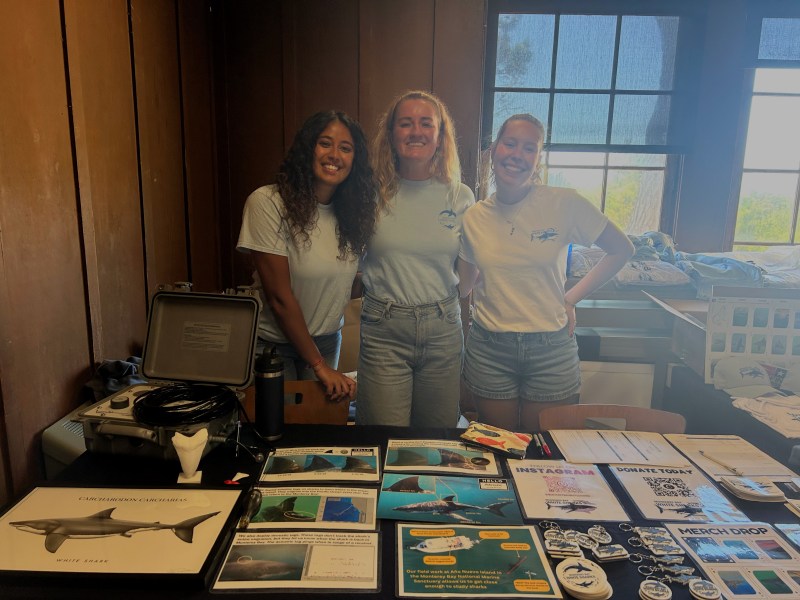
Sharktober was hosted on the Asimolar State Beach and Conference Grounds in Pacific Grove, about two hours away from Stanford. Alongside Hopkins, representatives from the University of California, Santa Cruz (UCSC); University of Washington (UW); Middlebury Institute of International Studies; Center for Ocean Art, Science and Technology (COAST) and California State Parks tabled at the event.
Hopkins uses acoustic and satellite tags to track white shark movement along the coast. Acoustic tags emit codes that buoys listen for, and each shark has a unique number. When the animal passes by, the buoy picks up the tag’s signal and sends it back to researchers.
“Over the last several years, we’ve expanded that acoustic array, so it runs from north of Tomales all the way down to Morro Bay,” said Sabrina Daley, a fifth-year Ph.D. student in biology who works at Hopkins. “That’s really allowing us to track the fine-scale movement of these white sharks along our coast.”
To tag sharks, researchers use seal or sea lion decoys, or a whale scent on their boat, to pull the sharks close. Then, they can tag, photo ID and take a biopsy. With tagging, Hopkins can track a shark’s behavior for up to a year. The tags track temperature, pressure, time and light to calculate the shark’s position in the ocean.
Instead of manually identifying sharks, Hopkins now uses artificial intelligence (AI) to match dorsal fins, which are as unique as human fingerprints, against photos of sharks in their database.
One of the Monterey White Shark Project’s goals is to create a census of white sharks in the bay, using the thousands of photos they have collected over the past 30 years. On the central coast, the project estimates 300 white sharks, members said during the event Q&A.
Hopkins also collects sharks’ environmental DNA (eDNA) by gathering water samples that contain skin or feces. This method doesn’t require direct interaction with a shark, unlike tagging or tissue samples.
According to Brown, 500 people registered for Sharktober, which was free to attend. Guests visited tables to talk to researchers about their projects before event programming started.
“I don’t know a lot about sharks, so it was very fascinating to learn about their patterns and their behavior and the research,” said Liz Greer, a San Jose resident and Monterey Bay Aquarium volunteer. “There’s that continued message of being responsible with nature and technology, and I think that’s really critical for our current circumstances.”
Once guests filled seats in Merrill Hall, local cinematographer Kip Evans presented his short documentary film “Monterey White Sharks,” which won the 2026 International Ocean Film Festival’s Golden Gate Award. The film follows Hopkins researchers out on the ocean, as well as UCSC’s and UW’s studies on white sharks’ prey, sea lions and elephant seals.
“Bringing cameras underwater helps us to understand not only the behavior of animals but whether they’re under stress or whether their population is decreasing,” Evans said to The Daily in an interview. “It’s really the only way to pull back the cover on the ocean and be able to reveal what’s really going on.”
Following the film screening, professors from the Monterey Bay White Shark Project’s partner universities spoke on their research. Using drones to track and count the animals, UCSC and UW researchers are exploring whether sea lions and elephant seals are drawing the presence of white sharks.
Barbara Block, a Hopkins professor of marine sciences and oceans, announced the launch of SharkTAG, an educational app that emphasizes users’ personal connections with sharks. Users will be able to collect shark cards; Block encouraged people to view them like baseball cards. The app is expected to go live at the end of the month.
Part of the project’s mission is to strengthen public outreach with events like Sharktober and encourage protection of these predators.
California’s white shark population has low genetic diversity, with genomics studies identifying many siblings but fewer parents. White sharks are also threatened by international fishing because they can be accidentally caught by gillnets, used in halibut fishing.
“It’s not easy to want to protect something with shark teeth,” Block said in her speech. “We need to get more to get people connected to the sea,” she added during the Q&A.
Since Sharktober is when the most white sharks return to Monterey, speakers noted that swimmers should exercise caution in certain parts of the bay. According to the California Department of Fish and Wildlife, there have been 19 white shark incidents (where a shark approached a person in the water) since 1950. Of those, three were fatal.
Shark attacks are less common in California than, for example, Australia, the Sharktober panel said, because there are fewer sharks, and they have more access to prey.
Despite the rarity of shark attacks in California, the colloquial term for white shark, “great white shark,” carries a fearmongering connotation, Daley wrote in an email statement to The Daily.
“White shark is the scientific name and what we use in the research world and generally try to shift the public towards using,” she said.