
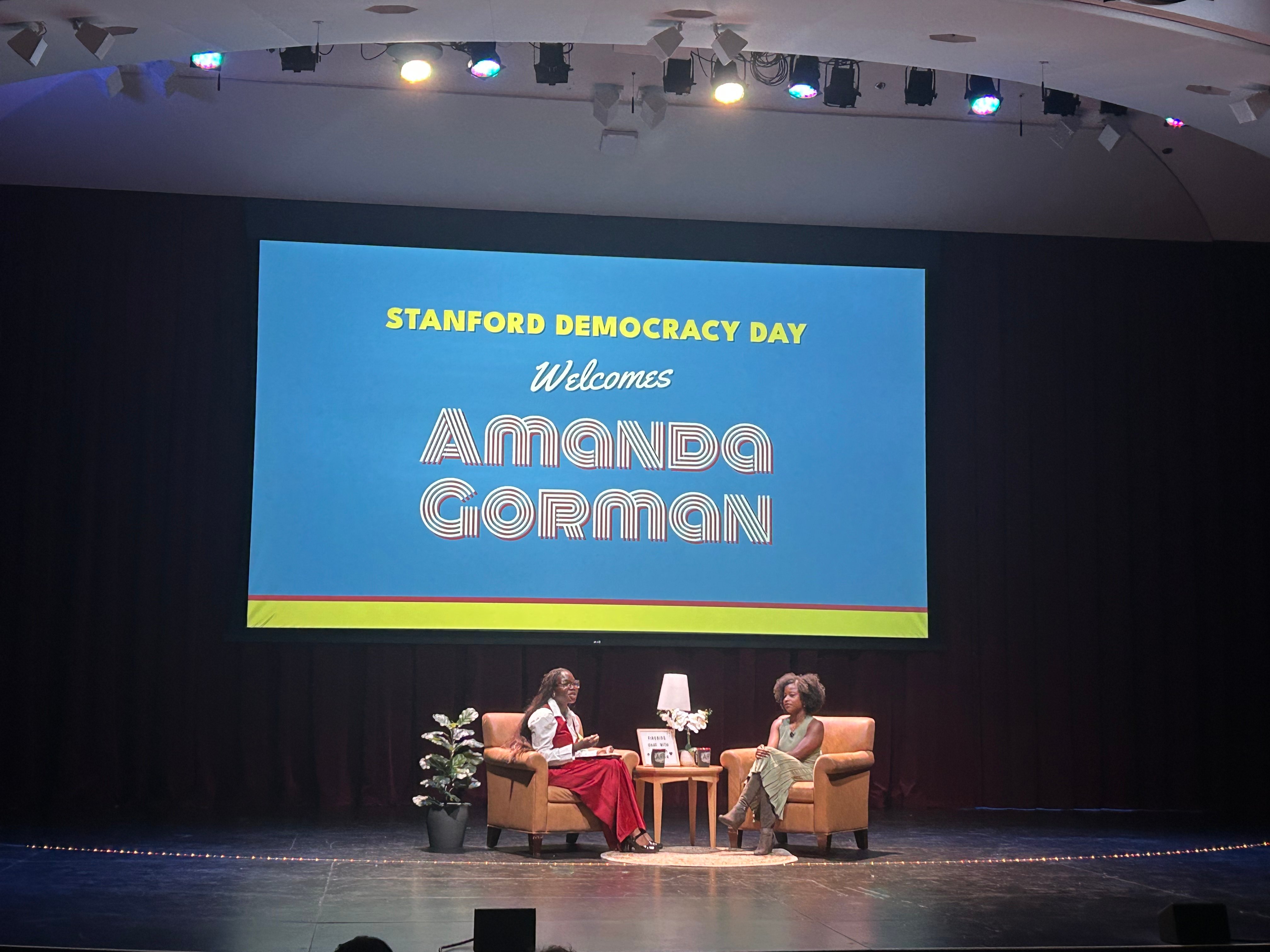
Poet and activist Amanda Gorman returned to Dinkelspiel Auditorium, one of the first stages on which she ever performed her poetry, to detail her creative process and the importance of voting during a fireside chat on Tuesday.
“There is something poetry can do that prose can’t always make possible in the hearts of people,” Gorman said at the event.
Gorman was the first National Youth Poet Laureate in 2017 and became the youngest inaugural poet in U.S. history at 22 when she read “The Hill We Climb” at Joe Biden’s 2021 presidential inauguration. Now 28, Gorman has authored poetry collections and children’s books and is a United Nations Children’s Fund (UNICEF) ambassador.
After her conversation with moderator Blessyn Nkrumah ’28, a Democracy Day executive member, Gorman read “This Sacred Scene,” the poem she recited at the 2024 Democratic National Convention.
“The way she carries herself and how she’s very intentional about what she says, it connects to everything that I want to do in life and how I carry myself,” Nkrumah told The Daily.
The Stanford Speakers Bureau (SSB) organized the event in partnership with Stanford Democracy Day, Stanford Arts, Stanford Live, Residential Education (ResEd), Ujamaa House, Otero, Spoken Word Collective (SWC), the Graduate School of Education, the Department of African and African American Studies and Stanford Medicine.
Members of SWC opened the event by sharing poetry and prose about language, civics and ancestry. Six members delivered pieces, including Ameera Eshtewi ’27, who performed a poem she wrote on the American dream, and Chidubem Nwosu ’27, who read a piece about the Israel-Palestine conflict.
“It was absolutely surreal and enlightening to meet Gorman and hear her discuss the relationship between democracy, activism and human art,” SWC poet Ethan Vo ’29 wrote to The Daily.
Gorman performed at Dinkelspiel when she was 14 during a summer program on the Farm. “It changed me,” she said.
Early on, she understood the legacy she wanted to leave, she. In sixth grade, Gorman told people that she planned on running for president in 2036. Her goal continued through college as she studied sociology at Harvard University and traveled the country performing poetry.
Following the acclaim she received following the inauguration, Gorman said she realized that poetry could be just as influential as running for office.
“I shared a stage with the president, and people left talking about me,” Gorman said.
A presidential run isn’t necessarily off the table, though. “If and when I do, I will bring everything else as a poet and activist,” Gorman said. “Campaign in poetry, govern in prose.”
Much like campaigning, Gorman said her writing aims to be dynamic and interactive. “I’m editing poems as I perform them,” she said. “It’s more of a dialogue and conversation. It’s this magic that happens in the air.”
Gorman added that she weighs the space her art occupies and how to make it subversive. For the inauguration of poet laureate Tracy K. Smith in 2017, Gorman performed “In This Place (An American Lyric),” where she used metaphor and sound to convey a message about Deferred Action for Childhood Arrivals (DACA) after moderators told her not to make an explicit reference to the program.
In the spirit of Democracy Day, Gorman addressed voter apathy and urged students not to discount the importance of their individual votes.
“We often conflate the idea of our vote changing everything to it mattering,” she said. “It matters because it happens, not because it happens the way we want it to.”
Casting a ballot, Gorman continued, honors the efforts of past generations to secure suffrage for all Americans. “People died and had their skulls beaten in Selma so I could do this,” she said. “I vote so the world that died to get me here has a voice in today.”
Gorman stressed that voting is only the first step in civic engagement. “If we lie to ourselves and tell ourselves that ‘all I need to do is show up to the polls, and I’ll wake up and it’ll all be different,’ then we will not be a sustainable force,” she said.
She drew a distinction between hope and optimism, advising the audience to be realistic about the action required for policy change.
Patriotism is not “blinding unconditional acceptance,” Gorman said, but a commitment to serving and improving the country. “I love America so much, and that’s why I’m fighting for her,” she said.
Gorman closed the event with a reading of her poem, “This Sacred Scene.”
“United, we can endeavor to humanize our democracy, and endear democracy to humanity,” she said to a snapping crowd. “Let us not just believe in the American dream. Let us be worthy of it.”