
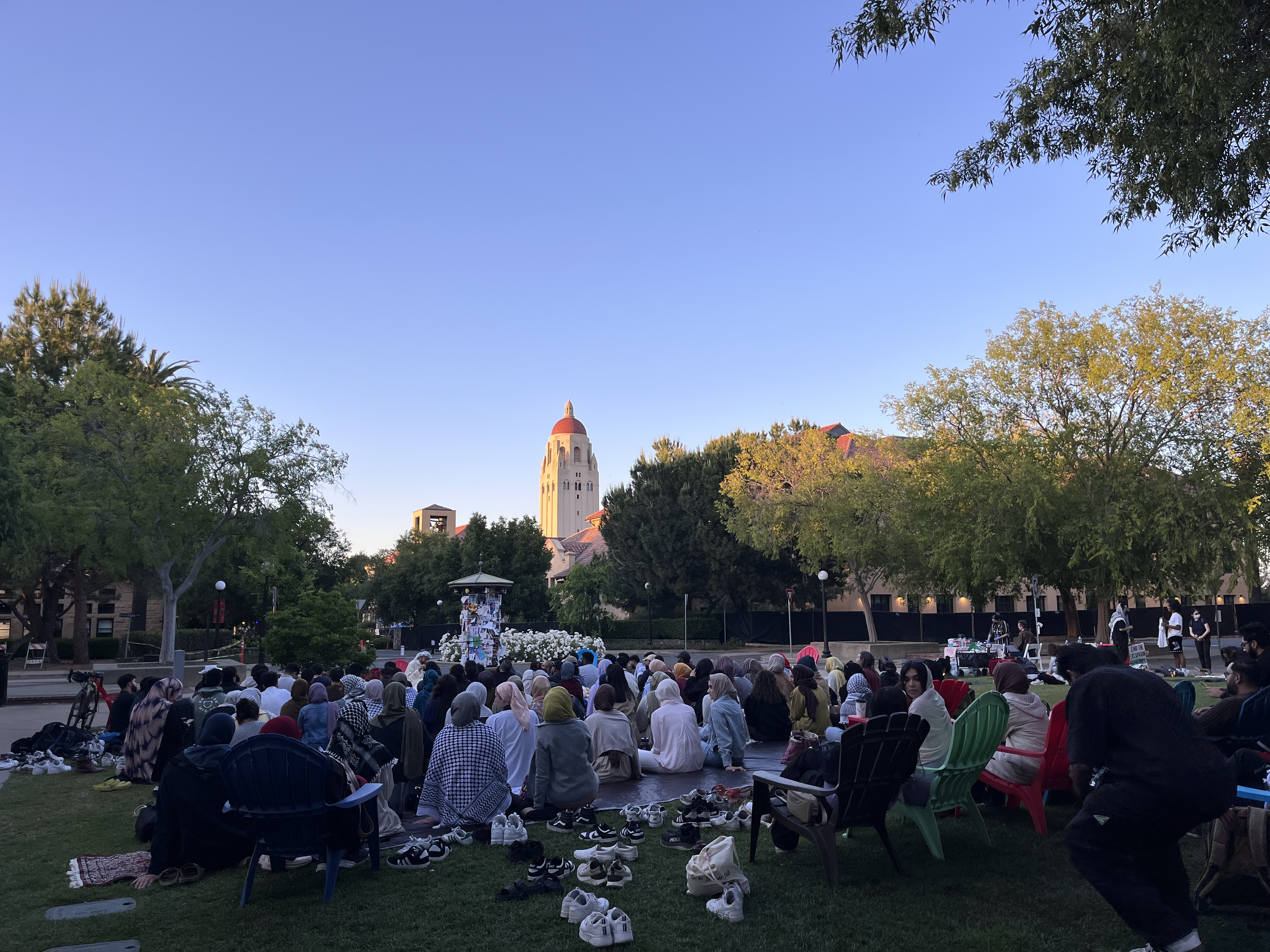
We, the Stanford Faculty and Staff for Justice in Palestine (FSJP), write to unequivocally express our support for the hunger strike for Palestine, which began May 12, 2025 and has now surpassed its 14th consecutive day. Strikers are making four demands of Stanford: (1) divest from companies complicit in the Israeli genocide of the Palestinian people in Gaza, (2) call on Santa Clara County District Attorney Jeff Rosen to drop the charges against the Stanford 12, (3) sign on to the American Association of Colleges and Universities letter and (4) rescind post-encampment speech restrictions.
Hunger strikes — from Ireland to South Africa to Palestine and elsewhere — are extreme acts of self-sacrifice and a protest of last resort. Last academic year, Stanford students organized over 20 rallies and marches, held a 120-day Sit-In to Stop Genocide, established the 41-day People’s University for Palestine encampment and passed an ASSU statement on divestment in April with over 72% support from both undergraduate and graduate student voters. Students also acted in good faith and followed proper procedure in submitting a divestment proposal to the Special Committee on Investment Responsibility in May. When the University didn’t engage with students’ myriad efforts to advocate through official University channels and mass public demonstrations, 12 students and alumni forcefully entered the University president’s office in June 2024 to demand Stanford divest from genocide.
This year’s escalated use of a hunger strike by students is the direct result of the Board of Trustees’ deceitful response to students’ May 2024 divestment proposal. As FSJP members have previously written, the Board’s own investment policy notes that “abhorrent and ethically unjustifiable” actions such as “apartheid, genocide, human trafficking, slavery, and violations of child labor laws” may warrant the University’s divestment from companies. In our earlier opinion piece, our members cited the International Court of Justice’s July 2024 advisory opinion finding Israel responsible for apartheid and the U.N. Independent International Commission’s October 2024 report that Israel is “committing war crimes and the crime against humanity of extermination with relentless and deliberate attacks on medical personnel and facilities.”
Although University president Jonathan Levin ’94 and Provost Jenny Martinez callously claim there is “no new ground to cover” in their refusal to meet with the hunger strikers, the situation today is even more catastrophic. In the seven months in which the Board of Trustees and this University administration have avoided their responsibility to uphold the terms of the Board’s own policy, every school and university in Gaza has been destroyed. Gazans are now on the brink of famine. Israel has violated the prohibition against collective punishment, resulting in the U.N emergency relief coordinator demanding that Israel cease this deadly practice immediately. Israel continues to relentlessly bomb hospitals in Gaza.
In short, it is more apparent than ever before that the Board must divest from those companies profiting, enabling and directly involving themselves in the “abhorrent and ethically unjustifiable” actions of Israel. Their failure to do so signals that they have decided that Stanford’s complicity with genocide and apartheid is acceptable.
In that regard, they have entirely forfeited their right to moralize in this domain. They are in no position to fault those who ultimately barricaded themselves inside the president’s office in response to the Board’s silence or question the rightness of the hunger strikers, especially in the face of obdurate and deadly inaction from states, institutions, corporations and universities.
We call on the University to meet the hunger strikers’ demands. Stanford must divest from corporations who are profiting from their partnerships with Israel’s genocidal apartheid regime. The University must take action to ensure charges against those who entered the president’s office last June are dropped.
David Palumbo-Liu is the Louise Hewlett Nixon Professor and a professor of comparative literature at Stanford University. He is representing Stanford Faculty and Staff for Justice in Palestine.
Signatories:
Stanford Faculty & Staff for Justice in Palestine
Joel Beinin, Donald J. McLachlan Professor of History, Emeritus, History
Avery Bick, Fellow, Climate & Energy Policy Program
Michelle Dinh, Associate Director, Asian American Studies
Moira M. Donegan, Writer in Residence, Michelle R. Clayman Institute for Gender Research
Curtis Fan, HR Ops Specialist, UHR
Gabrielle Hecht, Professor, History
Yusra Hussain, MD, Adjunct Clinical Assistant Professor, School of Medicine
Hilton Obenzinger, Associate Director, Emeritus, Stanford Chinese Railroad Workers in North America Project
David Palumbo-Liu, Professor, Comparative Literature
Jazmin Reyes ‘23, Program Coordinator, Office of the Vice Provost of Undergraduate Education (VPUE)
Rebecca Tarlau, Associate Professor of Education, Graduate School of Education
Natalie Zahr, Assistant Professor, Psychiatry and Behavioral Sciences