
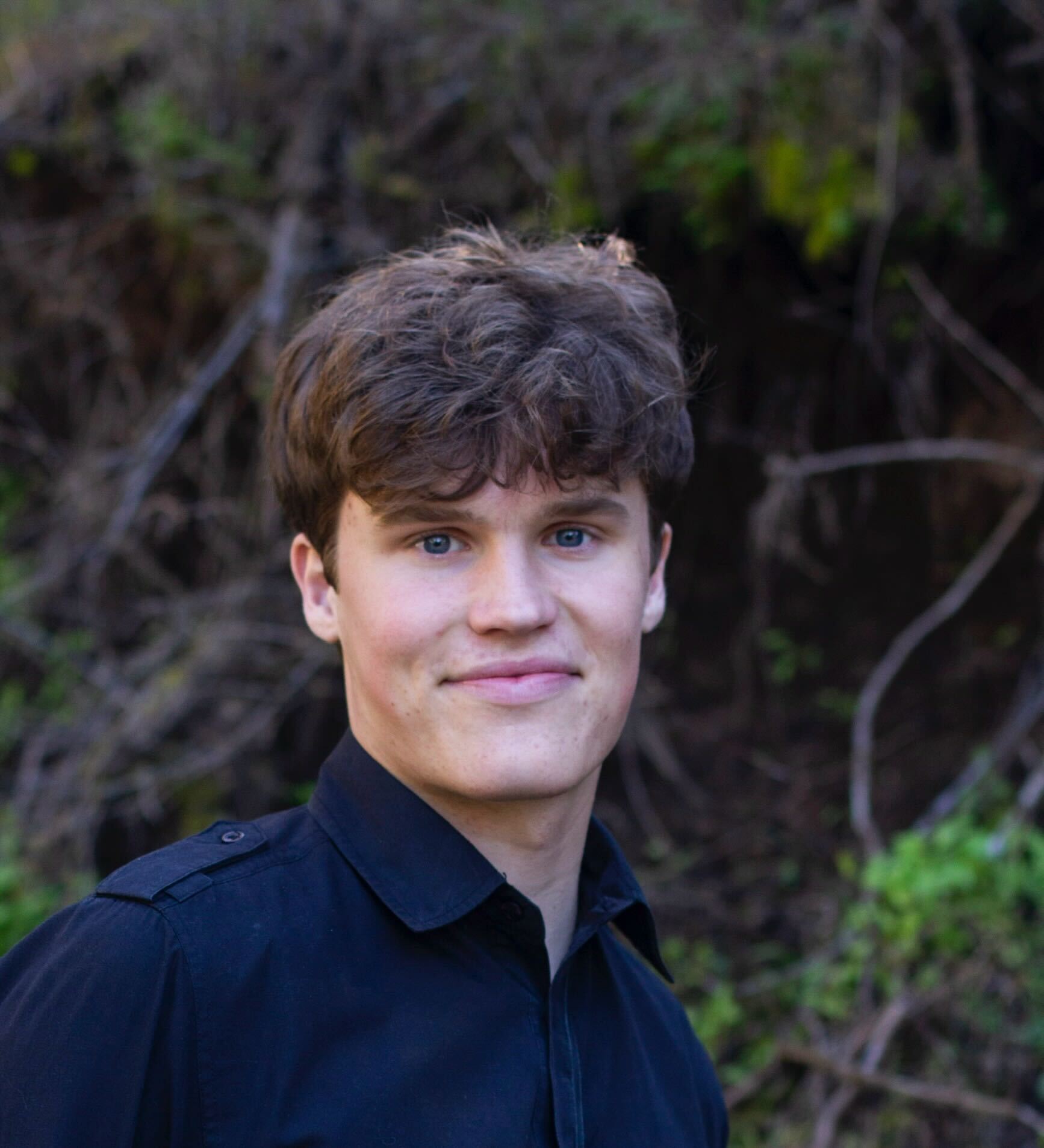
Turner Van Slyke ’28 was sitting at his dorm room desk in February when he received an unusual message over LinkedIn. The note was from James Intriligator, a mechanical engineering professor at Tufts University, and its subject line read, “Organizing/motivating protests and other actions.” Intriligator wanted to know if Van Slyke was available to discuss “why are not more students protesting — like at every campus?!”
Ten days after Donald Trump’s inauguration, Van Slyke had rallied a small group of students into the cold of Stanford’s White Plaza at night, where they chalked messages like “Stanford, Don’t Acquiesce to Trump!” An article about the chalking caught Intriligator’s attention.
Van Slyke was overwhelmed by school work when he received the message, and keeping up with LinkedIn was low on his priority list. But Intriligator seemed sincere, and Van Slyke couldn’t imagine an ulterior motive for the request. “There’s certainly not money in being a progressive political thinker or mobilizer,” said Van Slyke, who stands at six feet two inches tall with a muscular frame and a head of light-colored curls.
He agreed to talk with Intriligator over the phone, and came away with the impression of a “mad scientist” who operated “on a stream of consciousness basis.” Intriligator, who oversees a design lab at Tufts, had been experimenting with AI tools and encryption to generate ideas for progressive political organizing in the Trump era.
That initial call convinced Van Slyke to help Intriligator bring his plans to life. Over the next few weeks, a series of conversations between them and Cameron Conner, a community organizer at Tufts, centered on the fallout of Trump’s executive orders. They shared one question, Conner said: “How do we bring enough people together that we actually have enough of a constituency to raise our voice?”
Given their connections to higher education, the trio chose to focus on colleges and universities, which had become the target of cuts and investigations by the White House. In March, they founded Education and Democracy United (EDU), a national organization. Its mission was to build “local movements around a shared mission to protect student free speech, academic freedom, and civic engagement on campuses nationwide.”
Today, the group is being incorporated as a national non-profit with a presence at around 10 schools, including Tufts; Middlebury College; the University of California Irvine; the University of Georgia and the University of Illinois, Urbana-Champaign. At Stanford, EDU’s chapter hosted a well-attended pro-democracy rally and meetings during the spring.
Van Slyke didn’t anticipate that growth when he co-founded EDU. As the organization’s scale expanded on campus and across the country, he began to feel stretched thin. “I believed so deeply in the things we were advocating for, but there was no point in time where I felt like I had enough bandwidth to really think about what it meant,” he said. Still, he remained involved through the spring and summer, galvanized by what he saw as a “norm-shattering presidency” and concerns about rising nativism.
After Stanford announced significant budget cuts in June, Van Slyke also learned that his financial aid was being reduced, driving his tuition up by two thirds. By incorporating EDU as a non-profit, he and other organizers hope to receive a salary for their work and avoid taking campus jobs next year.
Now, with the school year beginning, Van Slyke plans to continue working with EDU’s national team and coordinating student campaigns across the country. Their focus, he says, will be “to shed light on the most anti-democratic elements of this current administration,” while encouraging civic engagement among students.
In the wake of settlement deals between universities and the federal government for hundreds of millions of dollars, the organization could be poised to sustain progressive political activism on campuses across the country. At least, that’s what Van Slyke hopes.
***
Years before he took up the cause of academic freedom, Van Slyke gained a passion for political organizing while growing up in the small city of Walla Walla, Washington.
“One of the things that I admire about Turner and people like him is that their principles are so central that sometimes you just take the risk, and you trust the process,” said Van Slyke’s father, JR, a world history instructor at Walla Walla Community College who once served as president of the college’s teachers’ union.
JR and his wife Courtney — a Walla Walla native and fellow educator who teaches English to local immigrants — tried to instill a spirit of “questioning” in their two sons early on. Their younger son, Kellen, is a high school junior in Walla Walla.
The boys grew up attending the United Church of Christ, whose congregants belonged to multiple faiths or no faith at all. “Half of the people there probably didn’t believe in God,” Turner joked. His liberal views developed early, and sometimes set him apart in Walla Walla County, which has voted for the Democratic candidate in only one presidential election since 1940.
“What are you, democratical?” a grade school peer once asked him after he made a left-leaning comment.
JR believes that some of Turner’s peers in Walla Walla saw him as “the weird smart kid,” a perspective that Kellen echoes. At school, Kellen says, he and his brother “have just been associated with tree huggers and [being] rather stuck up … I’ve heard people talking about my brother saying, ‘Why does he have such drive?’”
By the time college application season arrived, Van Slyke had racked up a list of accomplishments in community organizing — he advised Walla Walla public schools on sustainability issues, founded a climate action group and participated in the Bill and Melinda Gates Foundation’s Education Roundtable.
Those distinctions helped him gain acceptance to Stanford. The summer before new student orientation, he decided to bike his way down the Pacific coast to campus, carrying his belongings in stuffed packs. When he arrived, he found a home in Otero, a public-service themed dorm, where he made friends with like-minded students.
He enrolled in earth systems and international relations classes and picked up swing-dancing as a hobby, which he earnestly compares to “smiling with your body.”
For an American college student, his lifestyle goes against the grain. He shuns social media, having deleted accounts on Instagram and TikTok by the start of his freshman year because the platforms felt “artificial.” He uses the same word, “artificial,” to explain why he avoids the gym. In his free time, he prefers reading, weekend hikes at Yosemite and long-distance runs.
Once Van Slyke founded EDU at Stanford, growing the chapter meant recruiting his friends and classmates as organizers. It also required honing a message that would attract as many people as possible.
The unrest that shook college campuses after Oct. 7, 2023 informed the group’s strategy. Van Slyke and his friends in the first-year class were still finishing high school when a group of pro-Palestinian protesters barricaded themselves inside the university president’s office and spray-painted militant messages around Main Quad, leading Stanford to remove a pro-Palestine encampment. Police arrested 12 of the protesters, who now face felony charges.
When he started organizing on campus the following year, Van Slyke said he received “words of warning” from those who witnessed the encampment and protests firsthand. While he credited the movement with investing “orders of magnitude more effort” into its work than EDU, he also criticized it for an overly divisive approach that “painted enemies as evil people.” In particular, he hoped to avoid missteps like the acts of “hateful” vandalism and trespassing that blunted campus support for protesters’ cause.
As Van Slyke planned a rally in the spring, that philosophy shaped his approach. He told members of the group that their goal was to “unite” the Stanford community and specifically “advocate for academic freedom.” Their tactics, he stressed, were non-violent and non-partisan.
EDU’s logo had a similar feel, featuring two hands shaking: one blue and the other red. They planned to invite an unusually big tent of student organizations to participate in the rally, spanning Students for Justice in Palestine, Stanford Hillel and The Stanford Review, a conservative publication.
How did they plan to engage a politically apathetic student body, with many more focused on chasing success in Silicon Valley than staging protests?
EDU’s rally would have to seem “fun” to students, Van Slyke said. “Right now, I’m avoiding saying ‘the T word’” he added. There was no need to clarify his reference to the president.
***
On the day of EDU’s rally in May, Van Slyke wore jeans, hiking boots and a white T-shirt hand-printed with bright red letters that read “Stanford Stand for Democracy.” He and other organizers began by unfolding tables on the lawn of White Plaza.
Despite losing hours of sleep to help put on the rally, Van Slyke showed no outward signs of fatigue. “This is the fun part,” he said, rearranging the set-up an hour before his opening speech. “The last few days were the stressful part.”
Each table would host a different campus organization, including Stanford in Government and the Stanford ACLU. But more partisan pro-Palestine groups like Jewish Voice for Peace and Students for Justice in Palestine ultimately had no presence. Van Slyke said these groups’ absences had been “more on their end” than EDU’s decision.
The event also received logistical and funding support from the university. Collaborating with administrators was simply “the reality of politics, which is inherently frustrating,” Leela Mahajan ’25, an EDU organizer, said in an interview weeks later.
For Mahajan, EDU’s collaboration with Stanford connected to the rally’s silence regarding Palestine. “Not explicitly talking about it came about by working inside of a system that doesn’t want to acknowledge it,” she said.
Still, Van Slyke didn’t play it safe in his six-minute speech. Confident yet measured, he condemned pro-Palestinian activists being “kidnapped off the streets” for exercising free speech, and government threats to punish universities unless they limited students’ protest rights.
The rest of his speech disavowed partisanship, shifting away from the Trump administration’s actions. “This is not about resisting a specific party or politician,” he said. “It’s about building a better, freer university system where we don’t bounce between censorship coming from alternating sides of the political spectrum every four years.”
By the end of the rally, over 150 people had stopped to pick up a flyer or buy a “Stand for Democracy” T-shirt. “We made it clear there’s a community for thinking about these problems, and I think a lot of people found that uplifting,” Van Slyke said.
***
As the rally slipped into memory, Van Slyke came to agree with Mahajan that it overlooked Palestine. “We were trying to skirt that messaging in a way that I was kind of uncomfortable with,” he said.
By the end of May, he joined a pro-Palestine hunger strike that demanded university divestment from Israel, going two days without food. The experience, he said, helped him “empathize personally with the victims in Gaza.”
“I never really had much hope that the strike would bring administrators to the table,” he added. “But what I do know is that I can’t think of a single time when hunger strikers were on the wrong side of history.”
Van Slyke is noncommittal about whether he will return to pro-Palestine protests this year, but plans to remain involved with causes he cares about beyond EDU.
As for EDU’s future, he hopes to see it grow as an “outlet” for young people who might feel powerless in the current political climate. The success of that goal will likely hinge on college students’ engagement across the country. The 2026 midterm elections, he believes, represent the next major opportunity for students to mobilize behind “pro-democracy candidates.”
After spending his summer hiking through Europe, Van Slyke has also moved past some of his anxiety from EDU’s early days. He feels better prepared to ensure a “sustainable” work load, and more aware of his vulnerability as a student activist.
Still, he can’t seem to shake a sense of urgency about political action. “I wish that I had more time to enjoy college in more of a carefree way,” he said. “But it feels like so many important things are happening right now, and that demands attention, and that demands people who care.”
This article has been updated to reflect that not every organization that participated in the rally was political.