
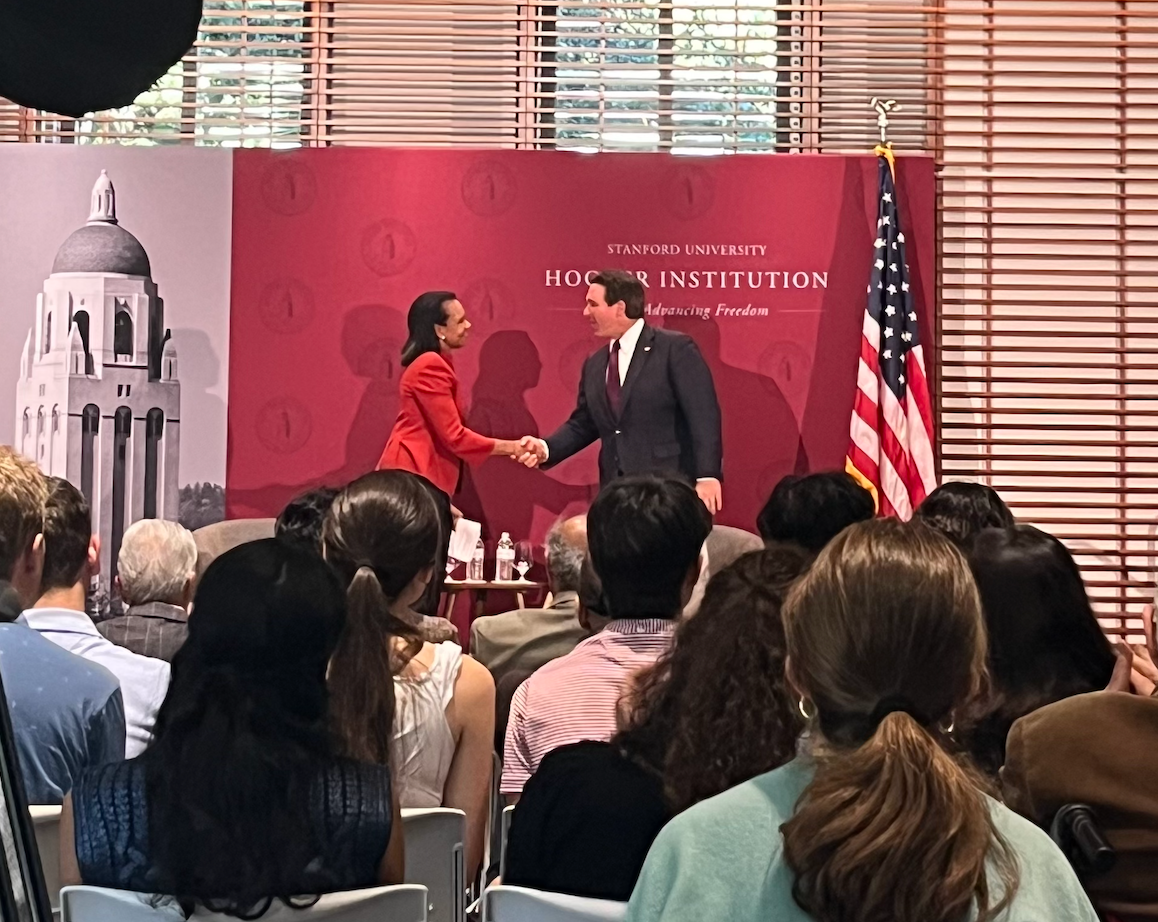
In his recent op-ed, Joe Nail wrote very positively of the Hoover Institution hosting Florida Gov. Ron DeSantis. He lauded what he called the event’s fervent commitment to the University’s “renewed commitment to free speech.” He framed it as a matter of necessarily engaging “with major political figures who shape the nation’s future, no matter where they lie on the political spectrum.” In essence, the bold nature of free speech and the vibrant, constructive democracy that it necessitates were both advanced.
To understand whether or not that’s actually true — the notion that the DeSantis event honored free speech — let us examine what DeSantis stands for.
DeSantis has expanded the deputization of Florida law enforcement under Immigration and Customs Enforcement (ICE) — agreeing with the ethnonationalism and community invasion of President Donald Trump’s deportation agenda.
DeSantis has, with the intent to “protect the innocence of Florida’s children,” gutted the medical rights of transgender Floridians, banned LGBTQ+ instruction before high school and forced transgender girls and women into male bathrooms. In doing so, he adopts the Trump position that transgender people are pedophilic criminals that violate “biological truth” and must be erased from our healthcare system.
DeSantis has even canceled research grants related to diversity, equity and inclusion (DEI) and overseen the mass closure of college community centers. In doing so, he stands toe to toe with Trump’s orders to purge higher education of the research and community practices that dare challenge his straight white male orthodoxy.
On some of the most pressing issues of our time — questions of how we enforce our laws, who belongs in society and what freedom looks like in a diverse, pluralistic society — DeSantis is in lock step with the White House. We must then ask ourselves: Is an event truly advancing a “commitment to free speech” if it advances the positions of the federal government? Is Hoover taking a bold, difficult step by conforming to the worldview of the most powerful person in the world? I think not.
Free speech, at its best, defies the conventional political discourse of the time. We see that in why the Founding Fathers believed in the First Amendment in the first place. Thomas Jefferson writing that “God hath created the mind free, and manifested his supreme will that free it shall remain by making it altogether insusceptible of restraint” and James Madison that “the opinions of men … cannot follow the dictates of other men” sends a clear message: We are created with a conscience that is meant to speak freely. The best way to speak our conscience in a democratic society is to challenge the mandates of whatever the governors, presidents or kings of the time may decree.
The promise of free speech — speaking the conscience, strengthening democracy — is one that American heroes have put so much on the line for. Civil Rights Era protestors demonstrated in bold, at times bloody, defiance of segregation. LGBTQ+ protestors now facing a backslide on their rights, forged a movement through immense bloodshed decades ago. Anti-ICE protestors have similarly honored this bold, risky tradition — being pepper-sprayed, thrown to the ground and even shot at by ICE. People like that, who have risked livelihood and safety to speak their conscience, resist the dictates of their day and shape the nation’s future, are truly committed to free speech.
I am more than willing to admit when the Stanford community has wavered on its commitment to free speech. The Undergraduate Senate attempted (unsuccessfully, thankfully) to deny the Stanford College Republicans a grant to bring former Vice President Mike Pence to campus. As well intended as the Stanford IT Community was with its since-ended Elimination of Harmful Language Initiative, it would have amounted to byzantine word policing. The Faculty Senate’s Ad Hoc Committee on University Speech and the Office of Community Standards, both of which I have unapologetically condemned, have been unaccountable to students’ free speech interests. Stanford’s record is imperfect, but it can do better. It must rise above the current free speech hellscape that is Trump’s second term.
Let us be clear on the broader, more consequential contours of free speech in this country. We are in an era where the White House is turning political supporters of Charlie Kirk into a protected class, indicting political figures who dare to challenge the president’s immigration agenda and outright criminalizing oppositional beliefs. I cannot view Hoover’s event with DeSantis as remotely courageous. I view it as Hoover taking the easy way out on free speech by conforming to the Trump administration.
Going forward, however, Hoover and the broader Stanford community can do better. A crucial way for us to honor free speech, a right that the University purports to value and many have died for, is to host speakers that are unapologetically opposed to Trump’s federally-enforced orthodoxy.
We ought to invite people like Kat Abughazaleh and Mahmoud Khalil, a Palestinian American congressional candidate and leading Palestinian organizer, respectively, who have both faced the brunt of Trump’s anti-dissident immigration enforcement.
We ought to invite people like Sarah McBride and Erin Reed, the first openly transgender member of Congress and a renowned transgender journalist, respectively, who have led the way on justice for transgender people.
We ought to invite people like Maura Finkelstein and Michael Hook — professors whose views on Palestine and Charlie Kirk were the cause of their respective terminations.
I urge not just Hoover but also groups like Stanford in Government, Stanford Political Union and the Center for Democracy, Development and the Rule of Law to invite the types of speakers that our free speech environment necessitates.
Trump is no friend of free speech. As small a step as inviting dissident speakers might seem, doing so would send the message to not just our peer institutions but to the nation at-large that free speech is still worth fighting for. For the sake of our democracy, Stanford must become the place where the winds of free speech blow like a hurricane.