
Nicholas Thompson ’97, the CEO of The Atlantic and a record-setting marathon runner, returned to his alma mater to discuss his most recent book, “The Running Ground,” at a communication department event on Nov. 21.
In the talk, Thompson answered questions from Jay Hamilton, Vice Provost of Undergraduate Education and Director of the Stanford Journalism Program, discussing how running mediated his relationship with his late father, Scott Thompson ’63, and informed his approach to other aspects of life.
Thompson shared that his father experienced academic and professional success throughout the first decades of his career, but spiraled after coming out as gay and feeling that his career was crumbling. Thompson noticed that when his father went for a run, he was the most in control of his fears and anxieties.
“One of the themes of the book was our relationship, which was quite difficult at times, and held together at points through running,” Thompson said.
In childhood, Thompson took up running to connect with his father. As he grew older, the sport became a meditative practice, and the insights he drew from it — the idea that the small choices made each day can accrue into larger successes or failures, for example — have been reflected in his career as an editor and a CEO. Faced with difficult problems, he would set timers to solve them as best he could in a given amount of time. Under his leadership, The Atlantic has reached its highest subscribership in its 167-year history.
Thompson graduated from Stanford with a dual degree in earth systems and political science. He also completed the requirements for an economics degree. He was also a member of the track and field team for his first year before dropping out due to injury. In an email to The Daily, he said that leaving the team not only allowed him to find his place on campus, but also prevented burnout as an older athlete.
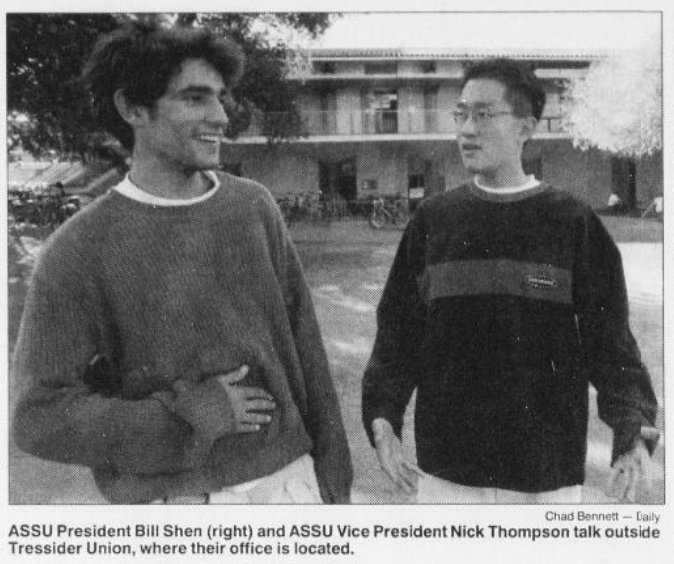
In his later years, Thompson joined Students for Environmental Action at Stanford (SEAS) and the Associated Students of Stanford University (ASSU), participating in protests on campus and around California. Political science professor Michael McFaul, who supervised Thompson’s senior thesis on Burma, remembered him as “multifaceted” and “interactive.” He was also a columnist for The Daily and co-founded The Thinker, a publication for cross-ideological debate, which he funded by selling ads.
Upon graduating, Thompson worked for CBS’s 60 Minutes, but was quickly fired due to inexperience. He then traveled through Africa, where he was kidnapped by drug dealers, an experience he wrote about for The Washington Monthly. He was also diagnosed with cancer, but recovered and continued to run.
“If you kind of come to the edge and face mortality, if you survive it … you start to focus,” Thompson said. “I could easily slack off. But I’m terrified, in part because I had so much failure in my twenties, and in part because I was watching my father’s example, [so] I don’t.”
Thompson has completed the New York City Marathon 12 times. In 2021, he set the American 45-49 age-group record for running 50 kilometers.
Thompson also answered audience questions on the ethics of The Atlantic’s paywall, how he chose the five marathon runners whose stories he interwove into his book and the role of artificial intelligence in journalism.
In 2024, The Atlantic signed a partnership with artificial intelligence company OpenAI that allows the company’s model to train on The Atlantic’s archives in exchange for access to their technology and a voice in shaping news experiences in ChatGPT and other products.
“I think something that came across really clearly in his talk is that he has both the analytical ritual of a journalist, but also, I think, an intuitive depth that comes from maybe being more literary and from being very introspective,” said Kate Li ’25, a first-year in the management sciences and engineering master’s program.
Thompson met his wife, Danielle Goldman ’96, while playing the guitar in CoHo. The final question he answered was about how he approaches the aspects of life that can’t be quantified, like love.
“I think that he speaks with a thoughtfulness, a rigor, and a forward-thinkingness that is rare in this industry,” Hannah Woodworth M.A. ’25 said. “Knowing that he’s had this trajectory of ups and downs that started here at Stanford and now led to this really incredibly powerful role in the media industry is inspiring being a student here now.”