
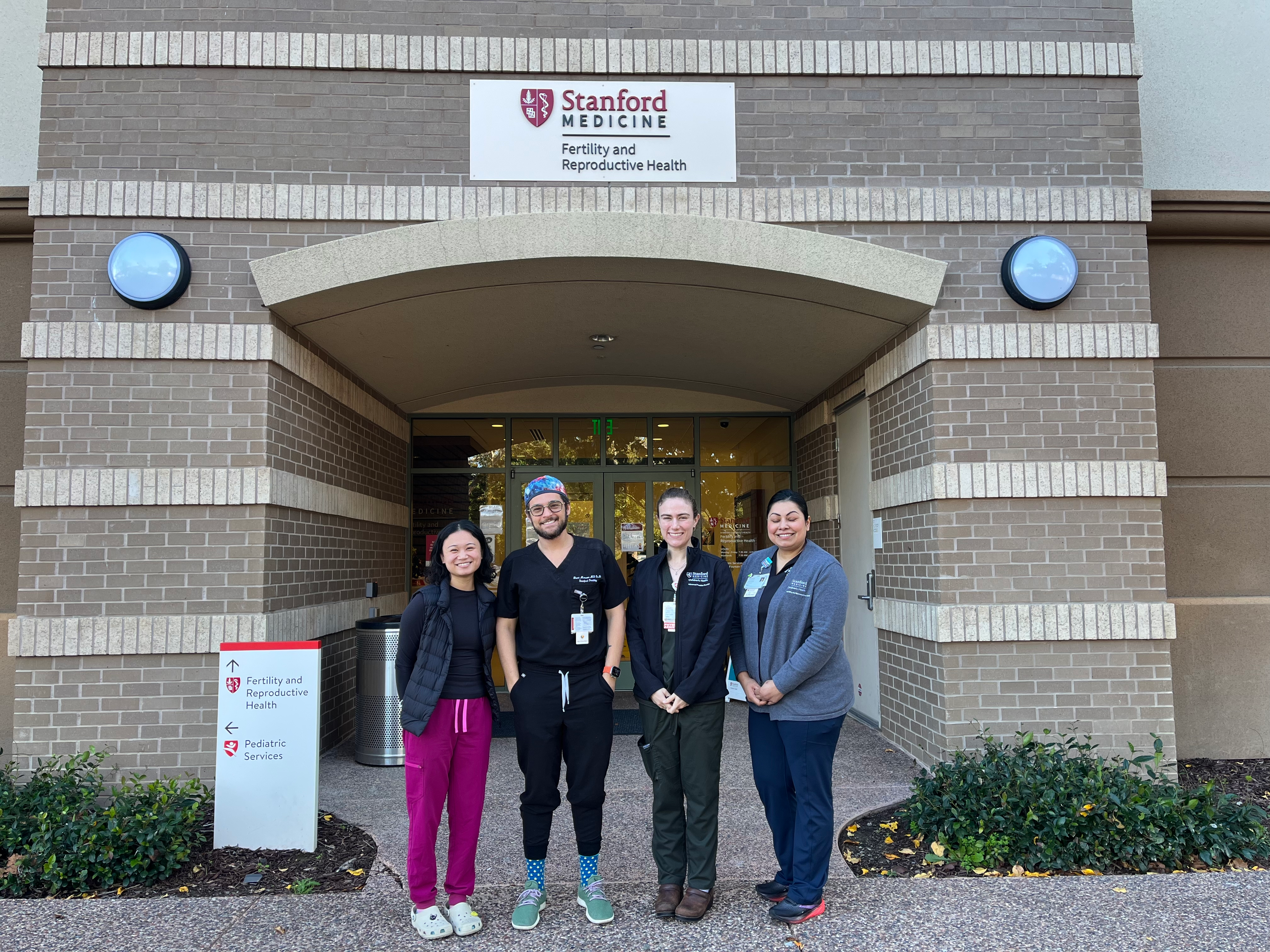
On Sept. 23, The Daily published an article on obstetrician and gynecologist Brent Monseur’s decision to leave Stanford Medicine after cuts to reproductive healthcare and gender-affirming care. Monseur, the founding director of the LGBTQ+ Family Building Clinic, described severe disruption to their own and their colleagues’ work this year. According to Monseur, grants related to LGBTQ+ healthcare and reproductive healthcare were lost, and clinical work was limited. When the program lost funding due to cancelations of federal grants, Stanford Medicine neglected to intervene and ensure a continuity of care. Stanford Medicine failed to stand up for its doctors and its patients.
We write as concerned Stanford graduate students and alumni to explain how Stanford Medicine’s preemptive concessions amid the federal assault on transgender healthcare that has continued into late 2025 must be understood as threatening to ourselves, our community and our University. While Stanford Medicine and the University are distinct institutions, they are deeply integrated. We view Stanford Medicine’s failures to support doctors and patients in LGBTQ+ healthcare as aligned with, and foreshadowing of, changes that have been and may be undertaken by the University.
The events that precipitated Monseur’s departure began months ago. In June, it was announced that Stanford Medicine would stop providing gender-affirming surgeries for minors. The move was framed as an effort to protect providers and patients in light of the Trump administration’s attacks on transgender healthcare. Stanford’s voluntary pause, which went into effect on June 2, came several months after the White House’s executive order, “Protecting Children From Chemical and Surgical Mutilation,” on Jan. 28.
In May, the Trump administration once again targeted transgender healthcare. The Centers for Medicare and Medicaid Services sent a letter to hospitals expressing that “the United States Government has serious concerns with medical interventions for gender dysphoria in children.” By spring, healthcare providers were under tremendous pressure from the federal government to reevaluate their approaches to gender-affirming care. By proactively stopping gender-affirming surgeries for patients under the age of 19 in June, Stanford enforced Trump’s policies. In doing so, Stanford Medicine limited access to forms of care for both its providers and its patients and denied patients the freedom to make their own decisions about their care with the guidance of their providers.
With the decision to limit access to gender-affirming surgeries, as well as the decision to curtail other programs, Stanford Medicine went beyond what was legally mandated by the federal or state government. This created tremendous concern and confusion for both patients and providers. As Monseur explained in The Daily article, after its halting of gender-affirming surgeries for minors, Stanford Medicine gave no clear answer as to whether other forms of care, such as egg-freezing services, would be permitted for pediatric patients.
Monseur’s departure is reflective of the complex history of Stanford’s care for LGBTQ+ patients. Stanford pioneered gender-affirming care with the start of Donald Laub’s Gender Dysphoria Program in 1968. The program was modeled on Johns Hopkins’ Gender Identity Clinic — the first center dedicated to transgender healthcare in the United States. Laub’s program performed surgeries, as well as other forms of gender-affirming care, including hormone therapy and counseling. While certainly a step forward for transgender healthcare, the program was not without faults. The program participated in medical gate-keeping, which drove many transgender people to seek care from unlicensed providers or in other countries.
On our campus, the Lane Medical Library still holds the records of the Gender Dysphoria Program. We have a responsibility not only to engage with this institutional history but also to uphold gender-affirming care in Stanford’s facilities and draw attention to the ways in which Stanford University and Stanford Medicine have failed patients. Our responsibility to protect the health and well-being of our transgender community has become apparent, especially after we observed a stark increase in transphobic fearmongering last fall. Facing the current administration’s attacks on transgender healthcare, Stanford Medicine has an opportunity to correct histories of withholding care from transgender patients. We hope it will decide to do so.
As current and former graduate students and employees at Stanford, we depend, or have depended, on the University’s healthcare system. Most of us receive health insurance through Stanford’s Cardinal Care program as part of our funding, and we are often routed through Stanford Medicine healthcare facilities. Those of us who receive reproductive or gender-related care remain particularly vulnerable. University staff and undergraduate students also often enroll in Stanford’s healthcare services. Some students and affiliates are minors who receive healthcare from Stanford Medicine and may be interested in seeking gender-affirming surgery. With this cut, Stanford limited its options for serving its community.
While cuts have hit us here first, there is a danger they will radiate outwards. The move by Stanford Medicine to stop these programs in advance of any explicit, legally-enforceable directive from a government agency, and in contradiction with state law, sets an alarming precedent for other health organizations. While we respect healthcare providers’ decisions to protect their patients, Stanford Medicine’s conciliatory attitude protects no one. Gender-affirming care saves lives and is critical to the mental health of transgender individuals. In failing to protect such programs, Stanford Medicine is placing patients beyond the community at risk.
Cuts to healthcare have run parallel to attacks on universities and students across our country. These assaults must be understood as connected within a broad strategy that aims to transform the culture and politics of American institutions. Stanford Medicine and Stanford University must stand together against this affront.
We write to assert that these actions — these failures — are unacceptable.
Stanford Medicine must reinstate access to all forms of gender-affirming care for all of its patients. It must maintain this access as a protective measure to work against the unending assaults on the rights of transgender individuals that we have seen across our country throughout this year.
We hope to see Stanford University and Stanford Medicine make decisions to protect our culture and our freedoms. Hope is a discipline. We take this stance for the sake of our shared future.
Miri Powell ‘27 is a Ph.D. student in history. Sasha Barish is a third-year Ph.D. student in classics.
The authors’ original letter has been edited for clarity and in accordance with The Daily’s editing style.
SIGNED
Miri Powell, Ph.D. candidate, history
Paul G. Nauert, Ph.D. ’23, history
Sasha Barish, Ph.D. candidate, classics
[Anonymous Signee], Ph.D. candidate, history
Justine Modica, Ph.D. ’23, history
Adele Stock, Ph.D. candidate, history
Mallen Clifton, Ph.D. candidate, English
Quinn Monette, Ph.D. candidate, modern thought & literature
Bella Shahani, M.A. student, History
Hannah Johnston, Ph.D. candidate, history
Matthew Previto, Ph.D. candidate, classics
Sinead Brennan-McMahon, Ph.D. candidate, classics
Charbel Bou-Khalil, M.D./M.S. student
[Anonymous Signee], Ph.D. candidate, classics
Amanda Zhang, Ph.D. candidate, history
Justin-Casimir Braun, Ph.D. candidate, political science
Lily Haupt, librarian, Stanford Law School
Megan Coram, Ph.D. candidate, engineering
Ev Nichols, Ph.D. ’24, biology
Ciel Haviland, Ph.D. candidate, history
Nicholas Cullen, Ph.D. candidate, classics
Matthew Padgett, Ph.D. candidate, anthropology
[Anonymous Signee], M.A. student, history
[Anonymous Signee], postdoctoral scholar, radiation oncology
Freya Schlaefer, Ph.D. student, classics
[Anonymous Signee], Ph.D. candidate, anthropology
Eric Lindheim-Marx, Ph.D. candidate, history
J.S. Huston, Ph.D. candidate, history
Alexa Russo, Ph.D. candidate, anthropology
Danielle Adair, Ph.D. candidate, theater and performance studies
Juniper Jeon, M.A. student, computer science
Victoria Varlack, Ph.D. candidate, developmental and psychological sciences
Emily Chen, Ph.D. candidate, materials science
[Anonymous Signee], Ph.D. Candidate, communication
Haley Lepp, Ph.D. candidate, education
Allie Cemalovic, Ph.D. candidate, civil engineering
Madison Bunderson, Ph.D. candidate, education
Emma Cuddy, Ph.D. candidate, materials science
Emi Soroka, Ph.D. candidate, electrical engineering
Max Sutton, Ph.D. candidate, Earth and planetary science
Jay Liu, M.D. student
Nora Enright, Ph.D. ’25, bioengineering
Helene Koumans, Ph.D. candidate, chemistry
Gina Kittleson, PhD candidate, civil and environmental engineering
Lena Phalen, Ph.D. candidate, education
Marcia Yang, Ph.D. candidate, education
[Anonymous Signee], Ph.D. candidate, education
Alexandrea Henry, Ph.D. candidate, education
[Anonymous Signee], Ph.D. candidate, oceans
Kendall Cole, Ph.D. candidate, education
Orisa, Ph.D. candidate, mechanical engineering
Harper Lowrey, Ph.D. candidate, biology
Adina Glickstein, Ph.D. candidate, art history
Sophie Callcott, B.A. ’24, history
Charlotte Wehner, Ph.D. candidate, electrical engineering
Kristen Guernsey, M.S. student, electrical engineering
Courtney MacPhee, Ph.D. candidate, history
Esther Tok, B.S., biology
Michelle Heeman, Ph.D. candidate, classics
David Barnstone, Ph.D. candidate, communication
Chris Plantinos, Ph.D. candidate, education
Sheen Kim, J.D. ’26
Kassandra Sharp, staff, Doerr School of Sustainability
Danny Sallis, research fellow, Stanford Law School
Tejas Dharmaraj, M.D./Ph.D. student
Cole Tanigawa-Lau, Ph.D. candidate, political science
Isabel Davidoff, Ph.D. candidate, materials science
Alex Basaraba, Ph.D. candidate, Doerr School
Kelley Langhans, alumnus, biology
Cecelia Morrow, Ph.D. candidate, anthropology
Ann Vu, undergraduate, bioengineering
Kae Heller, B.S. ’27, physics
Jack Correy, undergraduate, math
Mika Semke, undergraduate
Emma Muller, undergraduate
Daniel Stein, undergraduate
Cathy Zhang, undergraduate
Ryan Guan, alumnus, computer science
Daniel Beaulac, undergraduate
Liam Herndon, Ph.D. candidate, chemical engineering
Emma Follman, Ph.D. candidate, neurosciences
Ankita Bhattacharya, Ph.D. candidate, anthropology, Stanford Graduate Workers Union executive board