
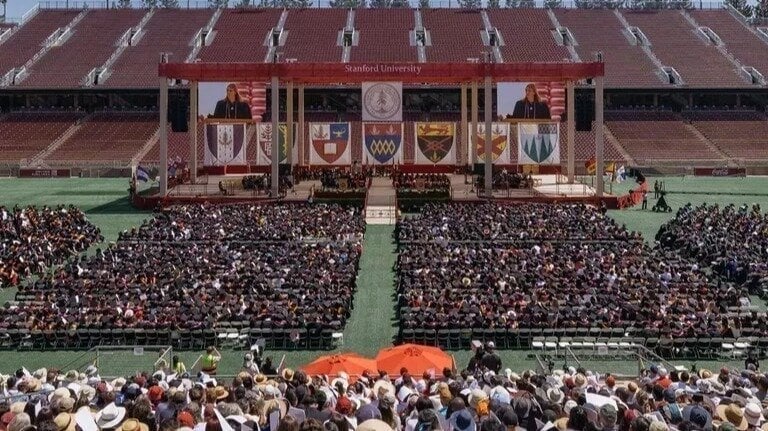
We are Stanford students affiliated with Education & Democracy United (EDU), a nationwide organization dedicated to advancing academic freedom, accountability and democratic participation on college campuses. Two months ago, the Stanford chapter of the American Association of University Professors (AAUP) published an op-ed noting that the University had quietly removed all student speakers from this year’s departmental commencement ceremonies. To our knowledge, this remains the only public acknowledgment of the change. Given commencement’s symbolic importance and role as a platform for student voices, we believe the decision warrants broader scrutiny from the student perspective.
Stanford must reinstate student commencement speakers. Limiting student speech at one of the University’s most visible ceremonies conflicts with Stanford’s commitments to academic freedom, undermines trust between students and campus leadership and weakens the democratic culture our school aims to cultivate.
Administrators have informally suggested that this decision was motivated by complaints from students and their families who felt their past commencement experiences were endangered by political speech surrounding Gaza. No student should feel unsafe at graduation. However, discomfort and disagreement are not threats, and a campus committed to free expression must distinguish between dangerous and unwelcome speech. Indeed, as emphasized by administrators, grappling with unwelcome ideas is central to our educational experience. Regardless of the politics expressed, Stanford should accept thoughtful protected speech as encouraging proof that students are willing to grapple with the world’s most pressing challenges. Shielding students from political expression at commencement implies that controversial speech is incompatible with ceremony and that harmony demands silence.
University policy already provides clear safeguards against disruptive or dangerous speech. Speech that incites violence or harassment is not protected. If a student speaker violates these standards or otherwise fails to “preserve the dignity and seriousness of University ceremonies,” targeted disciplinary action is appropriate. What is harder to justify is a blanket removal of all student speakers imposed beforehand and without reference to specific misconduct. Existing guidelines, vetting processes and disciplinary measures are sufficient to address genuine harms without silencing students altogether.
Over the past two years, universities including USC, NYU, MIT and George Washington University have faced backlash over unapproved commencement speeches related to political activism. Administrators at those schools responded by canceling individual speeches or imposing sanctions after the fact. However, Stanford’s approach goes further, eliminating student speakers altogether and setting a troubling precedent.
While the University has not publicly explained its reasoning, national trends suggest campus leadership hopes to mitigate political controversy, donor backlash or external scrutiny. These pressures are real, particularly amid intensified political attacks on higher education. Still, removing student voices from commencement is a misguided response. Concerns about our image should not outweigh the University’s responsibility to model principled leadership and democratic values precisely when higher education is under pressure. If Stanford hopes to build public trust and serve as a model for other universities, our school must demonstrate that its commitments to free expression hold.
Students invest deeply in Stanford through tuition, labor, research and representation beyond campus. In return, the University has a responsibility to engage student voices in good faith. Reinstating student commencement speakers would be a meaningful step toward rebuilding trust and reaffirming Stanford’s commitments. Universities are training grounds for democracy, and commencement marks the transition from learning civic lessons to living them. If our students can’t even speak at their own graduation, is our school really preparing them to engage with tomorrow’s most important conversations?
We urge the Office of the Vice Provost for Undergraduate Education and the Office of the Vice Provost for Graduate Education to reinstate student commencement speakers at this year’s departmental commencement ceremonies and engage students, faculty and shared governance bodies before future changes to commencement speaking policies.
To support these actions, please sign our petition. If you care about issues of democracy, accountability and academic freedom on campus, consider getting involved with the Stanford EDU chapter or other student organizing efforts. Working together, Stanford can ensure that commencement reflects both the dignity of the occasion and the core principles of the University.
Turner Van Slyke ’28 B.S. is an organizer with Education & Democracy United.
This piece is also co-signed by Georgia Allen ’28, Owen Rowe ’28 and Gauri Kathula ’29.