
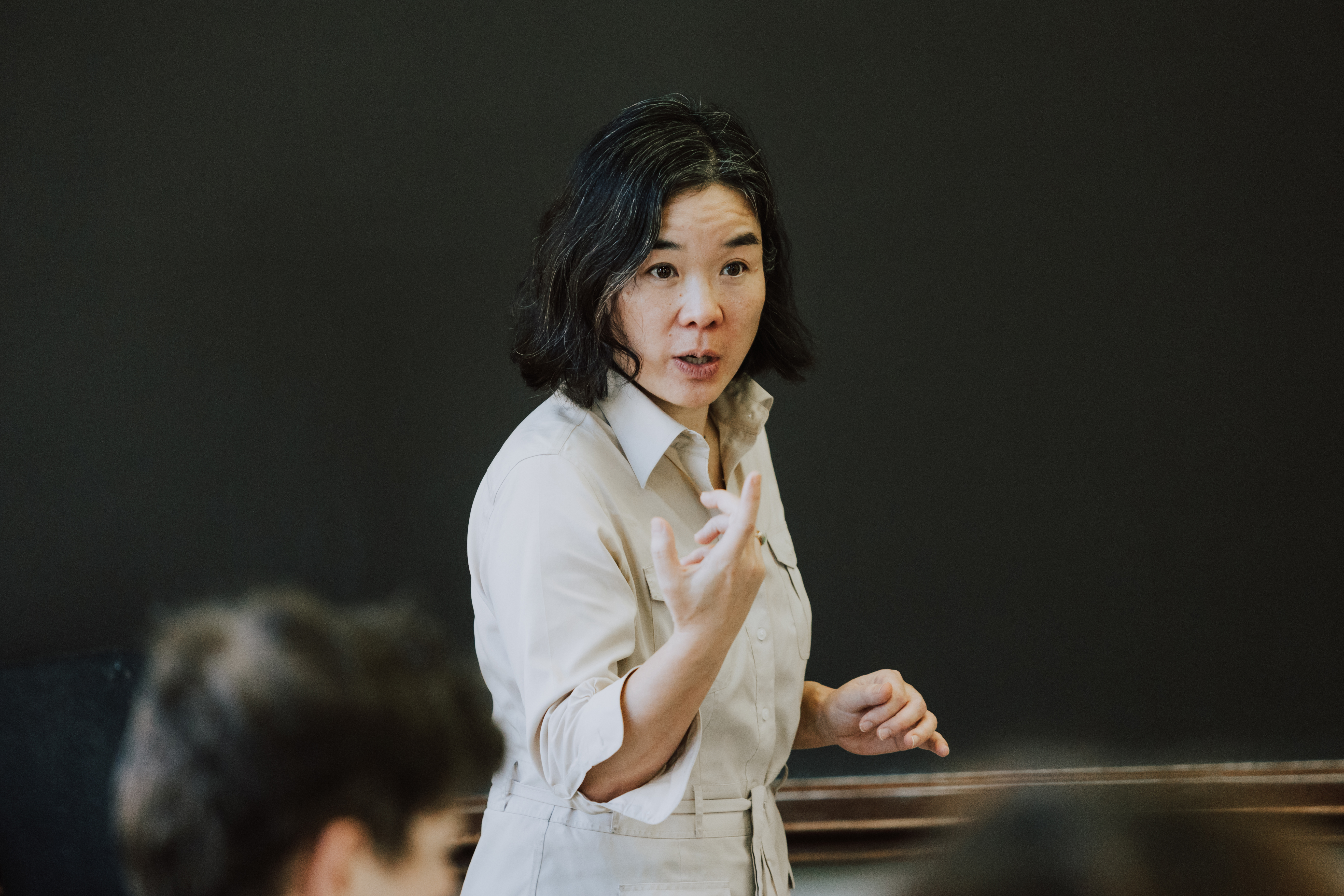
Pauline Lee ‘91, Ph.D ‘02 represented Chinese Taipei in the Ladies’ Figure Skating Olympic Championships in 1988. She is a professor of Chinese thought and cultures at Saint Louis University and author of “Li Zhi, Confucianism, and the Virtue of Desire.” With Rivi Handler-Spitz and Haun Saussy, she is the author of “A Book to Burn and A Book to Keep (Hidden).”
Alysa Liu’s Thursday performance has earned high praise for its technical brilliance and her effusive joy. I’d like to add one more layer of praise: that her performance shows us how to live well — in ethics, we’d say she knows how to live the good life, a satisfying life, a life of value — in the most fundamental way.
In the fall of 1988, I had just begun my life as a Stanford frosh. Months later, I flew to Calgary and had the great honor to be the first woman to skate for Taiwan, by Olympic rules known as “Chinese Taipei,” in what was then referred to as the “Ladies’” Figure Skating Championships.
These days, I am a professor of Chinese thought. In the early classic “The Zhuangzi,” a book I teach and study, there is a well-known story about a butcher carving up an ox. An observer marvels, “Imagine skill reaching such heights!”
Such is Alysa Liu’s skating. At age 13, she was a skating prodigy, landing two triple axels in her U.S. Championships free skate, becoming the youngest-ever gold medalist. The axel, unlike the other five triples, takes off forward, with 3.5 revolutions in the air. At age 14, she was the first American woman to land a quad jump in competition.
Whatever Alysa’s extreme discipline, daring and legendary physical gifts then, she returns not only as one of the sport’s greats, but as the forger of an entirely alternative joyous, raucous storyline for figure skating, for women, for athletes and for a life well-lived.
It’s not that there have never been rebels in the world of skating. The Olympic bronze medalist turned orthopedic surgeon, Debi Thomas, a Cardinal herself (’91), comes to mind. Amongst historical moments, we look to the 1988 Olympics when she shocked the audience, and her own coach, skating onto the ice in a unitard for her short program. I was there, having just completed my own performance. Debi’s unitard led to an International Figure Skating Union rule that ladies, as girls or women skaters were then referred to, must wear costumes with skirts of a certain length. I suppose I was a rebel of sorts, too, as it was oddly but commonly thought in those days, maybe even today, that it was either elite skating or serious academics, but surely not both.
Our newest Olympic champion has walked all over and off the map. A burned-out child prodigy retiring at 16, she returned at 19 as the world champion. Competing in a precision-demanding sport balanced on a four millimeter-edge blade, but an everyday American college student with a DIY smiley piercing capturing photos (on Olympic ice) for friends and family. She jumps with joy, literally, into the arms of her coaches and rivals, with her “angel halo” zebra-striped hair in wisps. She tells reporters she’s fine if she messes up. She just needs to be out there. Is this the simple joy of an innocent child prodigy, enviably unaware of the inevitable other side of blindingly radiant Olympic glory? Alysa Liu walked out of the rink at 16. She certainly knows that other side.
Back in 1988, the Closing Ceremonies were such a joy, celebrating with newfound skating friends, teammates from Chinese Taipei, the Jamaican bobsled team, Eddy the Eagle and all the athletes. That next morning while eating a bagel sitting with my teammates, I decided I’d retire. I had done what I wanted to do in skating. And then, I wasn’t sure I loved skating so much anymore. I had new mountains to summit. I had always skated for that sense of flight; those quiet moments tracing figure eights (there were figure eights back then); physical expression through the finger tips; musical resonance; boundless faith my deep edges would hold; the energy created between the audience and me within a mere four minutes and six seconds of a free skate.
I had competed at international and world skating championships. But the Olympics were different. The Olympics is not skating itself. The Olympics is a beautiful institution, but not the deep edges, not the satisfying clean landing, not the sense of flight.
I walked out of the rink at age 19 and joyfully back into my dorm room in Rinconada — my mind thrilled learning about how one base pair could cause sickle cell anemia, or the wonders within “The Zhuangzi” — I reveled in a world of intellectual grand adventure, crafting a book manuscript, translating the words of a thinker half a millennium ago, debating whether the character in a text was 均 or 鈞. In time, I found I missed, then loved, skating again.
That this past Thursday Alysa Liu performed gorgeously, seemingly effortlessly, effusively, is true gold. That she won a gold medal is the delectable frosting on her decadent cake.
Both her joy and medal are a great gift to us all. The first gift, her joy, fought for and won, is high inspiration. She must perfectly know the finest details of that understudied map of the (maybe not so) inevitable other side of radiant glory. The second gift, her two Olympic gold medals, might radically shift how we as a society might see the paths available to women and athletes for a life well-lived.
In “The Zhuangzi,” the story of the butcher ends with the observer marveling that he has not simply watched a skilled craftsman, but rather, in the performance he sees a human who has learned how to live life well.
At 20 years old, Alysa Liu returned to the rink and walked off the map. She shows us one example of how one can walk, glide and leap joyfully on both sides, all sides of the mountain, and all other peaks yet unknown.