
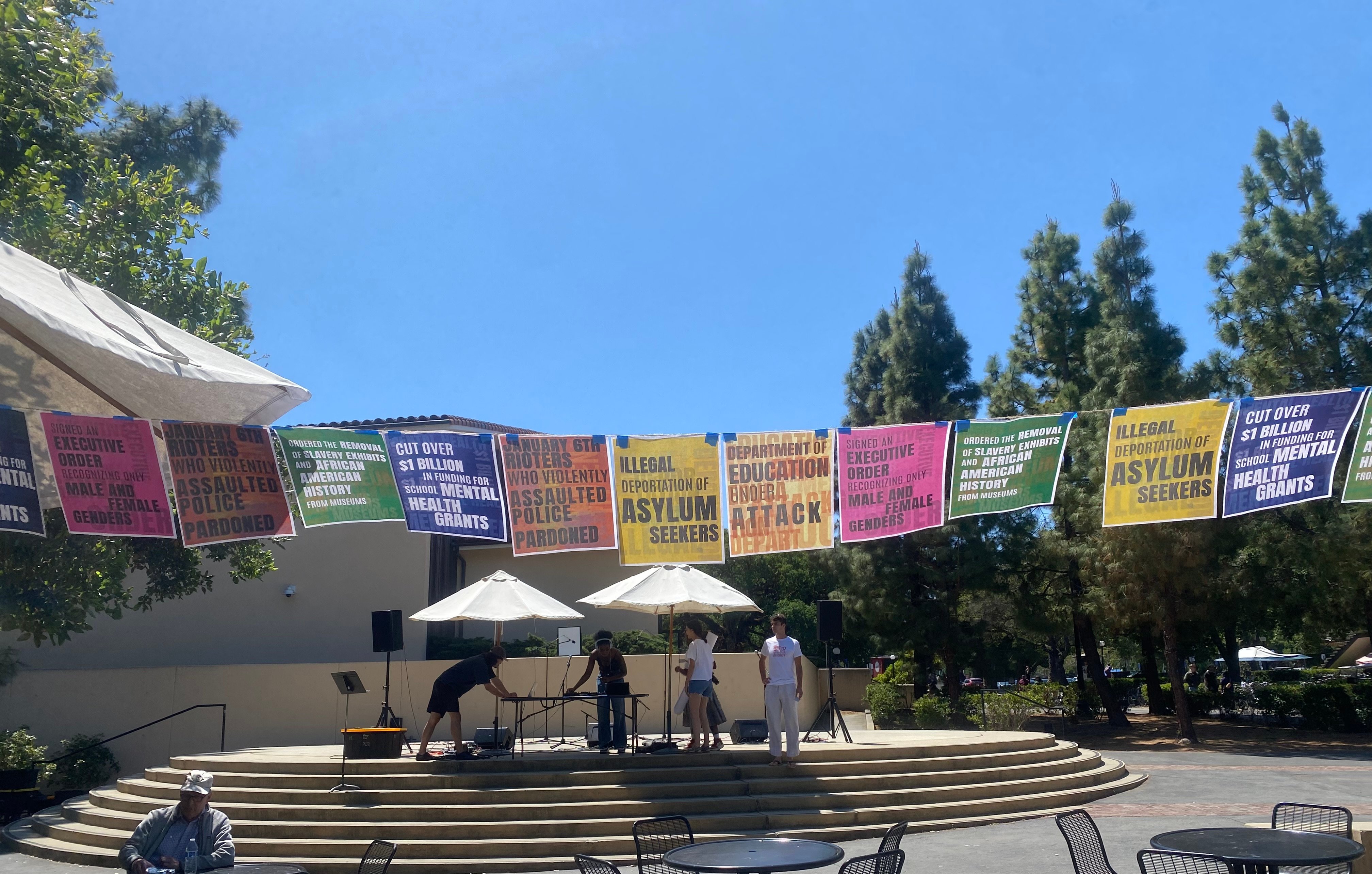
Gauri Kathula ‘29 is a first-year at Stanford and a member of Education & Democracy United (EDU), a nationwide coalition of organizers strengthening academic freedom and democratic participation on college campuses. The piece is also written in collaboration with Stanford Abundance, a group of students, faculty and staff renewing institutions to rebuild the American Dream.
At a moment when democratic norms are under strain nationwide, universities should be models of courageous, vigorous and accessible free expression. Stanford claims that role proudly in our mission statement, promising a “culture of expansive inquiry, fresh thinking, searching discussion and freedom of thought.” Yet Stanford students who attempt to organize, rally or respond to current events encounter a web of restrictions that make expression unnecessarily difficult. As students, leaders and advocates, we have firsthand experience navigating these frustrations. Stanford needs free expression reform now.
Several student groups are currently working with administrators to change Stanford’s speech policies. Our team appreciates that campus leaders have been receptive to student feedback throughout this process. We strongly approve of the recently refreshed and more approachable website on freedom of expression as well as the proposed pilot program allowing student groups unregistered as VSOs to reserve event spaces.
Nonetheless, we believe existing efforts are insufficient given the risk of substantially compromising the University’s civic mission by curtailing student voices. Stanford must overhaul counterproductive restrictions on when and how students can express themselves, further streamline the reservation and event coordination process and remove fees to reserve designated free expression spaces.
First, Stanford’s time, place and manner rules address genuine disruption and safety concerns on campus. However, the University acknowledges that these restrictions must “not restrict substantially more speech than necessary,” and we believe certain policies violate this standard. For example, White Plaza is designated as our central free expression space on campus, but Stanford limits amplified sound above 60 decibels for spontaneous events outside of an hour-long window in the area. This noise level corresponds to the hum of an air conditioner unit. Effective spontaneous student organizing responding to current events cannot proceed under these limitations.
Administrators argue that this noise cap arises from Santa Clara County residential noise ordinances and functions to prevent interruptions to classes or other core university functions. While the county’s rules clearly state amplified noise “shall not exceed sixty decibels” during the day in residential zones, no one lives near White Plaza, and the space is fairly removed from academic buildings that risk disruption. The law school has the nearest classrooms to the White Plaza stage, over a football field away. In line with California penal codes, those who “willfully create loud and unreasonable noise” should be disciplined on an individual basis, but these edge cases do not justify a blanket limitation on the expressive potential of all students.
Stanford’s time window for spontaneous amplified sound in White Plaza, between 12 and 1 p.m. on weekdays, is also problematic. Because substantive organizing depends on amplification, this policy effectively constrains public demonstrations to a narrow midday slot. Campus leaders justify this timeframe as a lull in academic scheduling that prevents disruption, but this “free expression hour” is also when most students are eating lunch or in class.
Students deserve context-based flexibility on when and where noise is amplified, and a greater effort to prioritize free speech by setting higher noise caps over more flexible timeframes is both possible and warranted. We request a concrete timeline for implementing a pilot program allowing amplified sound up to a tested, common-sense threshold. A reasonable expansion to the 60-decibel cap and a more flexible timeframe including mornings and afternoons on weekdays would allow students to convene spontaneous events based on their constituents’ needs. It’s important that these improvements apply to White Plaza, the most accessible of the designated free expression spaces on campus, facilitating public engagement while still avoiding academic interference.
Secondly, the event coordination process at Stanford is too complicated. Planned events are the lifeblood of student organizing efforts on campus, facilitating broad participation and engagement with the student body. Established procedures for reserving spaces and planning events are important, but these pathways should be clear and accessible. Stanford’s procedures are ambiguous, difficult to navigate and sometimes contradictory, dissuading student organizers.
Stanford Abundance is working in collaboration with the Office of Student Engagement (OSE) to isolate and eliminate redundancies and confusion in the reservation process. Key to our recommendations is a centralized, comprehensive webpage that clearly designates the availability and cost breakdown of spaces, the process of booking each space, the start-to-end tasks in event planning (e.g., noise permits or event tickets), the administrator(s) responsible for approving requests and the status of a request. We also recommend specifying an immediate point of contact to answer questions about booking status, space availability, the approval process and any other concerns. Transparency is critical to ensure students understand they have fair access to outlets for free expression.
Finally, Stanford charges fees for reserving “free expression spaces” for events. This contradicts Stanford’s commitment to “promote the widest possible freedom of expression” and violates the intuitive assumption that campus speech should be free of charge. Reserving a designated free expression area like the White Plaza stage costs $450, and that figure itself is buried in a convoluted reservation platform. Fees reduce the likelihood that students will convene events and restrict access to VSOs and other well-funded organizations, disincentivizing independent student organizing.
Event fees in places like White Plaza pay for security, maintenance and electricity for sound equipment. These costs are real, but Stanford should not charge students to exercise their right to free expression. Students invest significant tuition, labor, research and representation into making our school a special place. In return, the University should subsidize the costs of free speech. Last year, the EDU team coordinated an event in White Plaza. After we raised concerns about fees, administrators covered the costs by drawing from internal grant sources. This encounter should have been a matter of policy, not a generous exception.
Stanford’s campus speech policies, including excessive restrictions, opaque event coordination procedures and steep reservation fees, make exercising free expression too difficult. When students must navigate bureaucratic mazes or pay hundreds of dollars to assemble, the promise of free speech fades and tomorrow’s leaders lose the opportunity to engage with pressing issues.
Stanford needs to raise the White Plaza noise cap to a reasonable, tested level and expand allowable hours for this amplified speech, further clarify and simplify the reservation process and reduce or eliminate reservation fees in free expression areas. Reforms need to be transparent, timely and grounded in trust. Organizing, dissent and public debate should not be privileges reserved for the well-funded or the well-connected. Free expression must be a lived reality easily accessible to every student.
This piece is co-signed by the following Stanford students affiliated EDU and Stanford Abundance.
Georgia Allen ‘28, EDU
Gauri Kathula ‘29, EDU
Megan Luong ‘28, Stanford Abundance
Shreya Mehta ‘26, Stanford Abundance
Victoria Ren ‘26, Stanford Abundance
Owen Rowe ‘28, EDU
Daniel Stein ‘29, Stanford Abundance
Turner Van Slyke ‘28, EDU