
Editor’s Note: This article is a review and includes subjective thoughts, opinions and critiques. This review contains spoilers.
Beneath the glamour and cultural ferment of the late Weimar Republic — interwar Germany in the early 1930s — laid a weakening democracy, rising antisemitism and often-indifferent citizens.
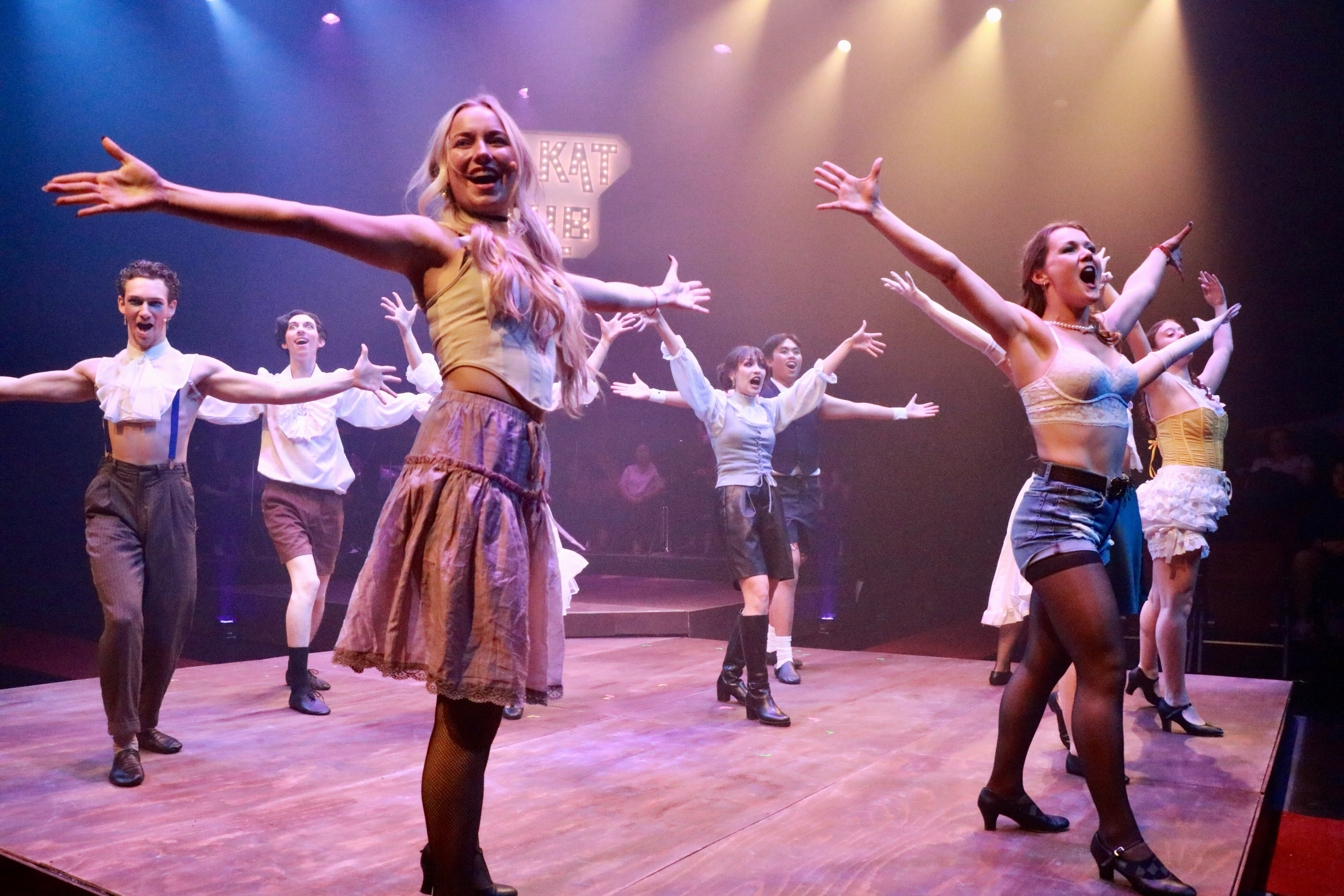
“Cabaret,” presented by the Stanford Asian American Theater Project (AATP) and Stanford Light Opera Company (SLOCO) from March 6-8, dramatized this duality.
The production starred Maya Ordas ’27 as the Emcee, Rachelle Weiss ’26 as Sally Bowles, Ph.D. student Quinn Bennett as Cliff Bradshaw and Emma Leibowitz ’26 as Fräulein Schneider. All four actors demonstrated equal talent at comedy and drama.
The musical’s story follows Cliff, an American writer of ambiguous sexuality who moves to Weimar-era Berlin to find inspiration for his latest novel. At the Kit Kat Klub, Bradshaw meets and falls in love with a dancer, Bowles, while another relationship develops between Schneider, Bradshaw’s landlord, and her Jewish neighbor, Herr Schultz (Akshar Sarvesh ’25 M.S. ’26). Rounding out the main cast are Ernst Ludwig (Elleson McCumber ’29), a man whom Bradshaw meets on the train to Berlin but later learns is a Nazi, and Fräulein Kost (Caroline Goldman ’29), a Kit Kat Klub dancer with Nazi sympathies.
Naturally, “Cabaret” does not have a happy ending nor an ebullient curtain call. Amid the tense political atmosphere, each character faces their own moral dilemmas. Schneider and Schultz break off their engagement, but find themselves with few other options, and believe that the Nazis’ tenure will pass. Bowles and the Emcee remain indifferent — Bowles can only see how “fun” Berlin is, while the Emcee is too late to take a stand. Bradshaw, disgusted by the Nazis, ultimately leaves Bowles and Germany. The question for the audience remains: Who would we be? We all might like to say we’d be Bradshaw, but fascism only took hold because of bystanders like Bowles or the Emcee.
The cast was stellar and versatile. Ordas shifted deftly from a manic, fourth-wall-breaking host to leading perhaps the most disturbing number, “If You Could See Her,” in which the Emcee danced with a love interest in a gorilla mask. The Emcee ended with the provocative lyrics: “If you could see her through my eyes / She wouldn’t look Jewish at all.”
Leibowitz excelled at physical humor in the first half, then delivered a wrenching performance of “What Would You Do?” in which Schneider explains the dilemma of her now-illegal relationship with Schultz.
Bennett grounded the play’s moral center in Bradshaw. Weiss simultaneously portrayed Bowles as a seductress and as a broken, indifferent woman in the excellent eponymous number “Cabaret,” the tragic penultimate song of the musical, which dripped with dark irony.
Ordas, Weiss and Leibowitz also impressively maintained their accents throughout their songs — an artistic choice made by musical and vocal director Simon Lee ’27 and director Da-Hee Kim ’27, a former graphics editor for The Daily.
According to Lee, using German and British accents allowed the cast to remain faithful to the show’s setting and occasional German-language lines. “When you’re taught to sing, you’re taught placement, which is basically where the vowel sits in your mouth,” he said. “Accents involve changing vowel sounds, so vocalists have to unlearn old habits of singing certain words.”
The fourth wall broke quickly in a carefully designed yet sparse set. As dancers interacted with audience members seated around the Harry J. Elam, Jr. Theater central stage, we all became clients of the Kit Kat Klub — we were also all literal bystanders.
The theater’s layout fulfilled Kim’s vision to echo the staging of the 2024 Broadway revival of the musical. “I knew that I wanted seats all around the stage,” Kim said. “Not having that separation between the person on stage and the person watching is very important to integrating the message of ‘Cabaret’ with people.”
The stage lighting complemented the story’s action, from the vaudeville-style spotlight that introduced the Kit Kat Klub dancers to the harsh, exposed focus on Bowles when she sang “Cabaret.” The final song of the first act, “Tomorrow Belongs to Me,” came as a reprise of a previously innocuous-sounding folk song which became an ugly jingoistic march. The lighting darkened to reflect this change.
Although the first act featured lighter moments, Kim emphasized that she intended to ground the story in the context of the Holocaust and antisemitism. “It was important for me to make sure that this show was handled with a lot of care in its messaging, that the political messaging was at the forefront and we weren’t being callous about what we were doing,” she said.
The costumes blended both period-accurate clothing and modern camp. The immersion of the club felt complete because of the excellent 19-member all-student orchestra conducted by Lee, whose instrumentalists demonstrated their skills in both the preshow and entr’acte.
The production ultimately spotlit its performers’ talents and prompted reflection by the audience.
“First they came for the socialists,” begins Martin Niemöller’s famous poem. “Then they came for me,” it concludes. “Cabaret” is clear in its plea against moral inertia: speak up while you still can.