
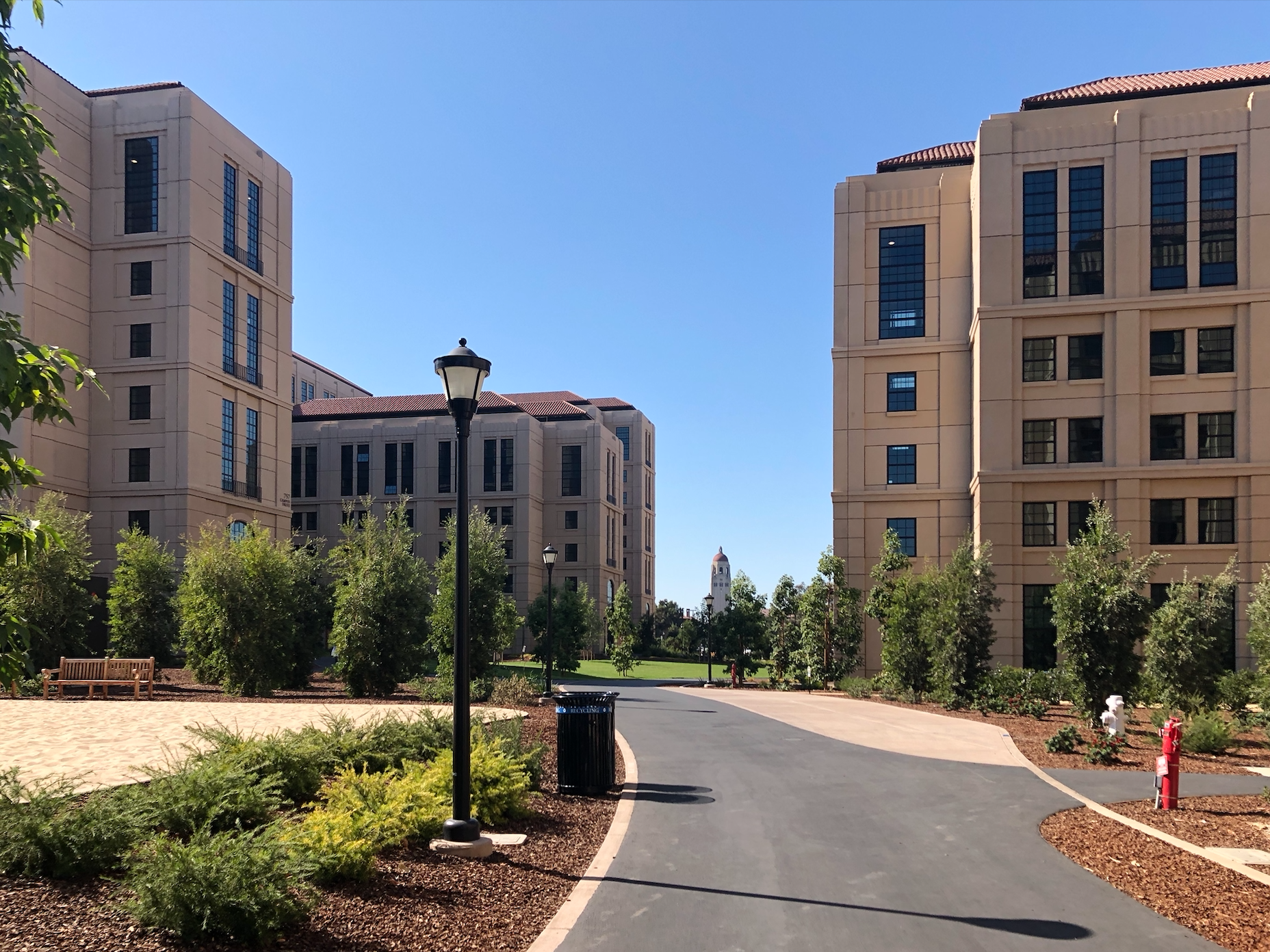
Construction projects to repave roads and update power systems have been met with complaints from residents in family housing, who note challenges from closed parking lots and power outages. While the University provides advanced notice of scheduled work and expected impacts, as well as resources to mitigate disruptions, residents express disappointment with the impacts to daily life.
“I can hardly think of a one-week period for the past two and a half years I have been living in this residence that there was no construction,” said Kasra Naftchi Ph.D. ’24. Naftchi lives in Escondido Village’s (EV) Hulme mid-rises with his wife and two kids.
Temporarily limited parking, power outages and worksite noise are among the impacts of construction to improve campus infrastructure. Last month, Land, Buildings and Real Estate repaved and restriped Serra Street and Olmstead Road near EV, limiting access and parking areas adjacent to five EV buildings from 8 a.m. – 5 p.m. on March 23. Vehicles could remain parked, but the repaving blocked them from leaving during the workday.
“There are construction activities that take away parking spaces for a limited time, but we work closely with our contractor to use spaces only when necessary,” Senior Civil Project Manager Brian Schultze wrote in an email to The Daily.
According to Naftchi, parking near his residence a few months ago was restricted for weeks. “Each time, you have to load the stroller, and if you’re going grocery shopping, you have groceries, you have a kid to hold in your arm – it’s a pain,” he said.
Naftchi said that residents still pay the full parking rate, despite having to search for spaces elsewhere when their lot is closed. “It becomes a competition for parking. I think the least they could do would be offering some sort of prorated discount for parking permits,” Naftchi said.
Construction materials and sharp debris has also led to flat tires, according to Carol, a 10th-year Ph.D. student who requested anonymity due to fear of retaliation from the University. She also noted that construction has pushed rodents into residential spaces.
“Multiple residents, including us, have had rodents enter cars, causing costly internal damage,” she said. “This is a direct consequence of construction disrupting existing ecosystems without adequate mitigation.”
Carol has lived in Hulme Mid-Rises with her partner and teenage child for about six years and said that ongoing construction has impacted her family’s finances and daily functioning. She expressed safety concerns of family housing conditions, including open electrical panels, fallen trees and unauthorized access to residential areas.
“Between noise, access limitations and repeated infrastructure interruptions, the environment has become difficult to live in, especially for families balancing work, school and caregiving,” Carol said.
The University has been keeping residents informed about construction progress. Kennedy Housing Service Center, which serves EV, emailed residents to notify them of landscape restoration, power outages and road work planned for March and April.
The emails included project details, safety guidelines and information on respite areas. The Graduate Community Center and Escondido Village Graduate Residences, for example, are offering meeting rooms on a first-come, first-served basis for residents to reserve a quiet space away from project noise.
The planned power outages in EV are part of Stanford’s Electrical Reliability Improvement (ERI) Project. According to the project page, about 60% of the University’s electrical system is “outdated and no longer reliable.” ERI is part of Stanford’s Climate Action Plan and will take place in phases over the next 12-16 years to replace old equipment and modernize the campus utility system.
The project includes upgrading to electric stoves, adding electric vehicle charging stations and converting buildings to electric heating. These changes are part of Stanford’s goal to achieve net-zero carbon emissions by 2050.
Many residents were not informed that they may be eligible for meal support during power outages, according to Carol. An email sent about a month before a planned power outage advised residents to start consolidating perishable food items in their freezer.
“During outages, families may depend on electricity for essential needs such as storing breast milk or temperature-sensitive medications, yet there is little transparency around backup power or contingency planning for residential units,” Carol said.
“We understand that shutoffs are a disruption and appreciate our community’s flexibility while this necessary work is being performed,” Schultze said. “R&DE provides tailored resources to support residents, including where refrigerated medication or breastmilk can be stored safely and accessibly during the work window.”
ERI’s anticipated schedule is available on the project page, and more direct updates are shared with residents well in advance of scheduled work, Schultze told The Daily.
“As with any construction project, unforeseen circumstances arise that may extend the timing of shutdowns or cause additional impacts. When that happens, we work with R&DE to communicate this information to affected residents as soon as possible,” Schultze said.
The project page includes an interactive map with information on when and where construction activity and disruptions may take place. LBRE also produces the HeadsUp newsletter that provides similar information.
“Planning decisions should reflect the realities of people living in these spaces,” Carol said. “At a minimum, improvements should include clear, high-priority communication about disruptions [and] proactive compensation and support.”