
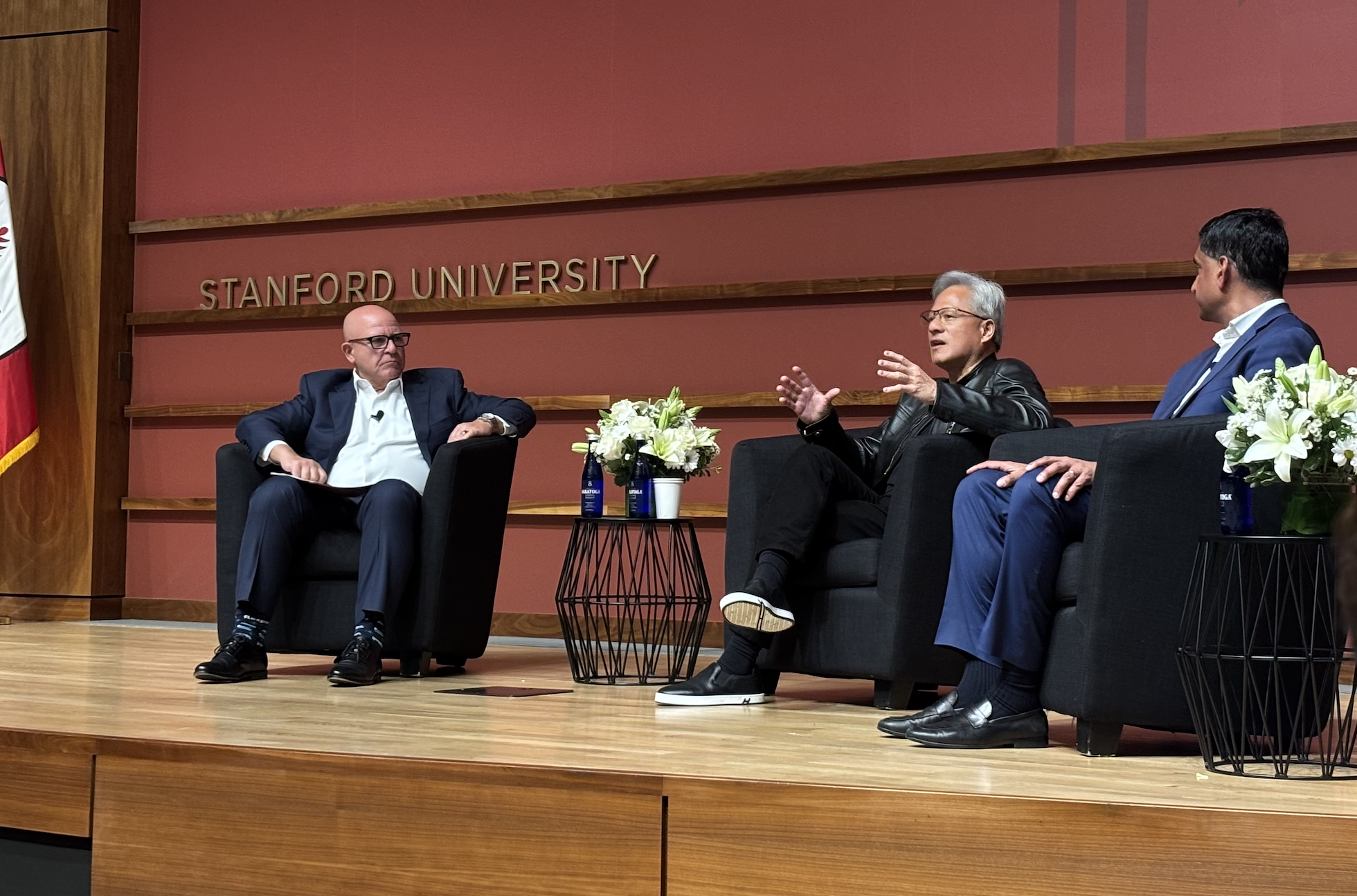
The newly founded Stanford Leadership Institute, based at Stanford Graduate School of Business (GSB), hosted a discussion on practical insights and important questions about leveraging the benefits of AI while addressing its risks on April 9.
The event brought together key voices in technology and national policy, including NVIDIA founder and CEO Jensen Huang M.S. ‘92 and Congressman Ro Khanna (D-Calif.). Former National Security Advisor and Senior Fellow at the Hoover Institution General H.R. McMaster moderated the event alongside its host, GSB Dean Sarah A. Soule.
The conversation gave attention to how the U.S. can maintain a competitive advantage in the AI industry. Huang described the multi-layered infrastructure of AI as a five layer stack: energy, chips, cloud infrastructure, AI factories, AI models and, crucially, AI applications.
To stay ahead, he stressed that the U.S. needs to lead in all of these layers, with the application layer being the most important.
Huang also urged the U.S. to fully capitalize on the AI industrial revolution it helped initiate. Because of this, he pushed for removing barriers to AI adoption and emphasized accelerating both the development of the technology and its applied uses.
Khanna offered another angle on maintaining a competitive edge. He emphasized that the American Dream is still alive, pointing to how the U.S. attracts global talent, creating “magic and innovation.” He also cited that many of the world’s top research universities are based in the U.S., advocating for continued education funding.
Khanna highlighted academic freedom as a key advantage, specifically the ability to question authority and challenge ideas. He emphasized the unique type of collaboration that the government, universities and the private sector have in the U.S.
Khanna argued that offshoring manufacturing was a “colossal mistake,” reflecting on resulting industrial decline in the midwest.
“This idea that we could just be a financial nation, an innovation nation without maintaining an industrial base was a mistake for our national security and for social cohesion,” he said.
The discussion then moved to the democratization of AI and its socioeconomic impacts. Khanna pointed out that many Americans are skeptical of AI, largely due to persistent economic inequality and a lack of trust in institutions. He argued that leaders have a responsibility to ensure that the benefits of AI are shared amongst all citizens.
Khanna wants to increase job creation and discussed the need for an “affirmative jobs agenda” whose purpose is to rebuild communities and restore national purpose.
Huang pushed back on the idea that AI is taking jobs out of Americans’ hands. Referencing radiology, he explained that although AI has automated parts of the work, the demand for radiologists has actually increased. He discerned between the tasks within a job and the purpose of the job itself.
Even though tasks can be automated, “the purpose of your job and the tasks that you perform in your job are related, but not the same,” Haung commented. He used his own experience to illustrate this point, joking that although his job includes both typing and talking, which have been automated by AI, he is “busier than ever”.
Huang claimed that it is more likely that someone who knows how to use AI will take others’ jobs than it is that AI itself will take people’s jobs.
AI regulation and national security became a key focus of the talk. Khanna emphasized the importance of establishing American standards for AI globally, while Huang noted that regulating AI is inherently difficult because of how quick technology evolves, and its interconnectedness with other industries.
General McMaster likened regulating AI to “asking the Wright brothers to first develop the maintenance manual for a 707 before further developing the airplane.”
All speakers emphasized the balance between regulation and innovation, and global competition and cooperation. Huang highlighted the importance of coexisting with other countries, stating, “We’re going to compete with China, but we’re not anti-China.”
He stressed that upholding the American Dream means fostering an environment that is open and welcoming to people from all backgrounds.
Closing with an optimistic outlook, Huang catered towards students attending the event. He believes the AI industry represents an unparalleled opportunity for students, and to consider that every industry is resetting because of it.
“You are exactly at the same place as everyone else. Nobody has a head start on you,” Huang said to students in the audience. He encouraged students to engage with AI, adding that “all of us on the other side are waiting for you, looking forward to working with you to build the future together.”