
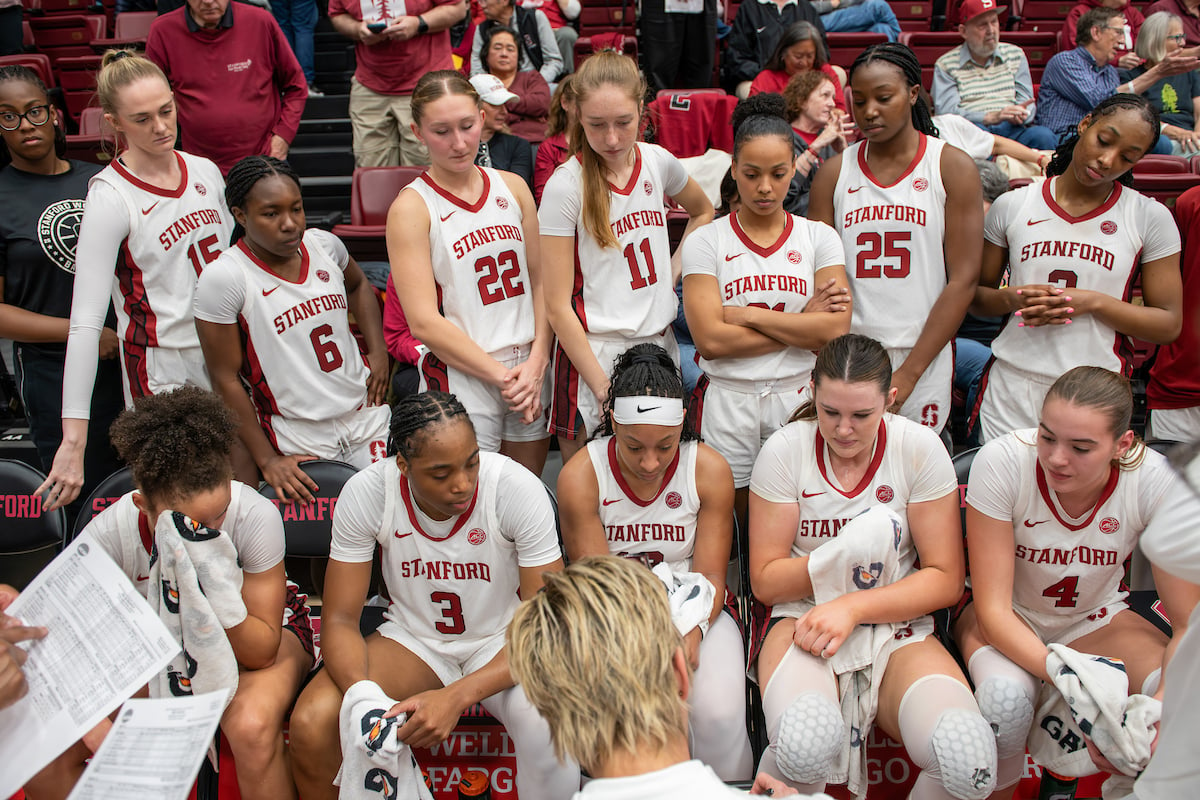
Dozens of high-profile Stanford athletes have entered the transfer portal in the past few years, leaving many fans to speculate about what could be going wrong on The Farm. This pattern is once again making headlines as seven women’s basketball players are set to leave Stanford at the end of this year, and a national survey paints Stanford Athletics unfavorably.
Athletes.org is an organization with over 5,000 members that regards itself as the “players association for college athletes.” “College athletes are judged constantly… They get evaluated as if they are products, yet are never given the opportunity to give their own feedback,” the group said at the beginning of their most recent article. “With ‘The Athletes’ School Ratings,‘ Athletes.org is flipping that power dynamic, giving athletes the power to rate and review their schools.”
Stanford came in concerningly low on the Athletes.org survey, claiming the 51st of 59 spots. Stanford still achieved a rating of 4/5 stars, but its ranking was dragged down by a 3.5 in the “College Experience” category and a measly 2.7 in “NIL Support.”
One student on the survey noted tensions between the athlete and general student populations, claiming that “regular students don’t want to be in our group projects ’cause they don’t think we can handle it.”
Another had very harsh words to say about the coaching support, saying “there is no development, negative environment, personal attacks, one-third of the team walked away during the season.”
On the other hand, Stanford ranked fairly high in “Strength and Conditioning” with a 4.6. No other category surpassed a 4.5 rating.
Stanford is known for having one of the most consistently competitive athletic departments in the country, but in recent years, the programs that are most popular and profitable in the U.S. — football and basketball (men’s and women’s) — have tapered off. Football hasn’t won more than three games in four years, and women’s basketball’s 36-year streak of March Madness appearances ended in March 2025. Much of this drop-off has come as a direct result of the ushering in of the NCAA’s new Name, Image and Likeness policy.
Last May, The Athletic wrote about star pitcher NiJaree Canady’s departure from Stanford in the context of these policies.
“The level of arrogance at Stanford is unique,” one former athletics administrator said. “There were so many Stanford people who were like, how could she possibly leave for money?”
Even the athletes who do manage to land big NIL deals at Stanford are at a disadvantage. In 2022, Stanford did not allow women’s basketball National Champion Haley Jones — who’d secured a Nike sponsorship — to use the Cardinal logo or the word “Stanford” in ads. In 2023, the school prohibited Cameron Brink from shooting any part of her Buick commercial in Maples Pavillion.
According to the more than 20 people The Athletic interviewed for their story, Stanford has also refused to adjust its admissions process for transfers, making it nearly impossible for athletes to play on the Farm unless they were recruited here. Some athletes are against changing the policy, however, for fear of worsening already-present tensions and preconceptions.
There is certainly an undercurrent of friction between athletes and non-athletes in all of these stories. Students have claimed that the University separates “athletes into a clearly distinct and superior community,” citing reasons like housing preferences and athlete-dining.
Many athletes, as well as administrators, are adamant that such privileges do not exist.
“There really is no favoritism toward athletes. People think athletes have it easy, but we don’t, because we’re not allowed to,” a former Cardinal told The Athletic.
Condoleezza Rice, director of the Hoover Institution commented to The Athletic on the academic side of things, saying that “the one thing we will never compromise on is, no faculty member will stand for being in front of a student who doesn’t belong in that classroom.” Implicit in this statement is Stanford’s refusal to adjust transfer policies for the sole reason of athletic performance.
Stanford will have to change something — most notably, NIL and coaching personnel — if it wants any chance at seeing its profit-driving programs back on the top.
All seven women’s basketball players that are transferring away from Stanford declined to comment.