
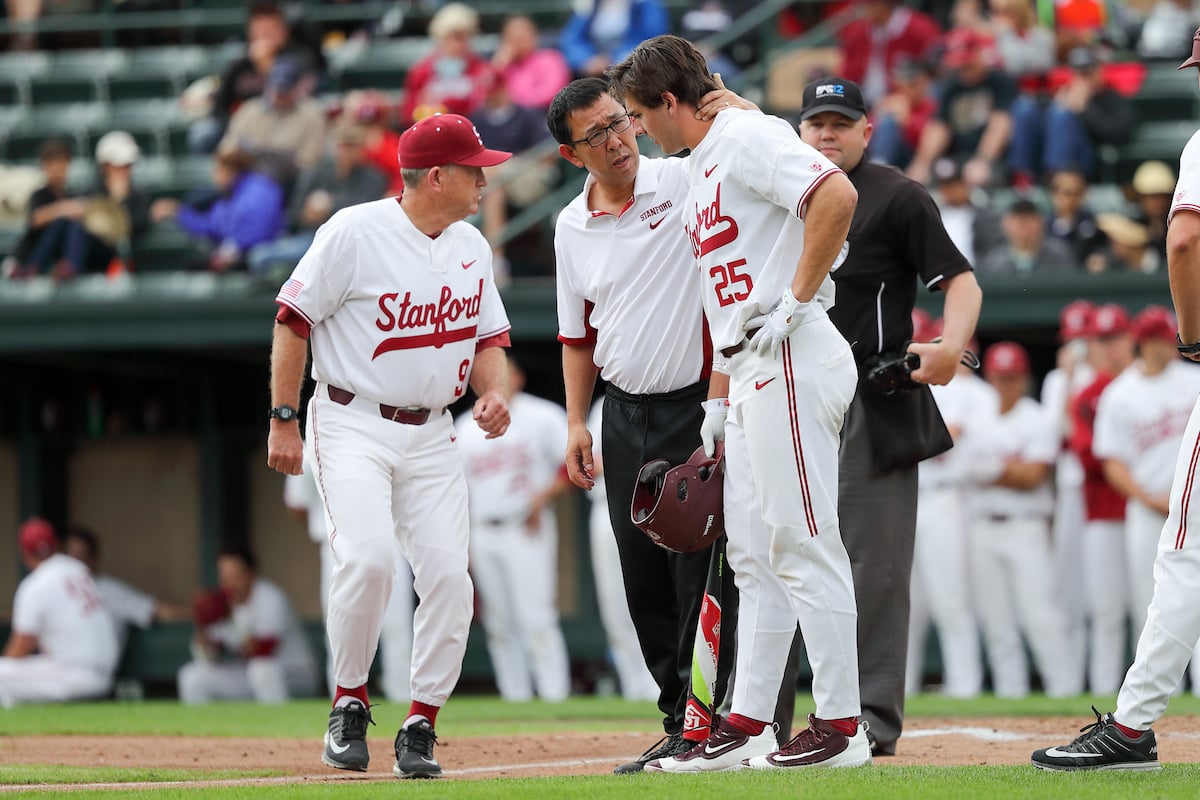
At 9 a.m., Tomoo Yamada settles into his office in the basement of Arrillaga Family Sports Center. Soon, the first student-athlete walks through the door. He asks about their week before examining injuries and offering a diagnosis or physical therapy exercises. 30 minutes later, the next arrives, and the process repeats. This has been his rhythm for 25 years.
This may sound like the quintessential role of an athletic trainer, but from the reception Yamada receives outside his office, it becomes clear that he means something far greater to Stanford athletics.
At Stanford, where NCAA championships are collected yearly and the Olympic medal count exceeds 335, fans are treated to high level competition year in and year out. But Yamada, along with his fellow athletic trainers, are the quiet constant behind the product on the field, keeping athletes healthy both mentally and physically.
These 30-minute meetings with Yamada can be sanctuaries for student-athletes — a mental reset from class and practice. Although he specializes in treating physical injuries, Yamada said his main job, really, is to listen. This ability to hone in on each individual has made Yamada endeared by everyone, everywhere he goes.
Yamada joined Stanford in 2002, spending his first two years as the rehabilitation coordinator for football, track and field and baseball. He worked with over 200 players each season, knowing each one personally, far beyond a first-name basis. When asked about his day-to-day back then, he laughed, mentioning there was no cellphone back then to text players.
“There was a physical sign-up sheet outside my office” he recalled.
From there, he spent 13 years as the primary athletic trainer for the men’s basketball team — a tenure that included several trips to the Sweet 16 — before joining baseball for former head coach Mark Marquess’ final season and picking up work with the golf programs as well. Today, he serves as the trainer for both the men’s and women’s swimming and diving teams.
He has served as a trainer for Brook and Robin Lopez, Landry Fields, Katie Ledecky, Simone Manuel, Nico Hoerner, Kris Bubic and Kyle Stowers, just to name a few. He still keeps in touch with all of them.
“I still remember every single swimmer from that team,” he said of Ledecky’s national championship squad.
Working in a wide range of sports made him grow as a versatile physical trainer. What’s most remarkable, perhaps, is the psychological attunement he’s developed across these sports that makes Yamada so appreciated by student-athletes.
“[These experiences] made me grow and become well rounded and versatile, in the mental part as well. Swimmers and football players have different thinking processes. Different types of spikes and downs mentally,” Yamada said.
Athletes come in with nagging injuries, but Yamada often finds himself talking through their week, getting a feel for where they are mentally. He is not technically licensed in this aspect, but believes it is crucial to their physical success. “I can help to guide them, navigate them through challenging times,” he said.
Yamada’s philosophy is simple: “The athlete needs to be healthy first. They need to be healthy as a person, then you can talk about them as a swimmer, runner or basketball player… establish good health as a person, then add the athlete portion to it.”
He also offers a new perspective removed from academics and the sport.
“The professor’s expectation, they want you to do well. And then the coaches want you to do well… and sometimes between 18-20 years old, it’s difficult to control mentally,” Yamada said. “But I see growth every year. Freshman year they are struggling and in their second year, they come back and I see growth. By their third year and fourth years they become leaders, teaching their experiences to the freshman. It’s rewarding.”
He extends that same attention to detail to his own development. He has sought out Stanford sleep medicine researcher Jamie Zeitzer and neuroscientist Andrew Huberman to better understand how sleep affects athletes bodies, minds and performance. He consults GSB communication expert Matt Abrahams to sharpen the way he communicates to athletes and coaches alike.
“I need to know how to talk to the athletes efficiently and understand their emotional spikes,” he said.
And after working at Stanford for over two decades, his humility is what makes him so dedicated to his craft.
“There’s this idea that what you know is everything. That’s the wrong idea. You know what you know. However, there’s always more out there,” Yamada said.
The relationships with student-athletes Yamada works with last far beyond the farm.
One spring training, he happened to be in Arizona and texted Cubs all-star second basemen Hoerner that he’d be stopping by the practice facility just to watch. Hoerner found Yamada and caught up, a testament to the relationships he’s invested in.
The current swimming and diving roster feels a similar gratitude for their athletic trainer. Freshman swimmer Ray Liu described Yamada as “super supportive and understanding of our schedule.”
Fellow freshman Alana Berlin said, “[Yamada’s] really helpful because he’s very personable and always tries to get to know the athletes and ask about their day. It’s fun to go and see him, not only for his help on our injuries, but also to build a relationship with someone on the coaching staff.”
Yamada also helps athletes beyond the scope of his title.
When Japanese baseball phenom Rintaro Sasaki announced his commitment to Stanford, Sasaki’s dad reached out to Yamada. Having grown up in Tokyo himself before coming to the U.S. for college, Yamada understood the uncertainty of arriving in America for the first time. He connected with Sasaki in his first few months, talking through the cultural shock, language barrier, even how to register for classes.
“I’m here for you if you need me,” Yamada told Sasaki. But characteristically, Yamada listened and only advised.
“I intentionally kept a light distance, not too much involved, but not too far away. That way, he can grow,” he said.
With his pedigree, Yamada may have chances to work in the professional sports realm, but he reciprocates this appreciation back to the students.
“I want to work in an environment of education and sports combined,” he said. “If you go pro, it’s sports and entertainment. There’s no educational component. I want to educate people, and then they compete, I want to see them grow.”
Not many outside of the Stanford Athletics realm may know of Yamada. But he is, simply put, an unsung hero.