
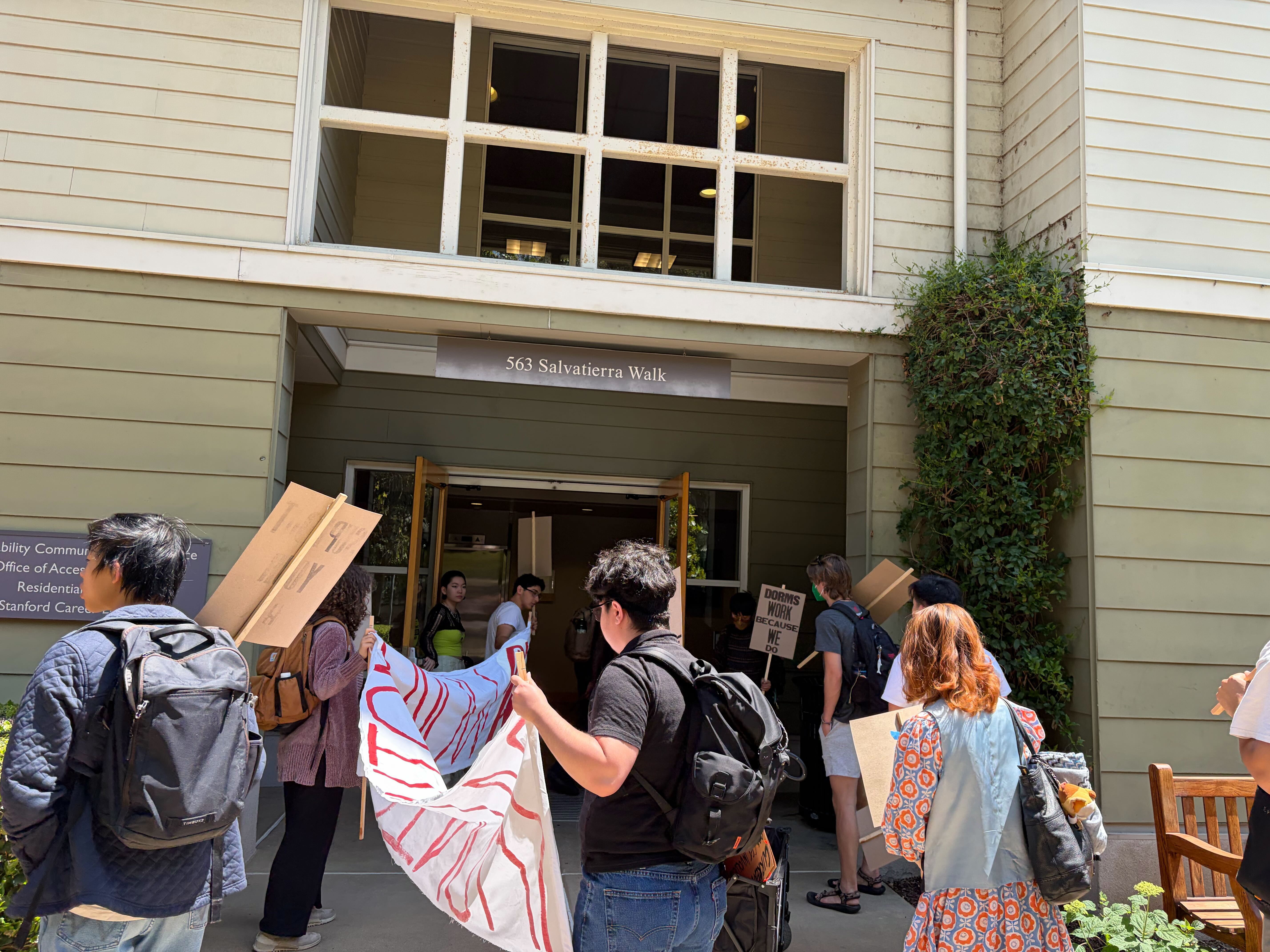
Stanford Resident Assistants (RAs) and supporters gathered at the Student Services Building on Wednesday afternoon to protest what organizers describe as University efforts to delay the resident assistant union election process.
Organized by Stanford Resident Assistants United Rising (RAUR), the protest opposed the University’s move to postpone a pre-election hearing until June 10 — a date organizers argue would effectively exclude many current RAs from participating because students will already be taking finals or leaving campus for summer break. RAUR asks that they receive a response to their request by Friday at 5 p.m.
The protest took the form of a “march on the boss,” in which demonstrators entered an ongoing Residential Education (ResEd) meeting to deliver a prepared statement addressed to Cheryl Brown. RAs have organized similar demonstrations in the past — in a January march, a group of about 30 demanded a solution to understaffing.
During this Wednesday’s demonstration, the group gathered with signs reading “Dorms work because we do” and “RA union now!” as Shuci Zhang ’27, an organizer for RAUR and RA at Terra House, read from a joint statement written by RAUR organizers. “We’d like to begin today by responding to ResEd’s attempts to postpone the National Labor Relations Board (NLRB) election hearing,” Zhang said. “We are troubled that the university has made a motion to delay our election hearing until June 10, when most students will be packing up their bags and leaving for the summer.”
Organizers expressed concern that legal maneuvers by the University are making the unionization effort a “more adversarial process than it needs to be.” Jesse JudahBram ’27, an RA at Mirlo, said. “We can’t help but feel that the reasoning for delaying it that far out was more so to wait us out through the process, and not really a step taken in good faith.
In a written statement to The Daily, Eli Tostado ’26, an RA for Soto, called the request to postpone the hearing until June 10 — just two days before the move-out date for non-graduating students — an “abuse.” Tostado wrote that it is “an abuse to take advantage of the academic calendar to keep the majority of non-graduating RAs from further participating in this election hearing.”
Angie Davis, University Executive Director of Strategic Communications and Media Relations, wrote that the University “value[s] the role of residential student leaders at Stanford” in a statement to The Daily. “The university will be responding to RAUR,” she wrote.
Davis wrote that the University is “following the policies and procedures outlined by the NLRB.” She stated that under federal law, the University has a responsibility to be “attentive to the privacy of students’ personal information”. Davis also noted that the NLRB hearing is scheduled for May 28.
As an alternative to a prolonged election process, RAUR proposed that Stanford voluntarily recognize the union through a card-check agreement on June 4. Under card-check, the University would recognize the union if a majority of eligible RAs signed authorization cards, avoiding a formal election overseen by the labor board.
“In the spirit of cooperation, we wanted to offer a quicker, more amicable resolution,” JudahBram read from a joint statement written by RAUR organizers. “Stanford RAUR requests ResEd commit to a card-check recognition process on June 4, facilitated by a mutually-designated party”. Organizers suggested an internal third party, such as a Stanford law professor, to facilitate the process.
Organizers say the card-check process would allow the unionization effort to focus on “the important issues our union has raised.” The union’s focus is on safe staffing practices, equitable conversation and just-cause discipline.
“What it’s about is having the RA work valued, having it be respected, and allowing us as RAs — people who are on the ground floor of residents’ lives — to have our voices respected and heard,” JudahBram said.
The action drew support from the broader student body. Franklin Liu ’29, an organizer for Stanford Students for Workers’ Rights, attended the protest in support. “I could definitely see that sense of collective power,” said Liu. “I think it was a good thing for the RAs and also just for the Stanford community.” He added that the movement is a “good first step in building more worker power and more student power at this university.”
“We mobilize when we feel like our voices aren’t being heard,” JudahBram said. “That’s the reason why we’re going for a union.”
Update: This article has been updated to clarify the location of the protest at the Student Services Building.